Clear Sky Science · en
Mapping the inhibition landscape of P-glycoprotein via conformational ensemble docking
Why this cell pump matters for medicine
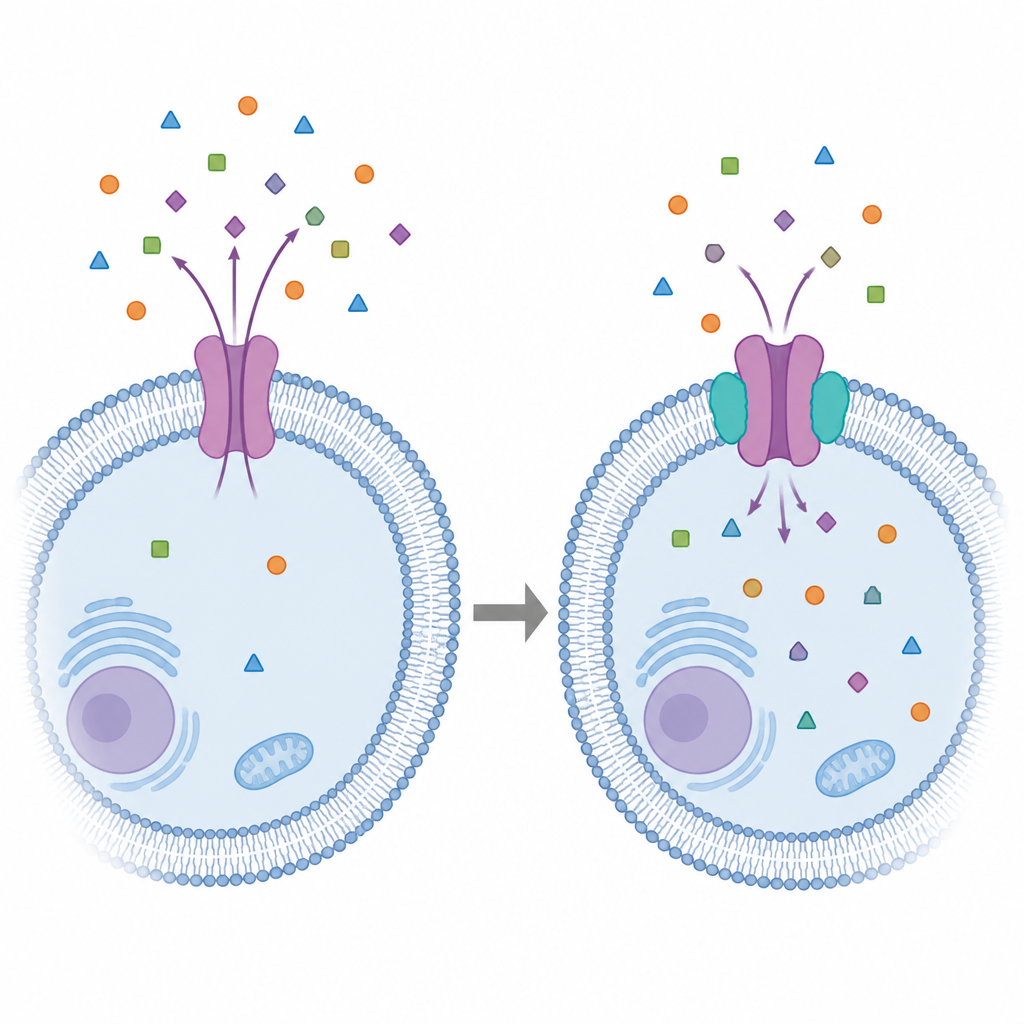
Many modern drugs fail not because they miss their target, but because our own cells push them back out. A key culprit is P-glycoprotein, a tiny pump lodged in cell membranes that expels a wide range of medicines, from cancer drugs to antidepressants. This study asks a simple but crucial question: can we design better blockers of this pump by looking not at a single frozen structure, but at the many shapes it adopts as it moves and works? The answer helps explain why past inhibitors often disappointed and points to smarter ways of taming this pump in the future.
A shape-shifting gatekeeper in cell walls
P-glycoprotein sits in protective barriers such as the gut wall and blood–brain barrier, where it acts like a bouncer, ejecting foreign molecules back into the bloodstream. It does this by cycling through several shapes, or conformations, that open to the inside of the cell, close, and then open outward to spit substances out. Earlier drug design often treated this pump as if it had just one main shape. In reality, it is flexible and spacious, with several overlapping pockets that can fit many different chemicals. This flexibility makes it very good at blocking drugs, but also makes it hard to block the pump itself in a precise and safe way.
Simulating a moving target
To capture this motion, the researchers used long computer simulations to watch human P-glycoprotein embedded in a realistic membrane made of fats and cholesterol. They started from detailed structures measured by cryo-electron microscopy and from artificial intelligence models, then let the protein move for hundreds of nanoseconds. From these movies they extracted 22 representative shapes, ranging from more open inward-facing states to more closed, occluded ones, and also built in a previously unresolved flexible linker that connects parts of the protein. This created a diverse structural “ensemble” that better reflects how the pump actually behaves in the cell membrane.
Testing dozens of inhibitors across many shapes
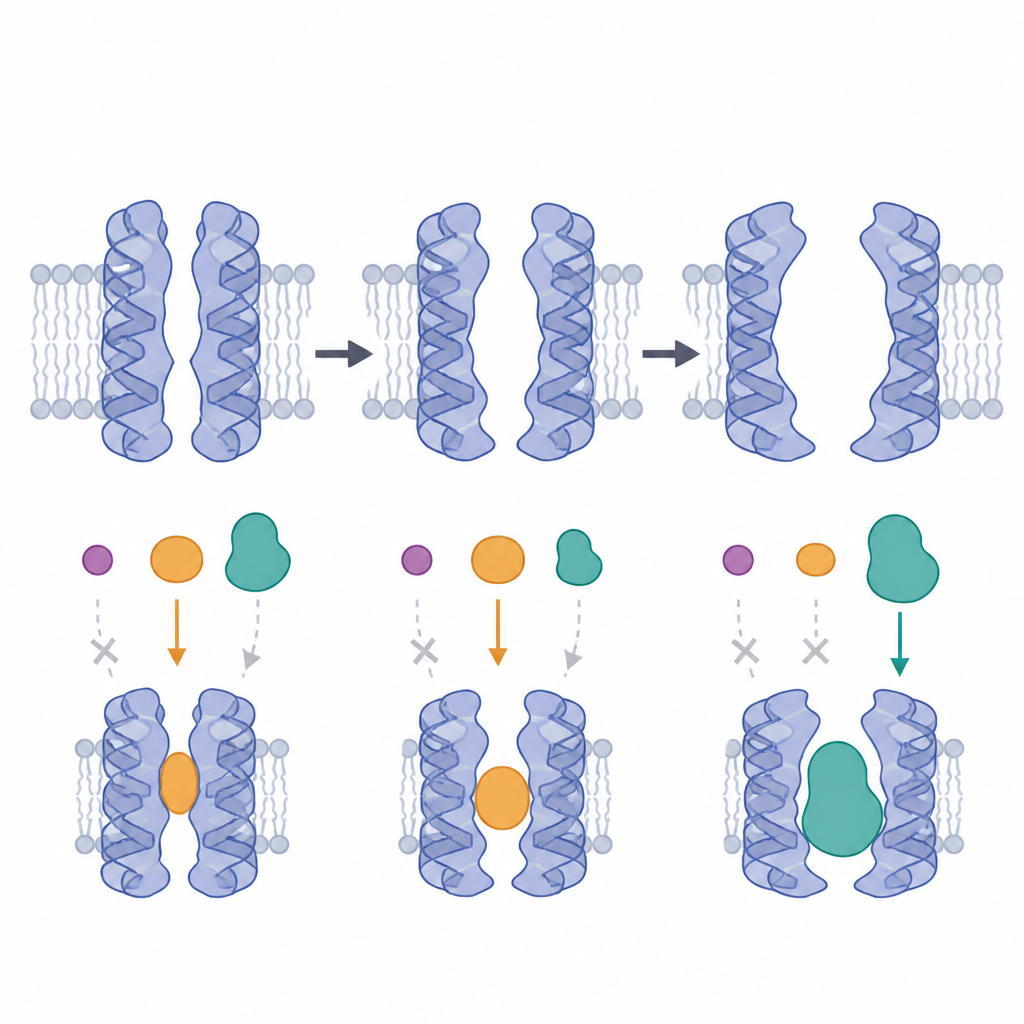
The team then docked 60 known P-glycoprotein blockers into each of the 22 shapes, scoring how tightly each compound might bind. Instead of a uniform picture, they saw clear preferences. More than half of the inhibitors favored a particular inward-facing conformation that had both a bound inhibitor and the flexible linker present, suggesting that this combination creates a snug, well-formed cavity. In contrast, a group of large ring-shaped drugs, such as cyclosporine and valspodar, did better in models where a side portal formed by two helices was wider, providing extra room to accommodate their bulky size. These patterns were reinforced by more detailed energy calculations on selected drug–pump pairs.
Where drugs tend to grab the pump
By examining where each compound settled inside the pump, the authors mapped three main pockets. One pocket, involving several key helices, emerged as the most frequently used binding site, especially in the favored inhibitor-bound, linker-containing shape. Certain amino acids in this region appeared again and again in contact with many inhibitors, matching earlier experimental hints about crucial interaction hotspots. At the same time, chemically similar drugs did not always prefer the same pump shape or pocket, underlining that small tweaks in size and flexibility can shift which conformation suits them best. This means that designing effective blockers requires thinking about both the drug’s architecture and the pump’s moving landscape.
What this means for future drug design
For a non-specialist, the key message is that P-glycoprotein is not a rigid lock but a constantly shifting gate, and successful blockers need to be matched to specific shapes of this gate. The study shows that certain conformations, especially ones including the flexible linker, appear especially attractive for many inhibitors, while bulky macrocyclic drugs need a more open portal. By combining realistic motion of the protein with systematic docking of many compounds, the work outlines a roadmap for designing pump blockers that are more selective and potentially safer. Rather than searching for a single perfect inhibitor, future efforts may focus on targeting particular states of the pump that best fit a given drug class, with the long-term goal of helping important medicines stay inside cells long enough to do their job.
Citation: Elbahnsi, A., Dragomirescu, C.D., Palumbo, N. et al. Mapping the inhibition landscape of P-glycoprotein via conformational ensemble docking. Sci Rep 16, 15393 (2026). https://doi.org/10.1038/s41598-026-46760-y
Keywords: P-glycoprotein, multidrug resistance, drug efflux pump, molecular docking, ABC transporter