Clear Sky Science · en
Histopathological effects of the fruit extract of Citrullus colocynthis on the integument of the female tick Hyalomma dromedarii
Why desert plants and camel ticks matter
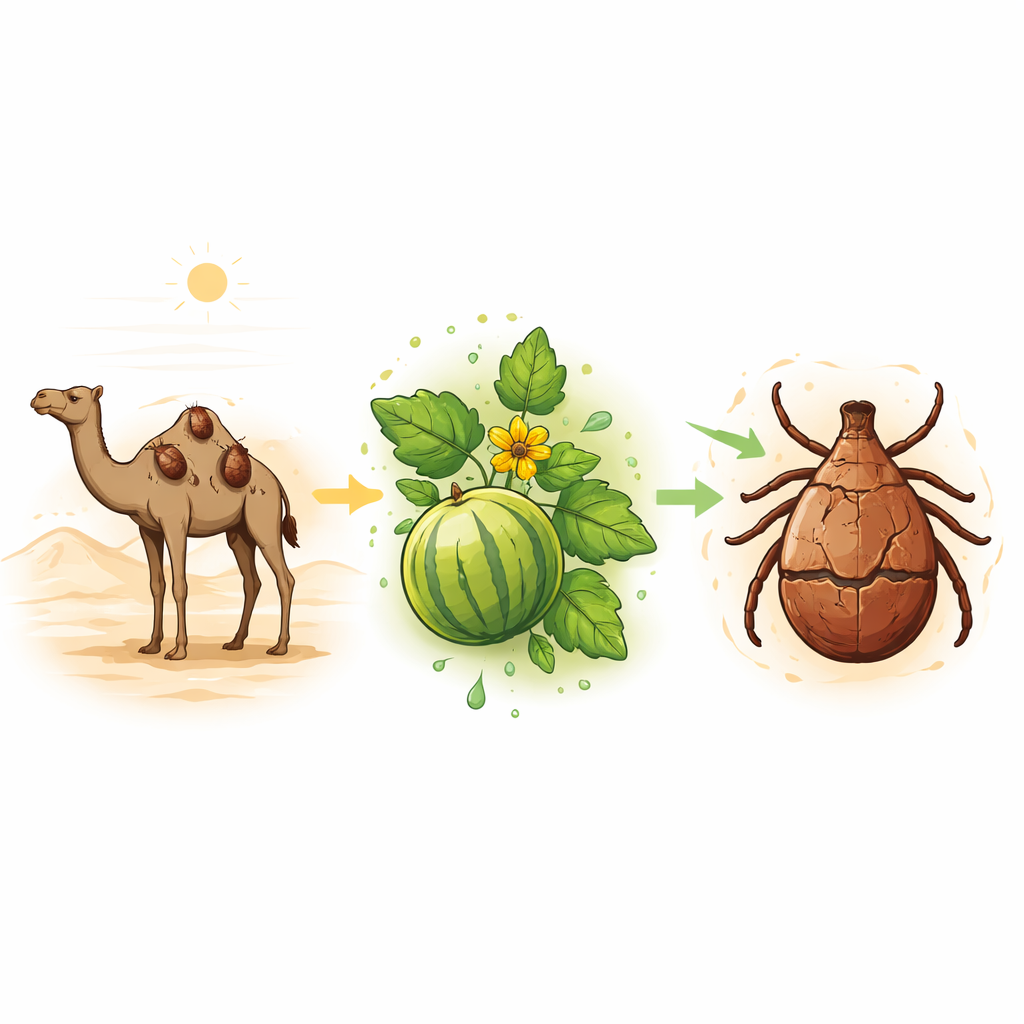
Camels are vital for transport, milk, meat, and livelihoods in many arid regions, but they are plagued by blood‑sucking ticks that weaken animals and spread dangerous diseases. At the same time, farmers and veterinarians struggle with the downsides of conventional tick-killing chemicals, including environmental pollution and drug-resistant pests. This study explores whether a common desert plant, the bitter apple (Citrullus colocynthis), can provide a safer, plant-based way to damage and ultimately control one of the most troublesome camel ticks, Hyalomma dromedarii.
A stubborn parasite on camels
Hyalomma dromedarii is a large hard tick that thrives on camels across the Middle East and North Africa. Heavy infestations cause blood loss, poor weight gain, reduced milk yield, and damaged hides, and they help transmit serious infections, including viruses that can make people and animals gravely ill. For decades, control has relied on synthetic acaricides, chemicals designed to kill ticks. While effective at first, these products are increasingly undermined by resistant tick populations, chemical residues in meat and milk, and contamination of soil and water. This has pushed researchers to search for new, more sustainable options such as bioactive plant extracts.
A bitter fruit with powerful ingredients
Bitter apple is a tough desert vine long used in traditional medicine and as a natural preservative for manuscripts and leather. Its fruits contain a cocktail of fatty acids and other compounds with known antimicrobial and insect-killing activities. In this study, the authors prepared an ethanolic extract from dried bitter apple fruits and used it at a concentration previously shown to kill about half of the exposed ticks. They then immersed engorged female camel ticks in the extract, kept them under controlled conditions, and examined the outer covering of the ticks—their integument—after several days using light, scanning, and transmission electron microscopes. They also analyzed the volatile, easily evaporated chemicals present in the extract using gas chromatography–mass spectrometry.
What the microscopes revealed
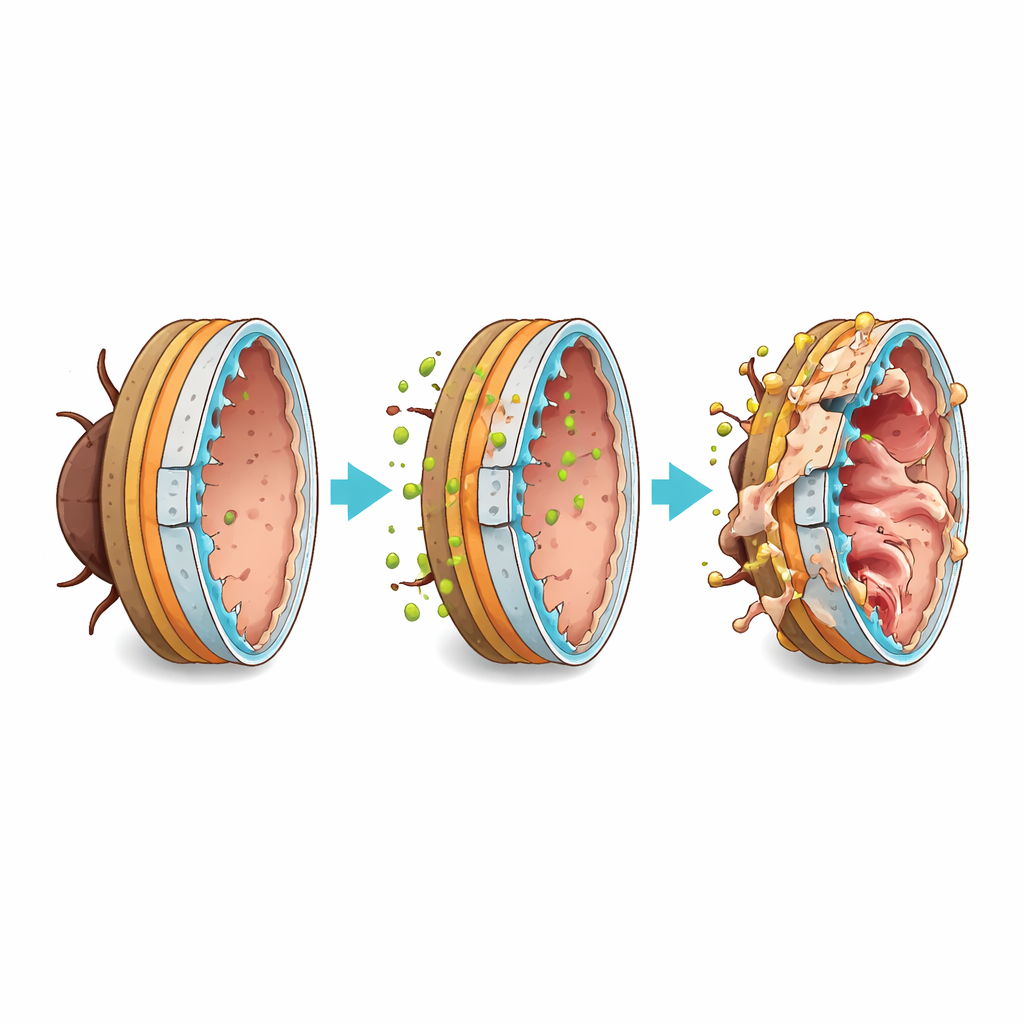
In untreated ticks, the outer covering formed a highly organized shield. It consisted of a thin surface film and a thicker supporting layer arranged in distinct sublayers, joined to a cushion-like zone and a single layer of living skin cells underneath. This structure allowed the tick’s body to stretch as it fed, while also serving as a tight barrier that controls water loss and blocks harmful substances from entering. Tiny channels and skin glands ran through this barrier, secreting waxy material onto the surface. After immersion in the bitter apple extract, however, this order broke down. Surface folds became irregular, the external layer showed erosions and wart-like bumps, and openings of skin glands became clogged and deformed.
Damage from the surface down to the living cells
Closer inspection at higher magnification showed that the plant extract disrupted every level of the tick’s protective covering. The outer film layers separated and thickened, the supporting layers beneath them lost their normal lamellar (layered) pattern and became disorganized and crumpled, and the cushion-like zone developed ruptures and vacuoles—bubble-like empty spaces. The living skin cells displayed swollen and misshapen nuclei, fragmented nucleoli, loss of normal cell structures, and heavily vacuolated cytoplasm, all signs of severe stress and cell degeneration. The fine channels penetrating the outer coat were dilated and left behind fibrous remnants, while the secretory glands exhibited enlarged, damaged ducts and decaying cells, indicating disturbed secretion and breakdown of normal function.
Clues from the plant’s volatile chemicals
The chemical analysis of the bitter apple extract uncovered a suite of volatile compounds, including several fatty acid derivatives such as methyl linoleate, palmitic acid derivatives, stearic acid, and octadecadienoic acid. These substances are oily, small, and easily evaporated, properties that help them dissolve into and pass through biological membranes. The authors propose that these lipophilic molecules pass through the tick’s outer waxy layers and pore channels, disturb the structure of cell membranes, and alter their permeability. This membrane disruption would explain the observed swelling, vacuoles, and destruction in the deeper layers of the integument and in the epidermal cells, ultimately compromising the tick’s barrier and internal stability.
What this means for greener tick control
By showing that bitter apple fruit extract can severely damage all layers of the camel tick’s outer covering and its underlying skin cells, this work provides microscopic evidence that a common desert plant may serve as a promising tool for biologically based tick control. For a lay reader, the key message is that certain natural plant chemicals can punch holes in the tick’s “armor,” making it leaky and dysfunctional. This not only harms the tick directly but may also allow more of the plant’s toxic ingredients to penetrate and affect internal organs. While further tests on safety, dosage, and real-world application are still needed, bitter apple extract emerges here as a serious candidate to help reduce reliance on conventional chemicals and protect both camels and the environment.
Citation: Montasser, A.A., Mohamed, S.N.A. & Ali, A.A.B. Histopathological effects of the fruit extract of Citrullus colocynthis on the integument of the female tick Hyalomma dromedarii. Sci Rep 16, 12708 (2026). https://doi.org/10.1038/s41598-026-46500-2
Keywords: camel ticks, bitter apple, plant-based acaricides, tick integument damage, Citrullus colocynthis