Clear Sky Science · en
Physics-based modeling and friction parameter identification of a proportional spool valve
Why a tiny sliding part matters
Modern machines from excavators to factory robots rely on hydraulic valves to move heavy loads with smooth, precise motion. At the heart of many of these valves is a small sliding part called a spool that must respond quickly and predictably to electrical commands. This paper explores how to model the behavior of such a valve in detail, with special focus on friction inside the valve, so engineers can design safer, more efficient hydraulic systems.
The moving core of a hydraulic controller
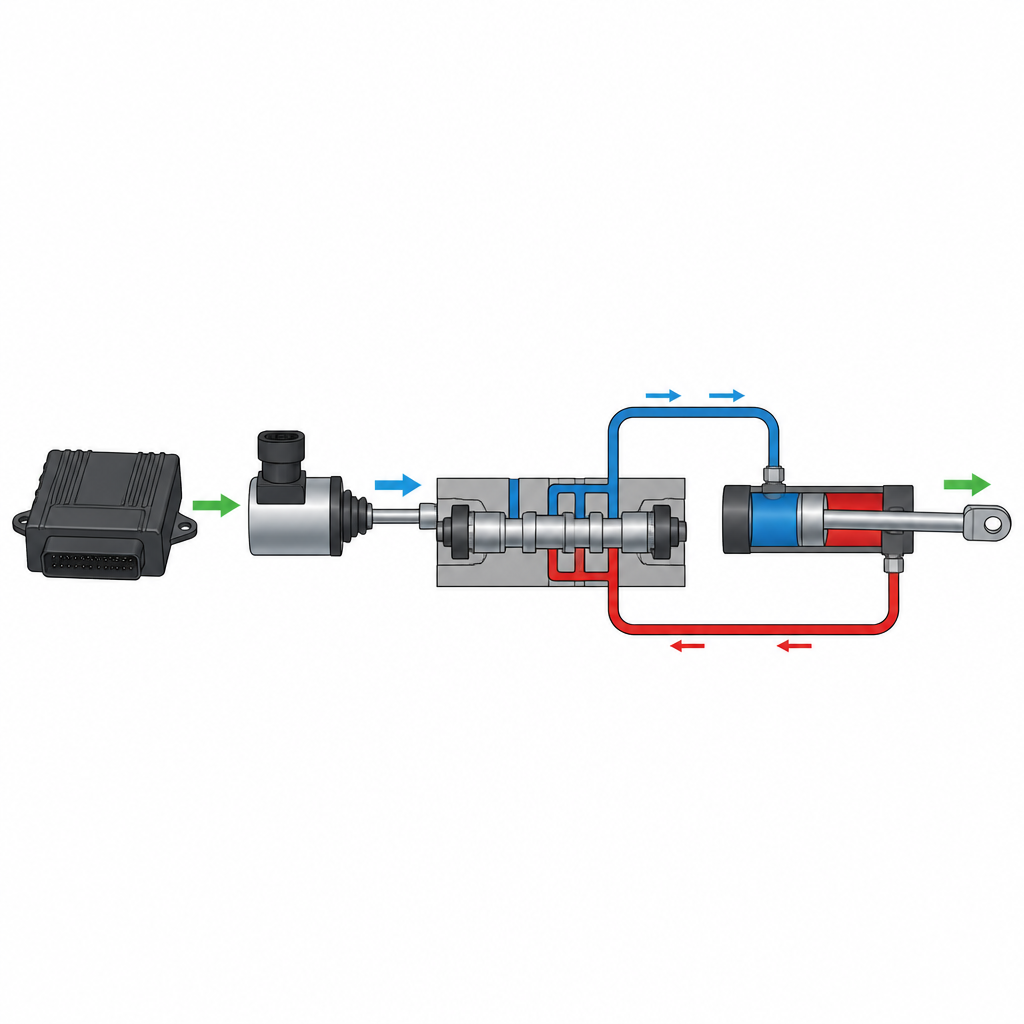
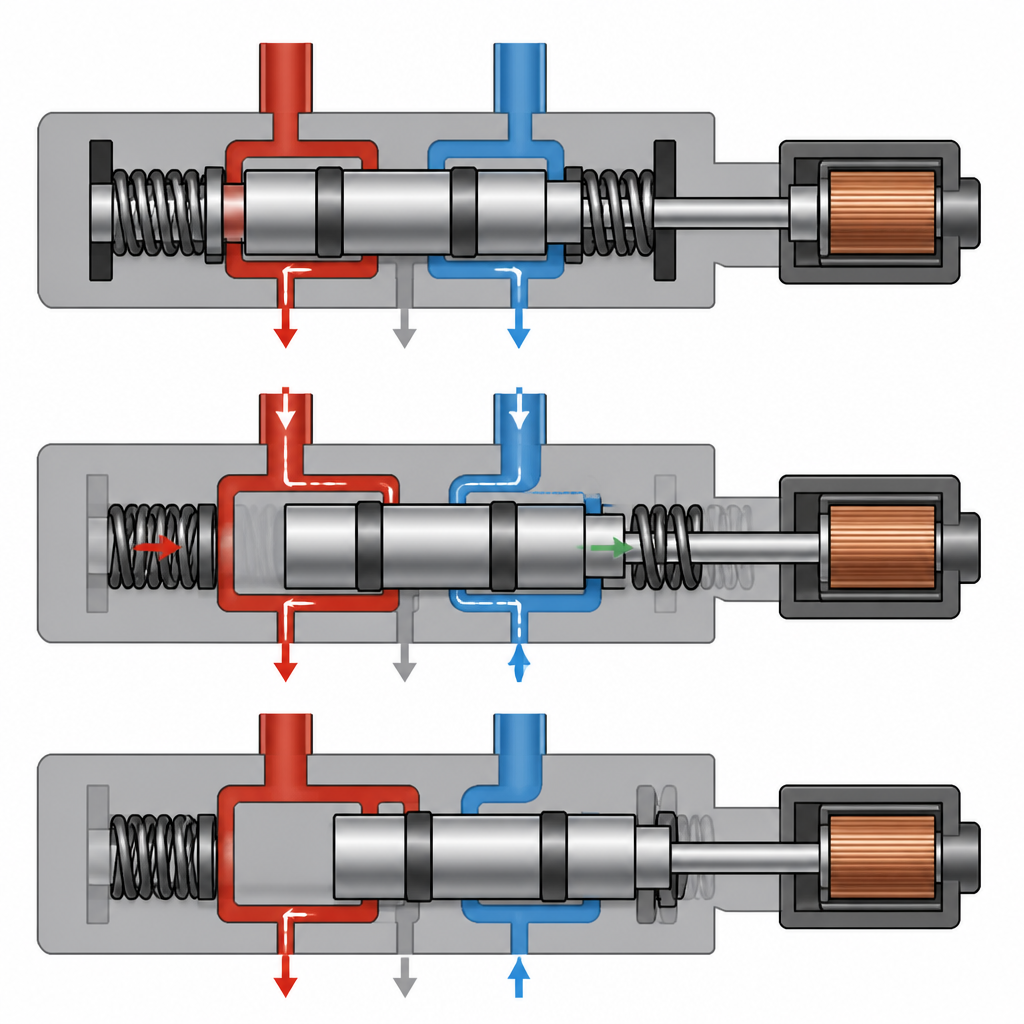
The study looks at a common industrial component known as a proportional spool valve. This device steers pressurized oil to a hydraulic cylinder or motor and can vary the flow continuously rather than simply turning it on or off. The authors analyze a commercial valve that combines three main parts: a cast-iron body with a finely fitted spool, a linear electric motor that pushes the spool back and forth, and built in electronics that adjust and measure spool position. Two opposing springs center the spool when power is removed, while an inductive sensor reports its exact location to a control unit.
Building a model from real forces
Instead of treating the valve as a simple black box with an input and output, the researchers construct a physics based model that tracks the individual forces acting on the spool. These include the push from the linear motor, the restoring force from the springs, the inertia of the moving parts, forces from the flowing oil, and friction between spool and body. Each contribution is determined from targeted measurements: static tests of motor force at different currents and positions, compression tests of the springs, weighing of the moving assembly, and earlier studies of flow forces. All of these are assembled into one equation of motion that describes how the spool accelerates, slows, and settles in response to a control signal.
Cracking the secret of internal friction
Friction proves to be the most elusive influence, since it cannot be measured directly while the valve operates. The team therefore uses an indirect strategy. They run the valve on a special hydraulic test rig and record how the spool responds to sudden step changes and to sinusoidal signals over a range of frequencies. With oil present but at first not flowing, they tune the parameters of an advanced friction description known as the LuGre model until simulations match the measured motion. This model captures how static friction must be overcome to start movement, how friction drops at low speeds, and how a viscous component grows with velocity. They then repeat the procedure with oil flowing at different pressures and with and without position feedback, showing that friction levels change when flow and pressure alter the contact between spool and body.
Testing the model against reality
Once calibrated, the physics based model is used to predict how the valve will behave in a variety of situations. The authors compare simulated and measured step responses, noting overshoot, rise time, and settling time for different command levels, both with and without feedback control. They also compare frequency responses up to 100 hertz, examining how the amplitude and timing of the spool motion change with excitation frequency. Across most of the tested range, the model tracks the real valve closely, including subtle resonances and the slowing effect of higher inlet pressures. Where mismatches appear mainly at high command levels and under strong flow they point to additional nonlinear effects and hydrodynamic details that are not yet fully captured.
Why this detailed picture is useful
To show the practical value of their approach, the authors contrast their physics based model with a simpler linear model often used in control design. While the simpler version can fit some measurements under fixed conditions, it must be retuned whenever operating conditions change. In contrast, the new model lets engineers adjust physical parameters such as spring stiffness, moving mass, or friction settings directly and still obtain realistic predictions. For machine builders, this means a more reliable way to test control strategies and valve designs on the computer before hardware is built, and a clearer understanding of how internal friction and fluid forces shape the smoothness and speed of hydraulic motion.
Citation: Ledvoň, M., Hružík, L., Bureček, A. et al. Physics-based modeling and friction parameter identification of a proportional spool valve. Sci Rep 16, 15238 (2026). https://doi.org/10.1038/s41598-026-46361-9
Keywords: proportional spool valve, hydraulic control, friction modeling, dynamic response, physics based simulation