Clear Sky Science · en
Development and validation of a questionnaire to assess the sports experimentation phase of young female football players (QEEF-FEM)
Why the early years of girls’ soccer matter
Behind every professional women’s soccer player lies a story of childhood games, family encouragement (or lack of it), and the fields—formal and improvised—where she first kicked a ball. Yet in Brazil, where soccer is a national passion, there has been no tailored tool to understand how young girls actually experience the sport in their early years. This study set out to change that by creating and testing a questionnaire that captures the key ingredients of positive beginnings in women’s football.
Looking beyond the scoreboard
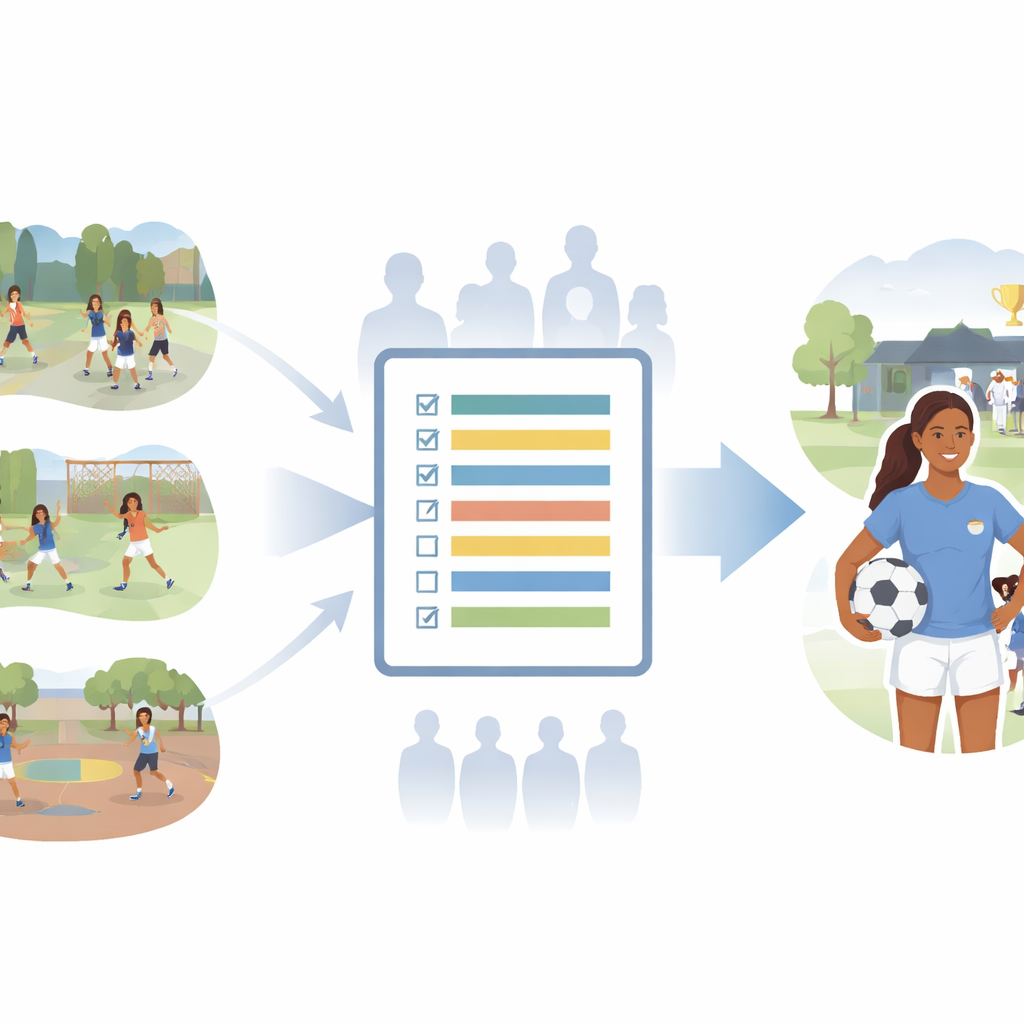
The researchers focused on what they call the “sport experimentation phase,” roughly the period when girls aged 12 to 17 are still trying out soccer, futsal, and other activities before full specialization. Rather than asking only about wins, losses, or training volume, the new questionnaire—named QEEF-Fem—looks at three big areas of a girl’s experience. First is personal engagement: Did she have fun? Did she try other sports? Did informal play, like street games, fuel her interest in football? Second is quality social dynamics: How supportive were parents, siblings, teachers, coaches, referees, and teammates? Third is appropriate settings: Were the pitches, rules, equipment, and school or club environments safe, welcoming, and adapted to her age?
Building the right questions
Creating the QEEF-Fem started with a long list of 45 candidate questions inspired by an existing developmental model known as the Personal Assets Framework. Young female players from a professional club first tested this early version, giving feedback on how clear, relevant, and engaging the questions were. Their responses showed that the items were easy to understand and enjoyable to answer. Next, ten university experts in youth sport and football carefully reviewed each question, rating its clarity, practical usefulness, and theoretical importance. Items that did not reach high agreement among experts were rewritten or removed, trimming the list to 38 questions that better reflected the realities of Brazilian girls in football.
Putting the survey to the test
The refined questionnaire was then given to 391 female players aged 12 to 17 from 15 professional clubs in southern Brazil. Using statistical techniques designed for survey development, the authors examined how the questions grouped together and whether they truly reflected the three intended areas: personal engagement, social relationships, and sport settings. The analysis confirmed a three-part structure that matched their theory. From the original pool, 17 questions showed especially strong and clean links to these three dimensions, forming the core of the final QEEF-Fem. Measures of reliability—essentially, checks on whether the questions hang together in a stable, consistent way—fell in the borderline to acceptable range for early-stage research, suggesting the tool is solid enough for exploratory studies while still open to future refinement.

What this means for girls on the field
By grounding the questionnaire in both an international development model and the specific context of Brazilian women’s football, the study offers more than a new form to fill out. It delivers a way for coaches, clubs, and policymakers to monitor how young players actually experience the game: whether they feel supported, whether their environments are welcoming, and whether they enjoy a healthy mix of play and structured practice. The authors note that more work is needed—such as testing how stable answers remain over time and expanding samples beyond southern Brazil—but they see QEEF-Fem as a crucial first step toward evidence-based planning.
A new tool for fairer futures in women’s football
In everyday terms, the study concludes that QEEF-Fem is a culturally tuned and scientifically tested questionnaire that can reliably capture the early sporting lives of young Brazilian female footballers. Instead of guessing which experiences help girls stay in the game and thrive, practitioners can now collect structured information on the mix of fun, support, and suitable conditions that shape their journeys. With this tool, it becomes easier to design programs and policies that give more girls the chance not only to play soccer, but to grow through it in safe, inclusive, and developmentally rich environments.
Citation: da Silva Bispo, J.C., Tozetto, W.R., Fiorese, L. et al. Development and validation of a questionnaire to assess the sports experimentation phase of young female football players (QEEF-FEM). Sci Rep 16, 10940 (2026). https://doi.org/10.1038/s41598-026-45712-w
Keywords: women’s football, youth sport development, Brazil, female athletes, questionnaire validation