Clear Sky Science · en
Sequential invitations to FOBT screening and colorectal cancer incidence
Why this matters for everyday health
Colorectal cancer is one of the most common cancers worldwide, but it often starts as small growths in the bowel that can be found and removed before they turn dangerous. This study from Stockholm–Gotland, Sweden, asks a practical question with real-life consequences: if people are invited to stool blood tests for bowel cancer screening several times over their 60s, does that actually lower their chance of getting cancer later on—and does the type and timing of those tests matter?

How simple home tests can spot hidden danger
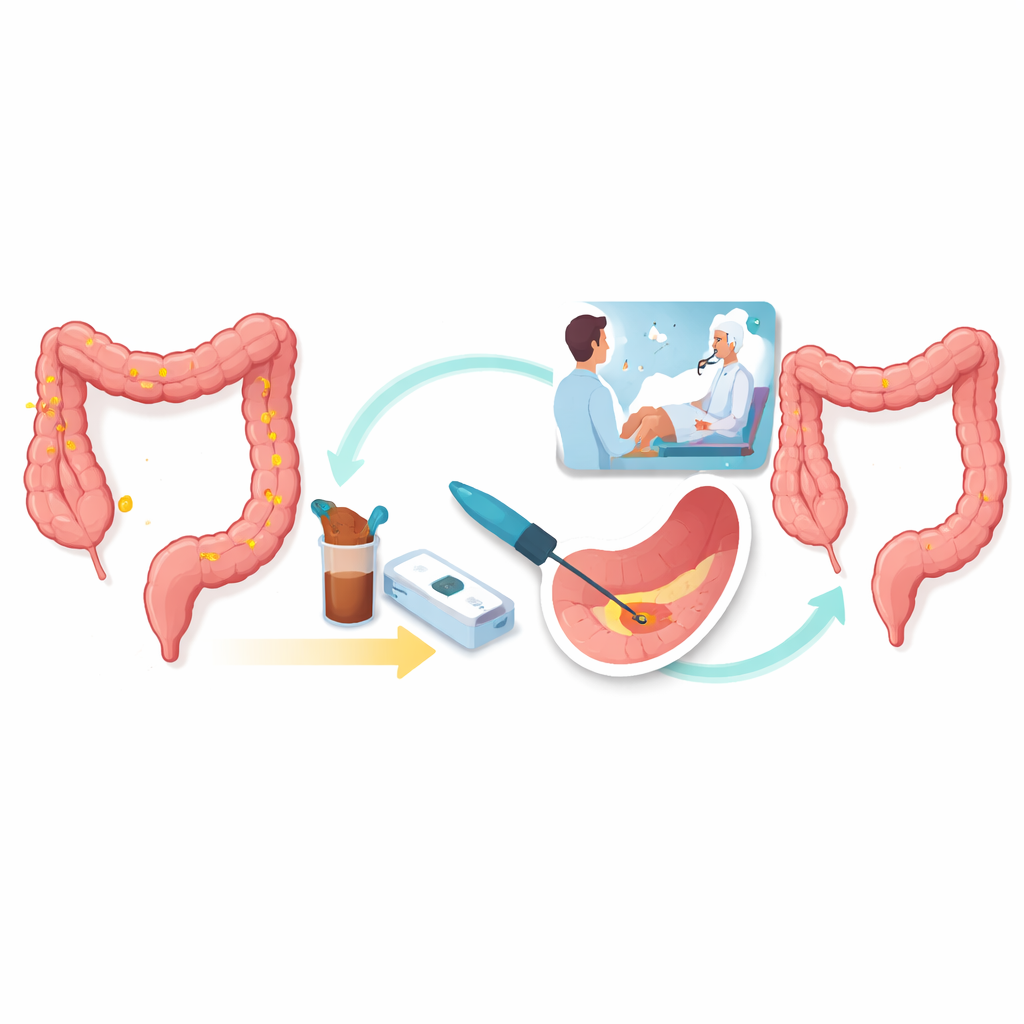
The screening program used two kinds of stool blood tests that people could do at home and mail back. Both aim to pick up tiny amounts of blood in stool, which can be a sign of polyps or cancer, long before symptoms appear. The older test, called guaiac-based FOBT, reacts to blood in a more general way. The newer test, called FIT, is more sensitive and tuned specifically to human blood, so it is better at picking up early changes. In Stockholm–Gotland, adults aged 60 to 69 were invited every two years to send in stool samples—up to five rounds in total—while some birth years were not invited at all and served as a natural comparison group.
A natural experiment across birth years
Because the health system rolled out screening year by year and switched from the older test to FIT in 2015, different birth years ended up with different patterns, or “sequences,” of invitations: some received only a single round late in their 60s, others got several rounds of the older test, and some had one or more rounds with the newer, more sensitive FIT. Everyone entered follow-up at age 60 and was tracked in Swedish national registers for cancer diagnoses, cancer stage, deaths, and moves out of the country through 2020. This setup mimicked a large randomized trial of invitation patterns without needing to assign individuals one by one, and allowed the researchers to compare cancer rates in each invitation sequence with those who were never invited.
More cancers found during testing, fewer afterward
During the screening years (ages 60–69), people who received invitations—especially those invited to multiple rounds—had more cancers detected than those who were never invited. For example, sequences with four rounds of the older test plus either one round of the newer test or several rounds of the newer test showed clearly higher detection during the screening years. This is expected: once you start looking carefully, you find cancers that would otherwise have stayed hidden for a while. Importantly, finding more cancers during the active testing period is not necessarily bad news; it can mean you are catching disease earlier, when treatment is more effective.
Fewer new cancers after screening stops
The key question is what happens later, after invitations stop. In the years 70–73, when no one was being invited anymore, the picture reversed. Birth years that had received more invitations—particularly those that included the more sensitive FIT—had substantially lower rates of new colorectal cancers than people who were never invited. In sequences with four rounds of the older test plus one or two rounds of FIT, cancer rates after age 70 dropped by roughly one third to one half compared with the never-invited group. Across all patterns, there was a clear downward trend: the more rounds of screening people had been invited to, the fewer cancers appeared later on.
Shifting cancers toward earlier, more treatable stages
The study also examined how advanced the cancers were when they appeared after screening stopped. Early-stage cancers are generally much easier to cure than cancers that have already spread. Between ages 70 and 73, both early and late stages of colorectal cancer became less common as the number of screening invitations increased, again with the strongest improvements in the sequences that included FIT. One sequence with three rounds of the older test already showed a noticeably lower rate of early-stage cancers, and overall trends suggested that repeated invitations help shift the balance away from both early and advanced cancers appearing in the first place.
What this means for people and programs
For a layperson, the bottom line is straightforward: being repeatedly invited to simple home stool tests in your 60s can reduce your chance of developing colorectal cancer in your early 70s, and newer, more sensitive tests seem to strengthen that protection. While screening briefly raises the number of cancers found—because it uncovers hidden disease—it ultimately leads to fewer cancers overall and fewer serious, late-stage cases. These findings support the idea that well-designed, repeated invitations to stool-based screening, especially with modern tests like FIT, are a powerful tool for lowering colorectal cancer burden and guiding more personalized screening strategies in the future.
Citation: Wang, X., Ribbing Wilén, H., Phillips, R.V. et al. Sequential invitations to FOBT screening and colorectal cancer incidence. Sci Rep 16, 12728 (2026). https://doi.org/10.1038/s41598-026-45674-z
Keywords: colorectal cancer screening, stool blood test, FIT and FOBT, cancer prevention, population screening programs