Clear Sky Science · en
Comparative evaluation of irrigation techniques on dentin nanohardness, flexural strength, and chemical composition: an in vitro study
Keeping treated teeth strong
Root canal treatment can save a tooth that would otherwise be lost, but many patients worry that the procedure might leave teeth weak and prone to breaking. This study asks a simple question with big everyday consequences: do modern ways of moving cleaning liquids inside the root canal quietly damage the inner tooth structure that must last for years?
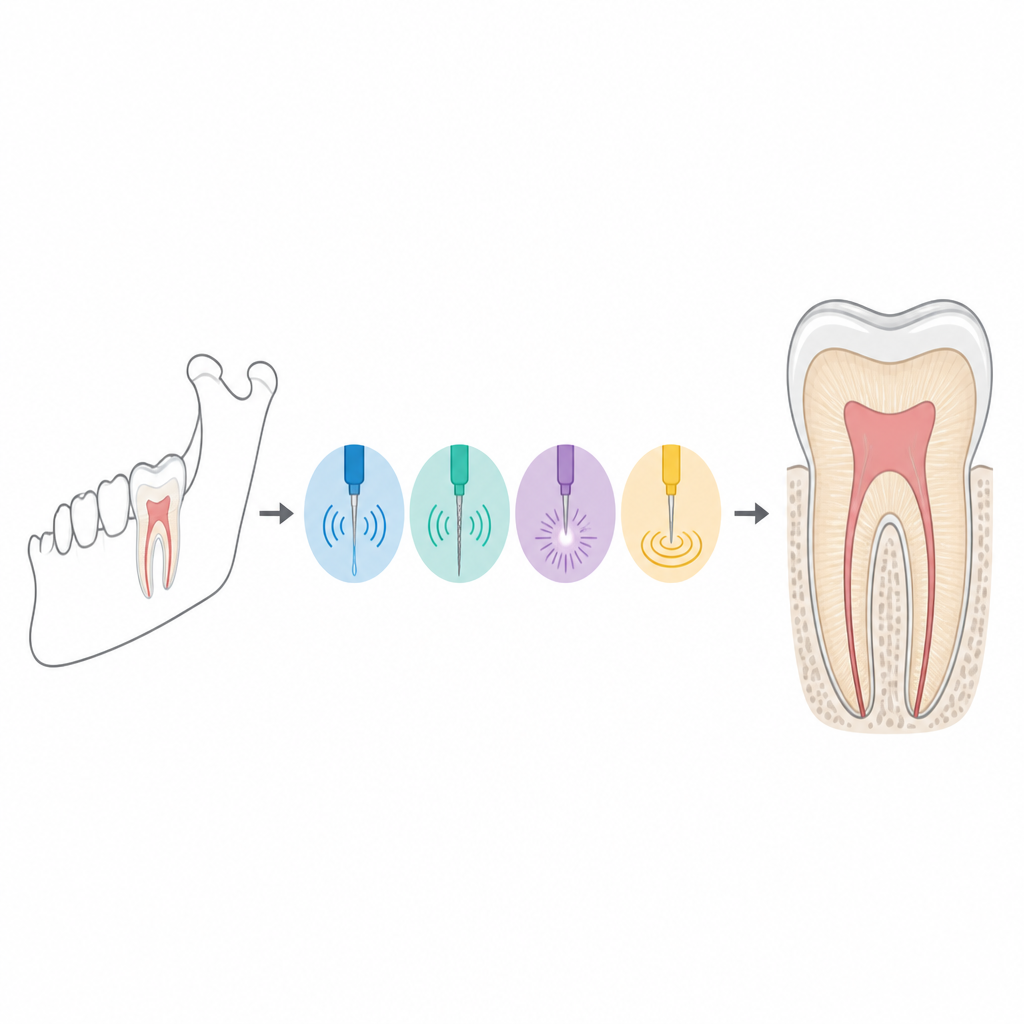
How dentists clean inside roots
When dentists perform a root canal, they not only scrape out infected tissue but also flush the tiny inner space of the root with cleaning liquids. A common mixture uses sodium hypochlorite to kill germs and dissolve soft tissue, along with a second solution that helps remove mineral smear left on the canal walls. New tools try to make these liquids flow better and reach hidden corners by shaking, vibrating, or flexing inside the canal, raising the concern that this extra energy might also harm the hard tissue called dentin that gives the tooth its strength.
Four ways to stir the cleaning liquid
The researchers collected fifty healthy premolar teeth that had been removed for reasons unrelated to this study. After shaping the canals in a standard way, they divided the roots into five groups. One group received simple syringe rinsing. The others used four popular activation methods: sonic tips that vibrate at lower frequencies, ultrasonic tips that vibrate faster, a flexible XP-Endo Finisher file that adapts to the canal shape, and manual dynamic activation, where a soft cone is pumped by hand inside the canal. Each root then went through tests that mimic real chewing stresses and examined the dentin on a very fine scale.
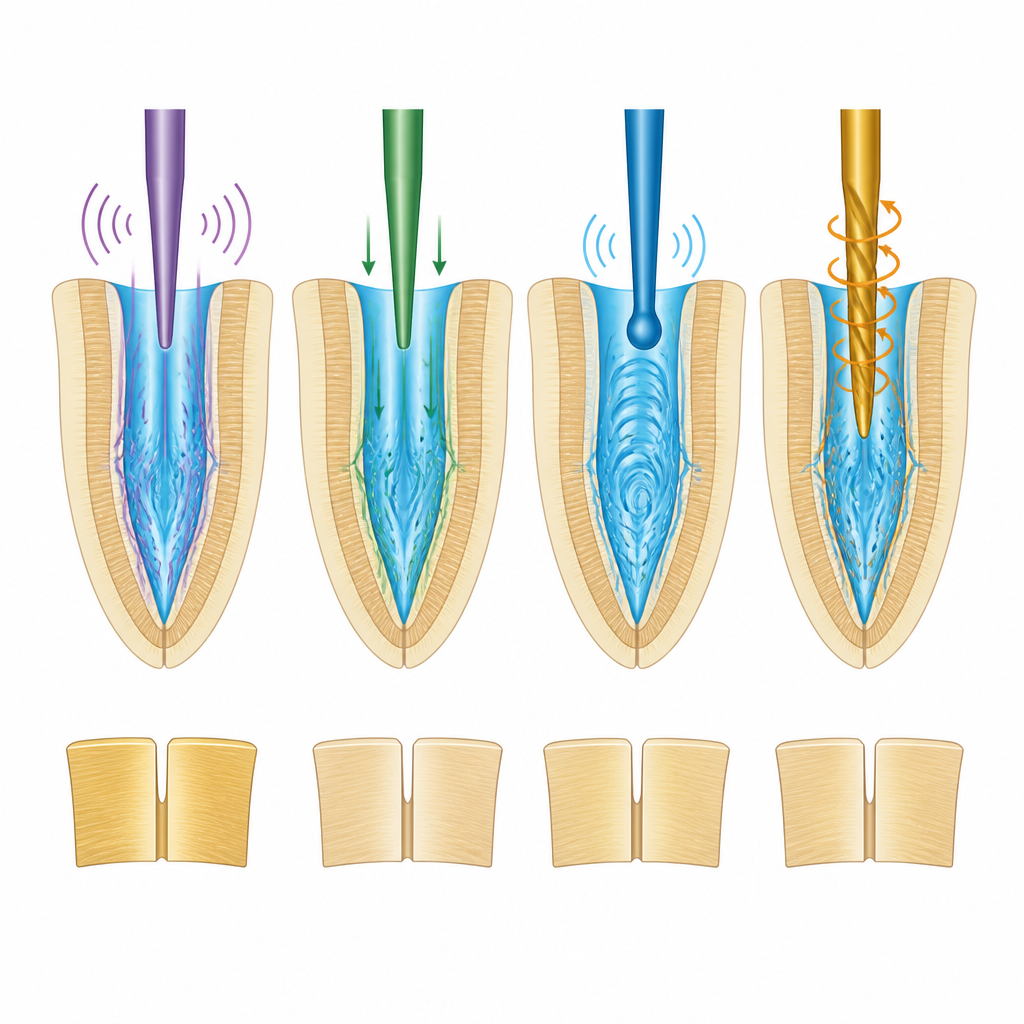
Testing tooth tissue at tiny scales
To see whether any method made dentin softer or more fragile, the team cut the roots into small bars and thin sections. Using a nano-indentation machine, they measured nanohardness and elastic modulus, which together describe how stiff and resistant the dentin is when pressed at microscopic points. They also used a three-point bending test to see how much force the dentin bars could withstand before breaking, a measure called flexural strength. Finally, they used energy-dispersive X-ray spectroscopy to check the levels of key elements such as calcium, phosphorus, and oxygen in the dentin surface.
What changed and what stayed the same
The results were reassuring for most measures. Across all five groups, dentin hardness and bending strength stayed very similar, and there were no meaningful changes in calcium, phosphorus, or oxygen content. This suggests that none of the activation techniques stripped important minerals or made the dentin notably weaker. One property, the elastic modulus, did differ: dentin exposed to sonic activation showed slightly higher stiffness than dentin treated with ultrasonic tips or the XP-Endo Finisher. However, these differences did not translate into clear losses of strength, and the study could not determine whether this change in stiffness has any real-world impact on tooth survival.
What this means for patients and dentists
Overall, the study suggests that commonly used methods for energizing root canal cleaning liquids do not significantly damage the inner tooth structure. The hard tissue that supports fillings and crowns kept its hardness and ability to resist bending, regardless of whether the dentist used sonic, ultrasonic, flexible file, or manual pumping methods. Although sonic activation slightly increased dentin stiffness compared with some other tools, the importance of this finding for everyday dental care is still uncertain. For patients, the takeaway is that modern activated irrigation techniques appear to clean more effectively without obviously sacrificing the strength of the tooth root.
Citation: Ahmed, R.A., AbuMostafa, A. Comparative evaluation of irrigation techniques on dentin nanohardness, flexural strength, and chemical composition: an in vitro study. Sci Rep 16, 14922 (2026). https://doi.org/10.1038/s41598-026-45610-1
Keywords: root canal irrigation, dentin strength, endodontic treatment, sonic activation, ultrasonic irrigation