Clear Sky Science · en
SODNet: a scale-oriented detection network for efficient UAV-based sewage outfall detection
Why spotting hidden pipes from the sky matters
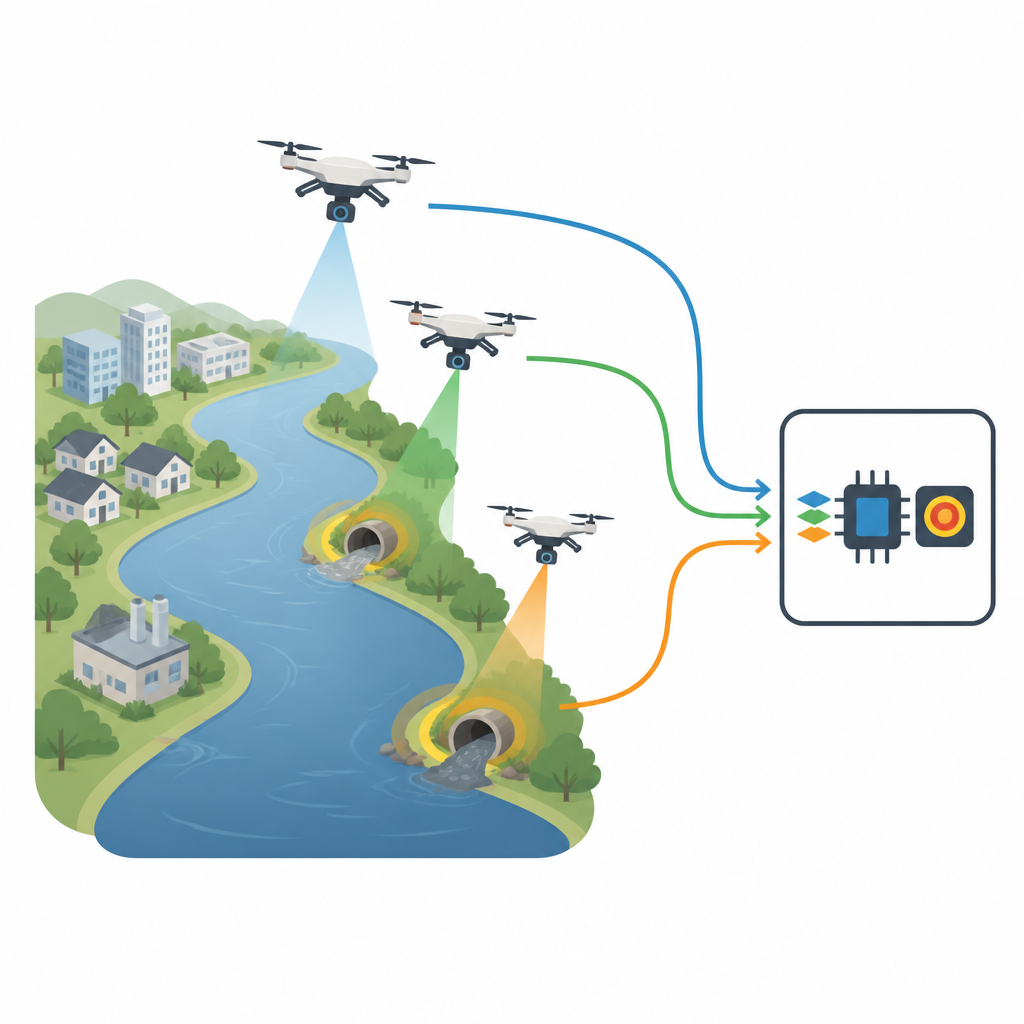
Many rivers are quietly polluted by pipes that dump untreated wastewater straight into the water. Finding these sewage outfalls is hard because they may be small, partly buried in vegetation, or spread along long stretches of riverbank. This study shows how small flying robots, combined with a smart but lightweight vision system, can automatically scan rivers from the air and flag these hidden pollution sources in real time.
Flying cameras over winding rivers
Unmanned aerial vehicles, or drones, are already used to photograph rivers and coastlines, offering wide views and frequent coverage. Until now, people usually had to look through thousands of aerial photos by eye to search for suspect pipes, which is slow and easy to get wrong. The authors argue that automatic detection is essential if we want to monitor large river systems regularly and respond quickly to new illegal or accidental discharges.
The challenge of big and tiny targets
Sewage outfalls do not look the same in every drone image. A pipe may fill a large part of the frame when the drone is low, but shrink to just a few fuzzy pixels when it is high. Sunlight, shadows, plants, and riverbanks further hide visual clues. Standard computer vision systems struggle with this mix of sizes and messy backgrounds, often missing the smallest or most hidden outfalls. At the same time, drone computers have limited power and memory, so bulky, slow models that work well on desktop machines are unusable in flight.
A scale aware eye for the drone
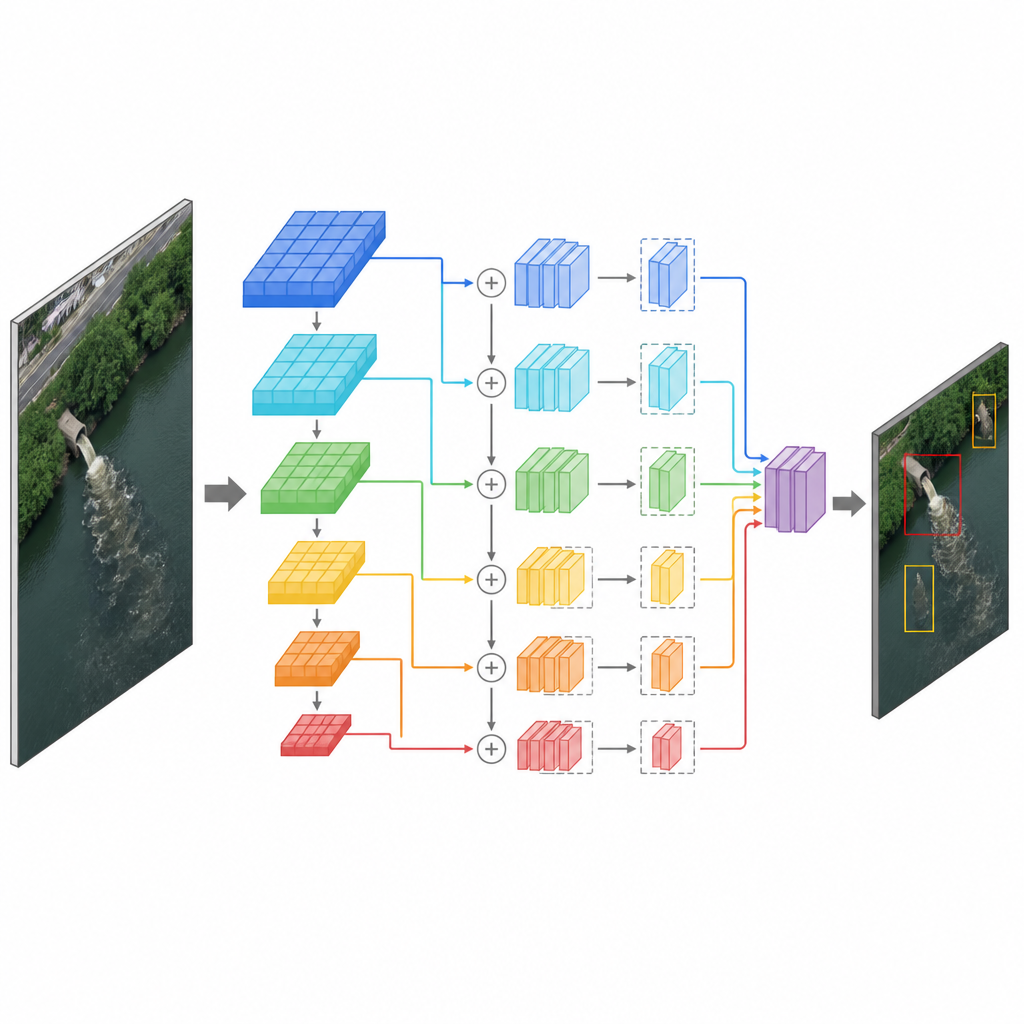
To tackle both accuracy and speed, the researchers created a new detection system called SODNet. It builds on a popular real time object detector but reshapes the parts that combine information from different detail levels. A new module, the Efficient Context Feature Pyramid Network, teaches the model to pay attention to the wider scene around each candidate pipe while toning down confusing background textures. Another mechanism, Adaptive Context Feature Fusion, lets high level, more abstract patterns guide how fine edge and texture details are merged, which helps keep both tiny and large outfalls visible to the network.
Doing more with fewer digital gears
The team also redesigned the “head” of the detector, where the system decides what is a pipe and where it sits in the image. Their Multi Scale Grouped Fusion module breaks features into parts and processes them with different virtual lens sizes to better capture both small and large structures, then recombines them efficiently. To speed things up even further, they applied channel pruning, a way of trimming away rarely used internal pathways so that only the most useful ones remain. This deep compression keeps the overall structure but shrinks the number of calculations, much like removing spare gears from a machine while keeping its function.
How well the smart drone eye performs
The researchers trained and tested SODNet on a dedicated dataset of more than ten thousand sewage outfall images from major river basins in China, covering many outfall types and lighting conditions. Compared with the baseline model, their approach boosted detection accuracy while slashing the number of parameters by more than three quarters and cutting the required computations by nearly the same fraction. In lab tests, the trimmed version of SODNet processed more than twice as many images per second as the original. When installed on a compact Jetson Xavier NX computer, similar to what might fly on a drone, it still handled over forty images per second, fast enough for real time river patrols.
Cleaner rivers through smarter monitoring
For readers, the key message is that it is now possible for modest, battery powered drones to scan long stretches of river and automatically spot most sewage outfalls with high precision. SODNet shows that careful design can balance sharp vision for both tiny and large targets with fast, low power computing suitable for field hardware. While the system may still miss some of the most subtle cases, it offers a practical tool to support inspectors, improve routine monitoring, and provide quicker warnings of new pollution sources that threaten ecosystems and human health.
Citation: Zeng, L., Liu, X., Dai, B. et al. SODNet: a scale-oriented detection network for efficient UAV-based sewage outfall detection. Sci Rep 16, 15103 (2026). https://doi.org/10.1038/s41598-026-45595-x
Keywords: sewage outfall detection, UAV monitoring, water pollution, lightweight deep learning, object detection