Clear Sky Science · en
Improving movie rating prediction accuracy and interpretability with narrative-aligned multimodal fusion
Why smarter movie scores matter
Online star ratings shape which films we watch, yet they can be noisy, biased, and hard to interpret. This study introduces a new way to predict movie ratings that not only improves accuracy but also explains which parts of a movie’s story and background information matter most. By blending plot summaries with production details and tracking uncertainty in the scores, the approach aims to make automated ratings more reliable and transparent for both viewers and researchers. 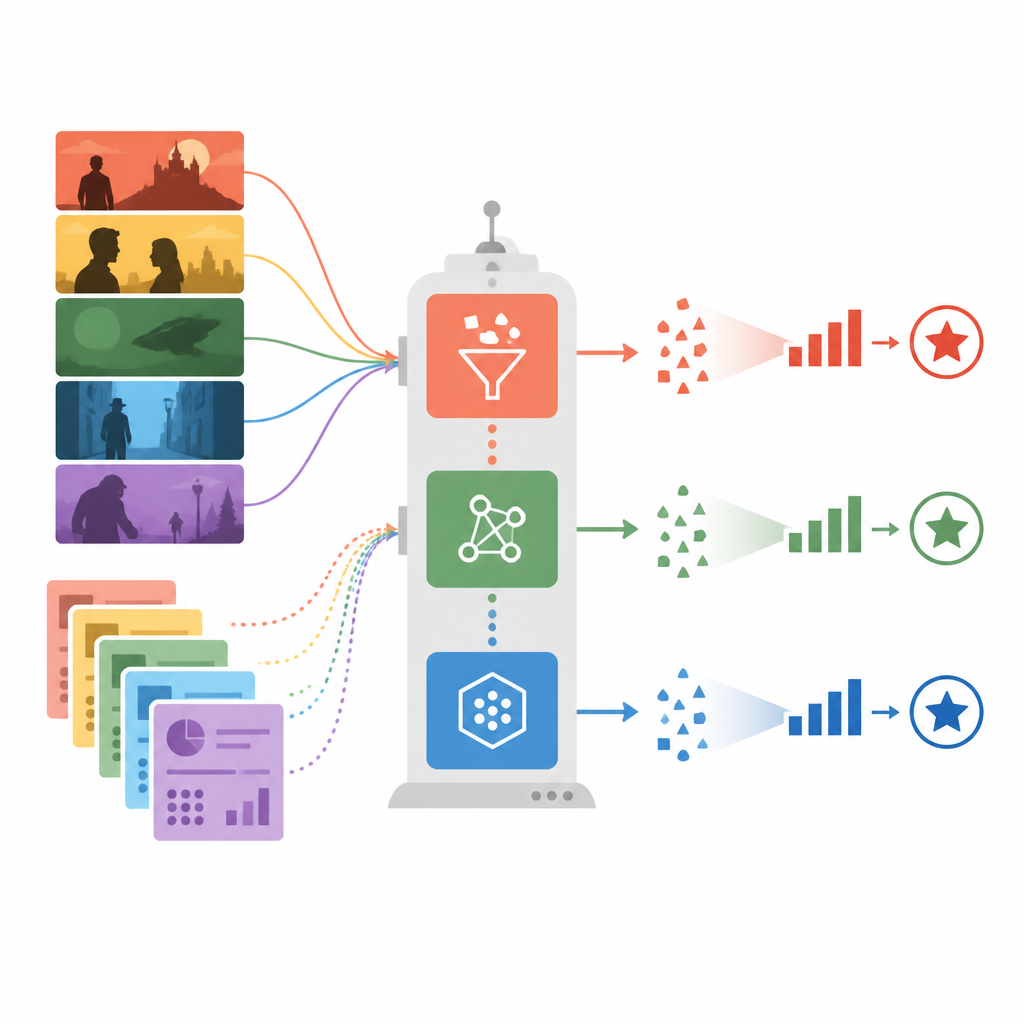
Looking beyond simple stars
Many rating tools treat a movie as a handful of numbers such as genre, budget, and average score. Others read the plot but use general language models that are not tuned to story structure. These systems often ignore how many people voted, even though a score based on a few fans is less trustworthy than one backed by thousands. The new model, called the Narrative-Aligned Multimodal Rating Network (NAMRN), is designed to tackle all three issues at once: it pays close attention to the narrative, it accounts for how uncertain each rating is, and it selectively combines different types of information rather than mixing everything together blindly.
Teaching a model to understand stories
A central idea in this work is to align written plot summaries with key movie attributes before doing any rating prediction. The authors use a training step where the model learns to pair each plot with its own metadata, such as genre and time period, while pushing it away from mismatched pairs. This contrastive setup encourages the system to notice themes, emotional tone, and major events that consistently go with certain kinds of films. The result is a compact representation of each story that captures more than just keywords and can later serve as a strong foundation for estimating how audiences will respond.
Dealing with shaky scores and mixed signals
Audience ratings are not equally reliable. A cult film with a few polarized reviews is very different from a blockbuster with tens of thousands of votes. NAMRN models this directly by predicting not only a movie’s expected rating but also its uncertainty. The training process penalizes errors in a way that depends on this uncertainty and on how many votes a movie has, so that confident scores weigh more than fragile ones. At the same time, the model receives several input channels: narrative text, structured details like budget, runtime, genre, and other metadata. A sparse gating mechanism learns how strongly to rely on each channel, gently turning down features that add noise and highlighting those that truly help. 
Testing across platforms and with noisy plots
The researchers combine three public datasets: a large movie catalog with plots and metadata, rating statistics from a major film website, and a separate user–movie rating matrix. After careful cleaning, alignment, and rating scale normalization, they train and test NAMRN alongside classic methods such as support vector regression and gradient boosting, as well as modern neural models based on LSTMs, Transformers, and attention. On all key error measures, NAMRN achieves the best scores and shows less variation from run to run. It also maintains similar accuracy when moved to the independent dataset, suggesting that it does not overfit to a single platform. When the authors deliberately corrupt the plot text with deletions, substitutions, and typos, performance drops as expected but remains competitive, showing reasonable robustness to messy real-world descriptions.
Seeing why the model decides
Beyond raw accuracy, the study emphasizes interpretability. By tracing how small changes in each input token or feature would alter the predicted rating, the authors generate heatmaps over words and metadata. These maps reveal that the model focuses on emotionally charged terms in the story and on production attributes such as budget and runtime in ways that match human intuition, and that its attention patterns shift between low- and high-rated films. The same tools also show how the gating mechanism shifts weight between narrative and structured inputs across movies. Together, these views give a rare window into how a complex model translates story elements and background details into a single predicted score.
What this means for future movie picks
For a lay reader, the takeaway is that it is now possible to build rating systems that do more than crunch averages. By learning richer story representations, treating some ratings as more uncertain than others, and carefully blending multiple data sources, NAMRN offers movie predictions that are both more accurate and easier to trust. The framework could be extended to rate specific aspects of films, add visual or audio cues, or support fairer recommendations, offering a clearer picture of why certain movies rise to the top of our watchlists.
Citation: Peng, D., Yue, K. & Zhou, Z. Improving movie rating prediction accuracy and interpretability with narrative-aligned multimodal fusion. Sci Rep 16, 14892 (2026). https://doi.org/10.1038/s41598-026-45472-7
Keywords: movie rating prediction, multimodal model, narrative analysis, uncertainty estimation, recommender systems