Clear Sky Science · en
Tribolium flour beetles are strongly attracted to decomposing wood, their putative historical habitat, over flour
Why beetles in your flour care about fallen trees
Flour beetles are notorious pests in grain bins, mills and kitchen cupboards, yet their lives outside these man-made stores are poorly understood. This study asks a simple but surprising question: given a choice, do these insects actually prefer our flour, or the decaying wood that likely formed their ancient home in forest logs? The answer reveals how a tiny beetle can link natural landscapes with modern food facilities, and hints at new ways to manage infestations.
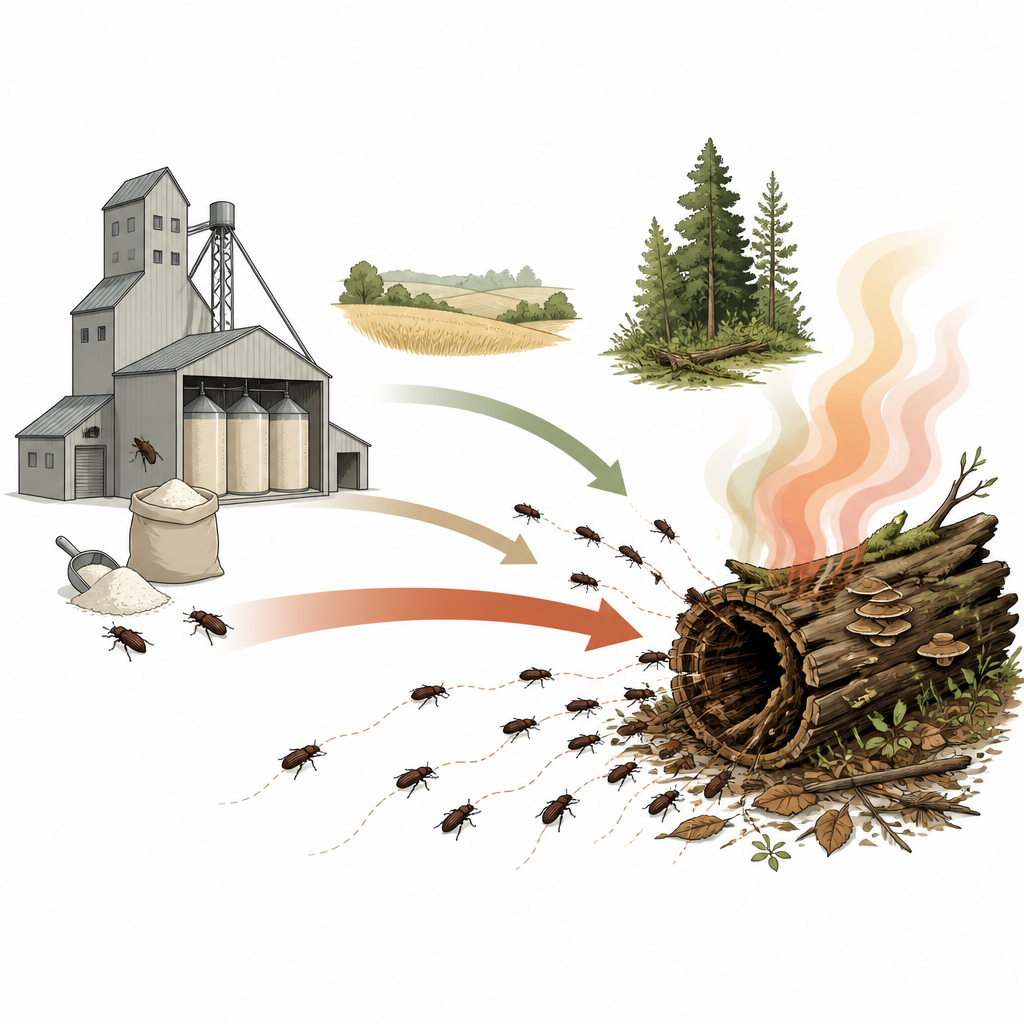
Beetles between cupboards and forests
The researchers focused on two common species, the red flour beetle and the confused flour beetle, which have followed humanity’s stored grain for thousands of years. Historical records and scattered field observations suggest that their wild relatives live in rotting logs under bark. The team wanted to know whether today’s flour pests still feel a strong pull toward decomposing wood, and whether such habitats can actually support their survival and reproduction. Understanding this link could show how beetles move between hedgerows, wood piles and grain facilities, shaping pest pressure over time.
Testing beetle choices by scent alone
To probe beetle preferences, the scientists used a circular choice arena where adult beetles could walk toward different scent sources: ground decomposing wood from three common tree species, wheat flour, or an empty control. Only smells reached the insects; they could not see or touch the materials at first. Thousands of beetles were released into these arenas. The results were striking: both beetle species were far more likely to move toward the decomposing wood than toward flour, and both chose flour more often than the empty control. The exact tree species did not matter, and males and females behaved similarly, suggesting a deep-seated attraction to the general smell of rotting wood rather than to a specific tree or sex-related cue.
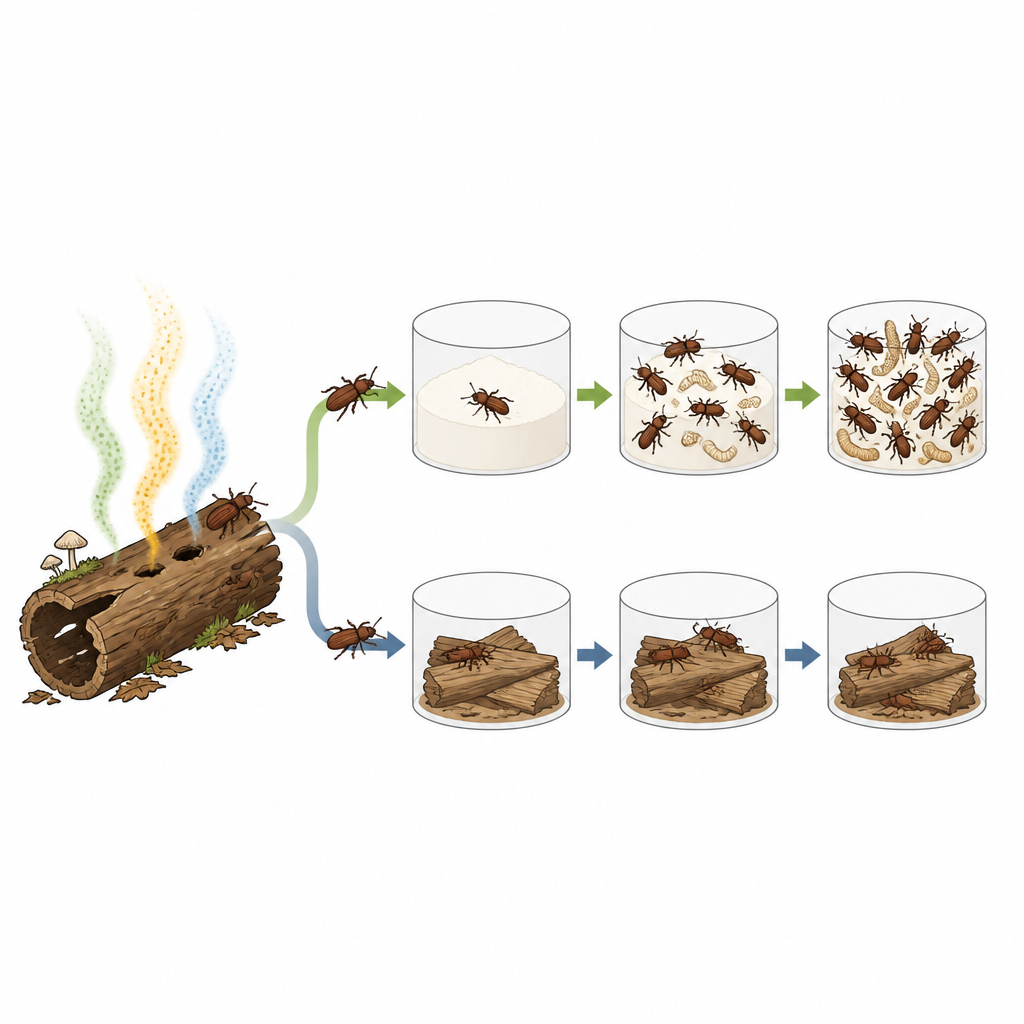
When favorite scents do not mean good food
Preference is not the same as good nutrition, so the team next tested whether the red flour beetle could actually live and reproduce on wood alone. Single females were placed into containers holding only wheat flour, only ground wood, only chunks of wood, or an almost empty container. Over several weeks, the researchers tracked survival and then counted any offspring. In flour, beetles survived well and produced many young. In both types of wood and in the nearly empty containers, adults died within the test period and produced no offspring. Survival in wood was equal to or even slightly worse than in containers with no real food, showing that the wood itself did not provide enough nutrition or suitable conditions.
Clues to beetle history and hidden partners
The strong pull toward wood smells, combined with poor performance on wood alone, suggests that in nature these beetles may not rely on the wood itself as food. Instead, they may historically have lived in rotting logs while feeding on fungi, microbes or other small invertebrates that share that habitat. Modern flour beetles carry gut microbes that help digest cereal grains, but lack many of the genes needed to fully break down woody plant walls. The study argues that, over evolutionary time, shifting from complex woody habitats to grain stores may have traded the safety and diversity of logs for the rich, consistent food of flour, helped by crowd-drawing scents produced by the beetles themselves.
What this means for managing pantry pests
For a layperson, the key takeaway is that flour beetles in bins and cupboards are still “forest-minded” at heart, strongly drawn to the smell of decomposing wood yet unable to thrive on wood alone. This lingering attraction may help scientists design lures that pull beetles away from grain and into traps that do not rely on insecticides. It also underscores that managing stored-grain pests is not only about what happens inside the silo, but also about the surrounding landscape of hedgerows and fallen branches that continues to call to these tiny insects.
Citation: Rosenberger, D.W., Chung, H.E., Elsen, S.D. et al. Tribolium flour beetles are strongly attracted to decomposing wood, their putative historical habitat, over flour. Sci Rep 16, 14642 (2026). https://doi.org/10.1038/s41598-026-45364-w
Keywords: flour beetles, decomposing wood, stored grain pests, insect habitat, beetle attraction