Clear Sky Science · en
Differential impact of various in-class physical exercise interventions on cognitive function and mathematics achievement in primary school children
Why Short Breaks in Class Matter
Teachers and parents know that children can only sit still and focus for so long before their minds start to wander. Many schools now try “brain breaks” during lessons, but not all breaks are created equal. This study asked a simple, practical question: which kinds of short, daily classroom breaks best support both children’s concentration and their progress in math—energetic exercise, balance games, or quiet thinking tasks?
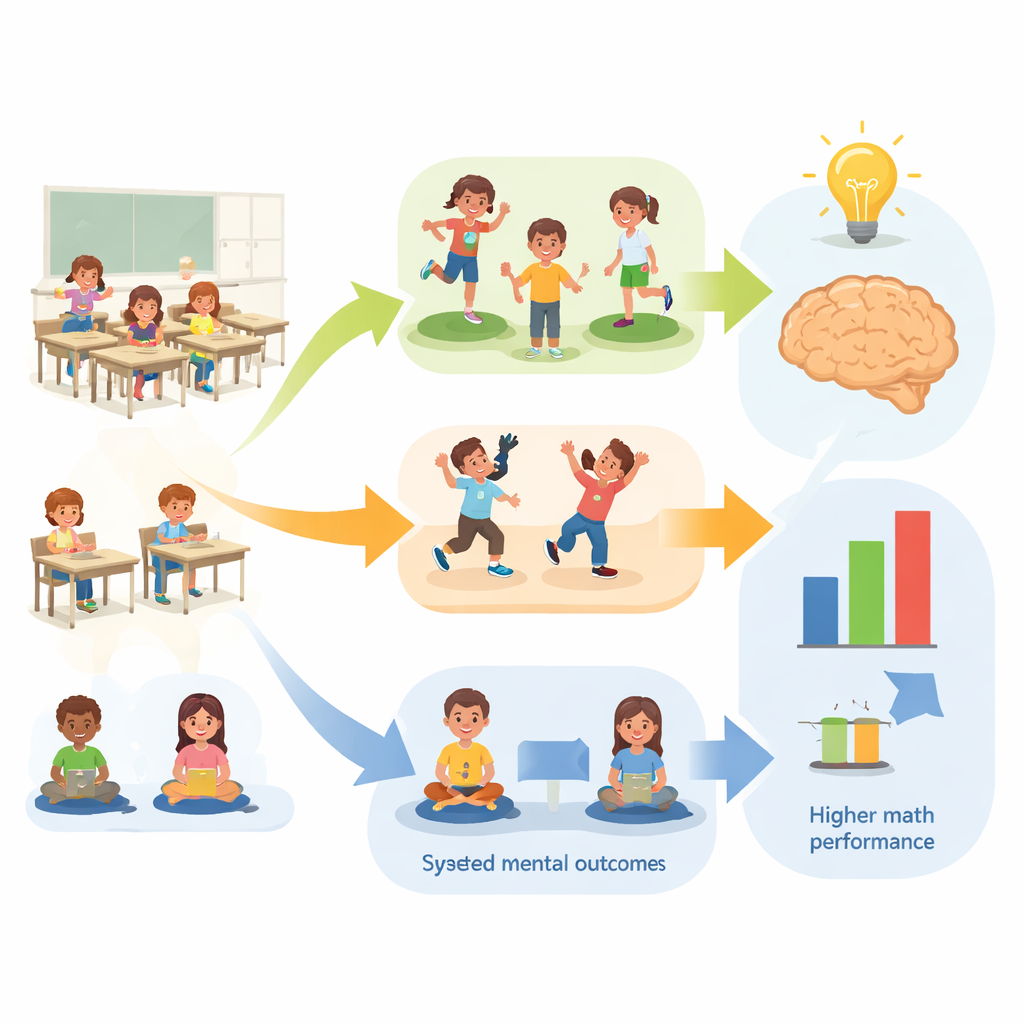
Three Ways to Pause During Lessons
The researchers worked with 157 children in 2nd and 3rd grade at two primary schools in Germany. Entire classes were randomly assigned to one of three daily 15-minute in-class activities for five weeks. One group did vigorous whole-body movement such as running in place and jumping exercises (CARDIO). A second group practiced balance challenges—standing on one leg, walking along lines, or using simple unstable surfaces in a playful “circus” setting (BALANCE). A third group stayed seated and did mental-focus activities without physical exertion, such as remembering patterns, listening carefully, and brief relaxation or mindfulness tasks (MENTAL). Most sessions took place right before the math lesson.
How the Children Were Tested
Before and after the five-week program, all children completed two kinds of tests. First, a standardized concentration test measured how well they could focus on relevant images while ignoring tempting distractions. This provided age-adjusted scores for both speed and accuracy. Second, they took a math test tailored to what they were learning in class. The “easy” part used one-digit subtraction or multiplication, while the “difficult” part involved two-digit problems that demand more careful step-by-step thinking. This design let the team see not only whether children learned new material, but also whether they became faster and more fluent with simpler tasks they already knew.
What Helped Attention and Math
All three types of breaks—CARDIO, BALANCE, and MENTAL—helped children’s concentration scores improve over time. In other words, simply interrupting long periods of sitting with a structured activity, whether physical or mental, seemed to sharpen overall focus. The picture was different, however, for math performance. Only the BALANCE and MENTAL groups showed clear gains in both easy and difficult math problems. The CARDIO group, despite working hard physically, did not improve in math to the same extent. Teachers’ comments offered a possible clue: many reported that after the vigorous CARDIO sessions, students often seemed overly excited and harder to calm down for the lesson that followed.
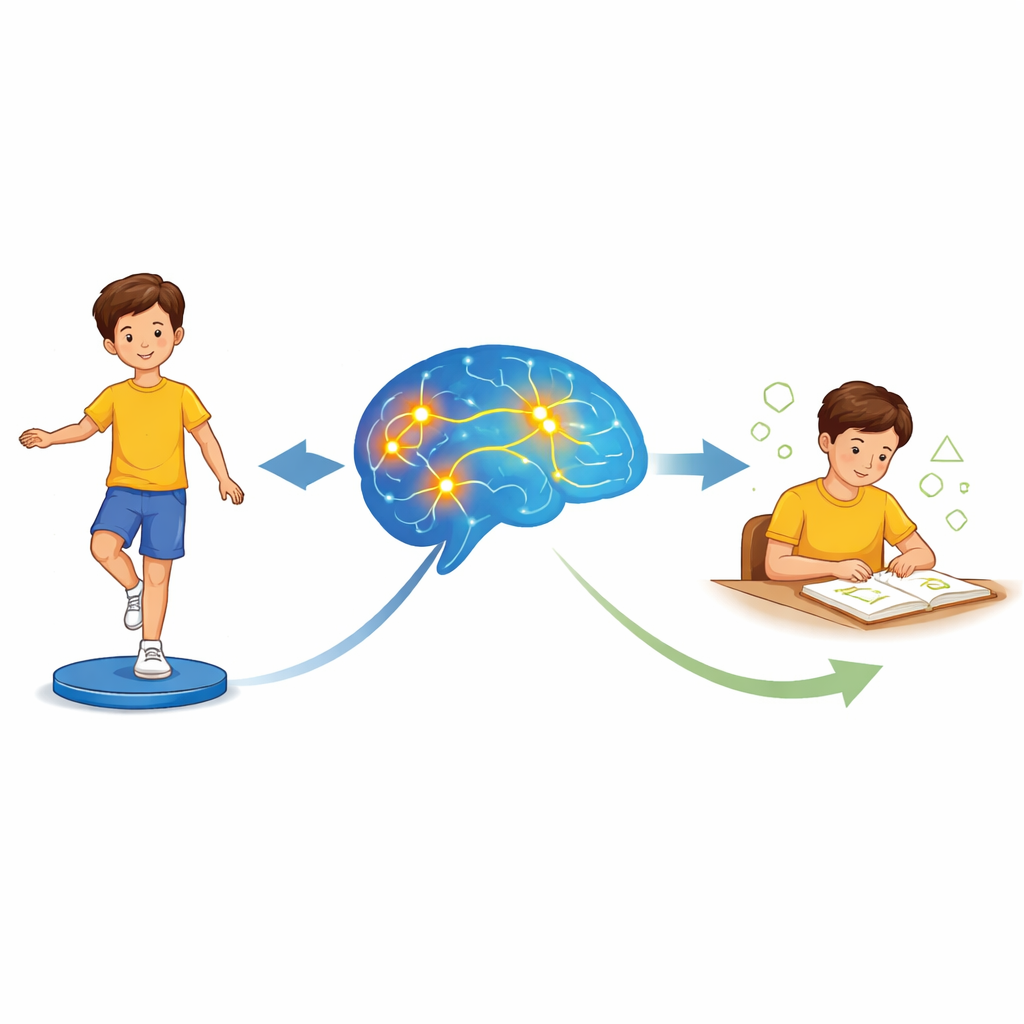
Children Who Struggle to Focus
The researchers also looked closely at a subsample of children whose starting concentration scores were noticeably below the group average, a pattern often seen in youngsters with attention difficulties. For these children, BALANCE and MENTAL breaks again tended to support better progress in the easier math tasks, while the CARDIO approach did not show comparable benefits. None of the groups showed strong gains for these children on the most difficult math items, suggesting that short breaks alone cannot fully overcome the challenge of mastering more complex material in a brief five-week window.
What This Means for Classrooms
For everyday school life, the study offers a helpful takeaway. Short, structured breaks—whether physical or not—can raise children’s concentration, which is good news in an era of long sitting times and digital distractions. But when it comes to boosting math learning, balance-based movement and quiet mental-focus activities appear more helpful than intense cardio bursts just before a lesson. Balance tasks have the added advantage of promoting physical health without overstimulating the class, and they require little space or special equipment. In simple terms, a few minutes of calm balancing or focused thinking may prepare young brains better for math than an all-out sprint in the middle of the school day.
Citation: Leukel, C., Lauber, B., Leuders, J. et al. Differential impact of various in-class physical exercise interventions on cognitive function and mathematics achievement in primary school children. Sci Rep 16, 9852 (2026). https://doi.org/10.1038/s41598-026-45347-x
Keywords: classroom breaks, children’s concentration, elementary math learning, balance exercises, school physical activity