Clear Sky Science · en
Advancing cardiovascular screening: deep learning-based heart-sound classification using SMOTE and temporal modeling
Listening to the Heart in a New Way
Heart disease is the world’s top killer, yet in many clinics the main screening tool is still a doctor’s ear and a simple stethoscope. Subtle “whooshing” sounds, called murmurs, can warn of dangerous valve problems, but they are easy to miss, especially outside specialist centers. This paper explores how computers can analyze recorded heart sounds to spot murmurs more accurately and consistently, potentially bringing expert-level screening to crowded clinics and low‑resource settings.
Why Heart Sounds Matter
Every heartbeat generates a rich soundtrack as valves snap shut and blood rushes through the heart. Doctors learn to interpret these sounds through years of training, but even experienced clinicians can disagree, and primary‑care doctors often miss important clues. At the same time, cardiovascular diseases cause millions of deaths each year, many of which could be prevented with earlier detection. Digital microphones now make it easy to record heart sounds, but turning those wavy lines into reliable diagnoses requires smart algorithms that can handle noise, patient differences, and rare but critical abnormal patterns.
Turning Raw Beats into Useful Patterns
The researchers built a step‑by‑step pipeline that mimics how an expert might listen, but with machine precision. First, they automatically detect key heartbeat events—the main “lub‑dub” peaks—and cut the recording into short, one‑second snippets centered on these points. This preserves the natural rhythm of the cardiac cycle. Next, they convert each snippet into a compact description of its pitch and tone using a method originally inspired by human hearing. Instead of feeding raw sound into the model, they use these distilled patterns as input, which makes it easier for the computer to focus on medically meaningful differences between normal and murmur sounds. 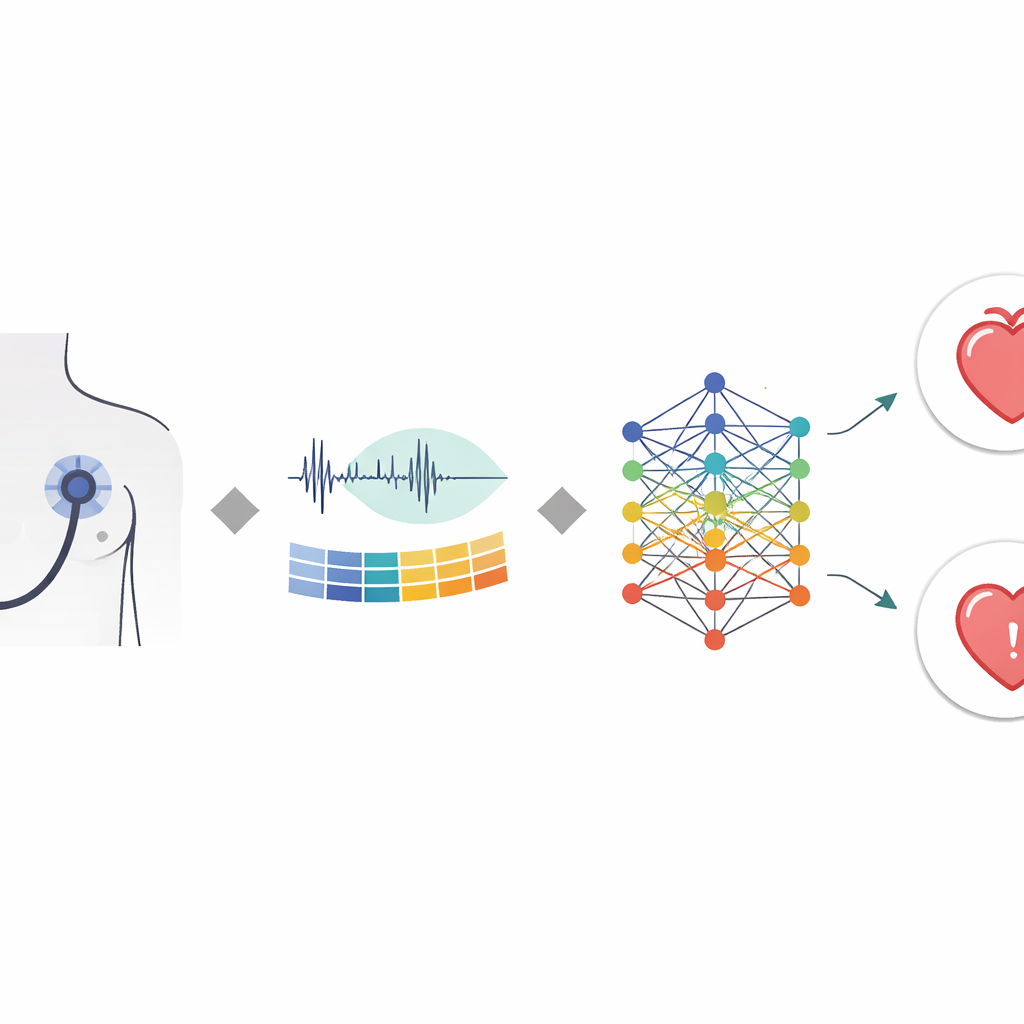
Balancing Rare Murmurs and Learning Over Time
In real clinics, recordings of healthy hearts are far more common than those with serious problems. If a computer learns mostly from normal beats, it may simply label everything as normal and still appear accurate on paper. To avoid this trap, the team uses a technique that creates carefully crafted synthetic examples of the rarer murmur patterns, evening out the training set without copying data. Just as important, they use a type of neural network designed to understand sequences over time, allowing the system to pay attention to how sounds evolve across each heartbeat rather than treating every instant in isolation. Together, these choices help the model become both sensitive to abnormalities and resistant to noise and variability between patients.
Testing Fairly and Avoiding Hidden Shortcuts
A common problem in medical AI is “data leakage,” where the same patient’s recording accidentally influences both training and testing, making performance look unrealistically good. The authors tackle this head‑on by splitting their data at the recording level in one dataset and at the patient level in another, ensuring that no segment from the same person appears in both sets. They evaluate their system on two large, public heart‑sound collections that differ in how common murmurs are and how varied the recordings can be. Across both, the model correctly distinguishes normal from abnormal heart sounds in about 99 out of 100 cases, with very few missed problems and few false alarms. Additional checks that reshuffle the data in multiple ways show that this strong performance is stable, not a fluke of one lucky split. 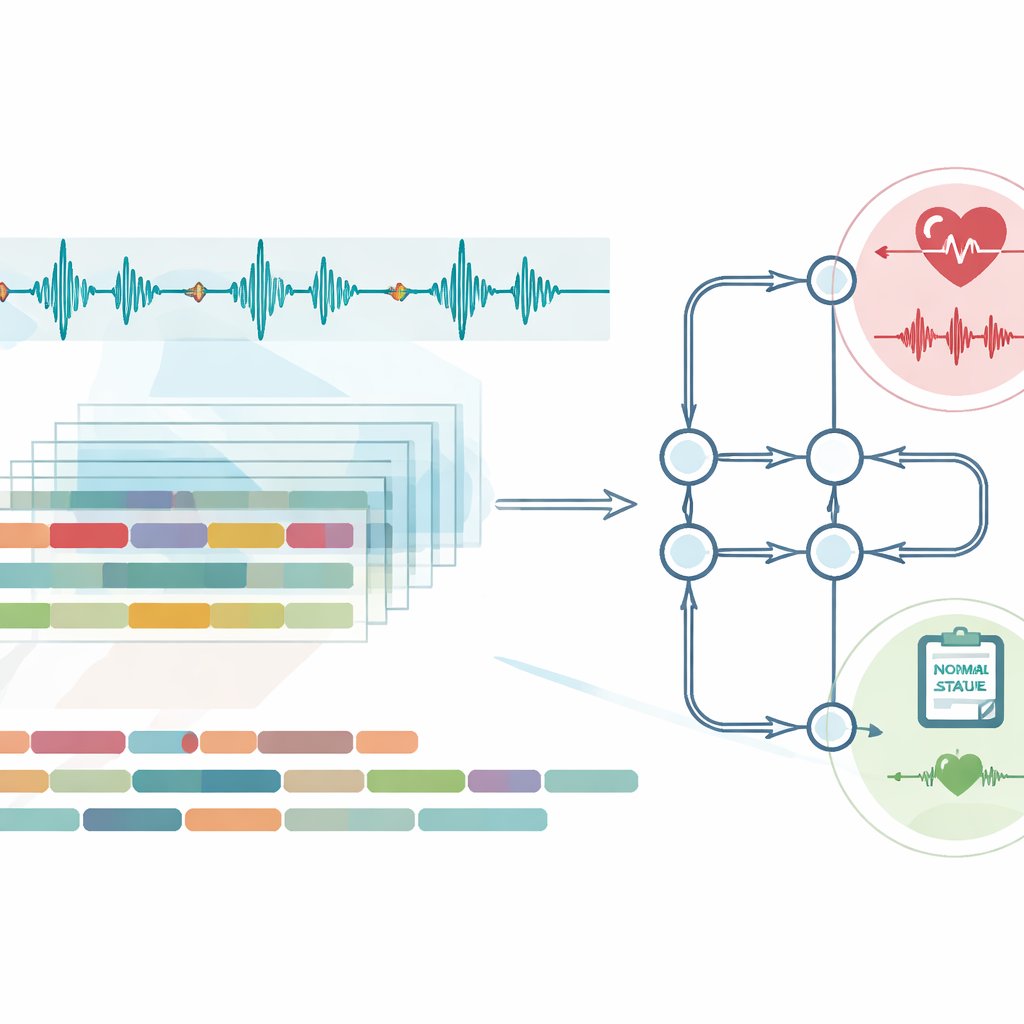
What This Could Mean for Everyday Care
The study shows that carefully designed listening algorithms can match or surpass many earlier approaches for automatic murmur detection, even under stricter and more realistic testing rules. By respecting the natural timing of heartbeats, balancing rare but crucial cases, and guarding against hidden shortcuts in the data, the authors demonstrate a robust blueprint for future digital stethoscopes. While more work is needed to handle noisy real‑world environments and to make the system’s decisions easier for doctors to interpret, this framework points toward a future where a small sensor and a smart model could help frontline clinics catch dangerous heart problems early, no matter where patients live.
Citation: Ameen, A., Eldesouky Fattoh, I., Abd El-Hafeez, T. et al. Advancing cardiovascular screening: deep learning-based heart-sound classification using SMOTE and temporal modeling. Sci Rep 16, 12063 (2026). https://doi.org/10.1038/s41598-026-45276-9
Keywords: heart murmurs, digital stethoscope, deep learning, cardiovascular screening, heart sound analysis