Modern artificial intelligence systems powered by deep neural networks are now trusted to spot pedestrians for self-driving cars, recognize faces in photos, and help doctors read medical scans. Yet these systems have a surprising weak point: tiny, carefully crafted changes to an image—imperceptible to us—can cause them to make wildly wrong predictions. The study in this paper tackles that vulnerability, showing a new way to build such “adversarial” images that can trick many different models at once, offering both a sharper warning about AI security and a powerful tool for stress‑testing future systems.
How attackers trick neural networks today
Most existing attack methods work by nudging each pixel in the direction that most increases a model’s usual training loss. When attackers know everything about the model—its structure and parameters—this “white‑box” strategy is very effective. But in the real world, we usually face a “black‑box” model deployed by a company or hospital, where internal details are hidden. To attack it, one must craft adversarial images on a surrogate model and hope they also fool the hidden system, a property called transferability. Standard gradient‑based tricks often overfit the surrogate: they exploit quirks of that one model’s decision boundary, so their success drops sharply when the same images are sent to different architectures or to models hardened by defensive training.
Looking at what the model is paying attention to
The authors start from a simple but powerful observation: different neural networks trained on the same dataset tend to “look” at similar parts of an image when making the same prediction. This internal focus can be visualized as a heatmap showing which pixels contribute most to a decision—a sort of machine attention map. Even when architectures differ, these attentional patterns are strikingly alike for the same input and label. The paper formalizes this shared pattern as the Attentional Semantic Property (ASP), a quantitative description of how strongly each pixel supports a particular category. Instead of treating attention maps as just a visualization tool, the authors turn ASP itself into an object that can be directly optimized.
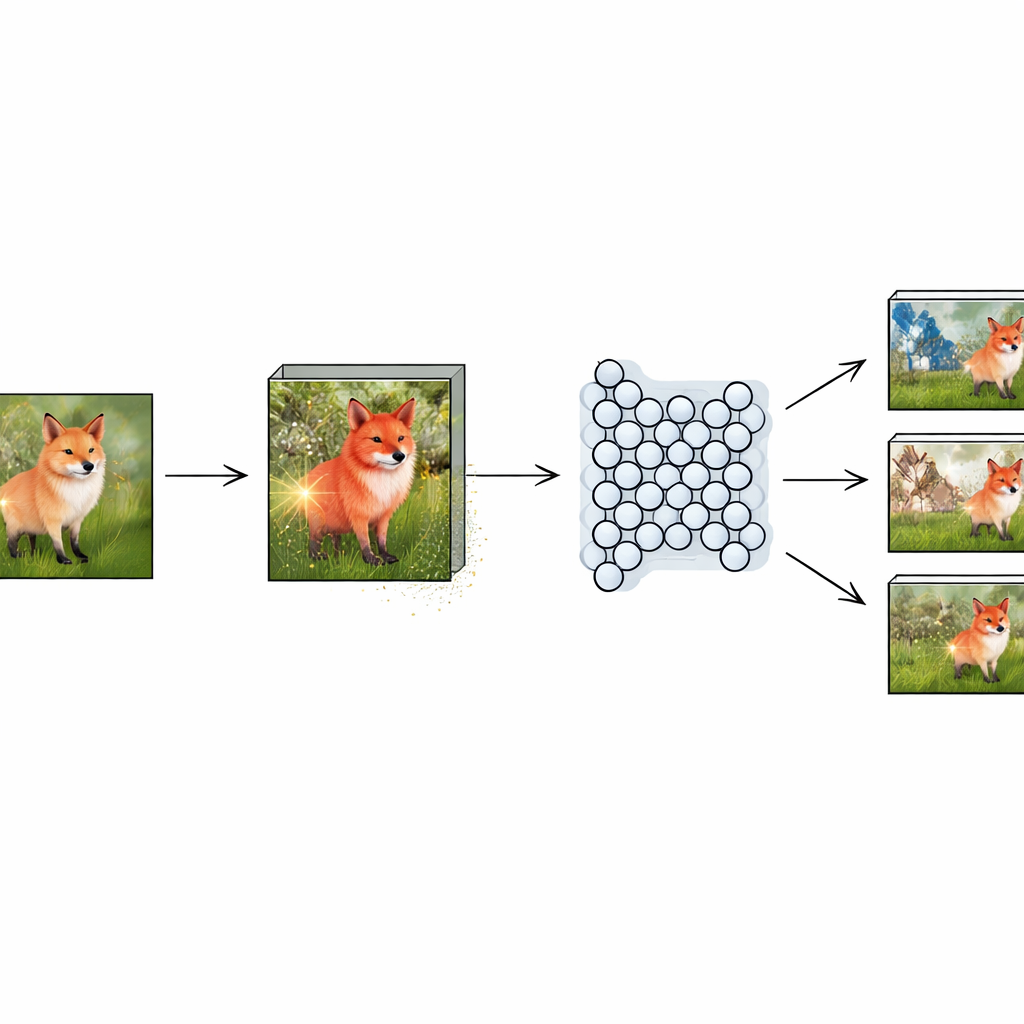
Destroying shared meaning instead of chasing labels Figure 1.
Building on this idea, the paper introduces the Attentional Semantic Attack (ASA). Rather than pushing an image to increase the usual classification loss, ASA searches for tiny pixel changes that specifically distort the ASP. The attack aims to reduce the attention devoted to the true class while increasing attention for some other, incorrect class. To avoid overfitting a single alternative label, ASA often chooses that other class at random during each optimization step, forcing the perturbation to disrupt more general patterns of evidence instead of merely swapping the top two predictions. Technically, ASA computes pixel‑wise relevance maps using a method called Layer‑wise Relevance Propagation, then defines loss functions that measure how similar or different these maps are before and after perturbation. Iteratively following the gradient of this attention‑based loss yields “attentional perturbations” that reshape what multiple models consider important in the image.
Measuring and comparing the damage
To test their method, the authors generate adversarial images on one well‑known model and evaluate them on a dozen others, including standard convolutional networks, models hardened with adversarial training, and modern vision transformers. Across extensive ImageNet‑based experiments, ASA consistently achieves higher attack success rates than a wide range of competitors that rely on clever gradient tweaks, input transformations, or intermediate feature manipulation. The paper also proposes a new way to quantify how “strong” an attack is, called Label Confidence Change (LCC). Instead of just asking whether the predicted label flips, LCC measures how much the model’s confidence in the original correct class drops. High LCC signals that the image has been deeply corrupted in a way that is more likely to transfer to unseen models, and ASA’s samples show notably larger LCC than rival methods.
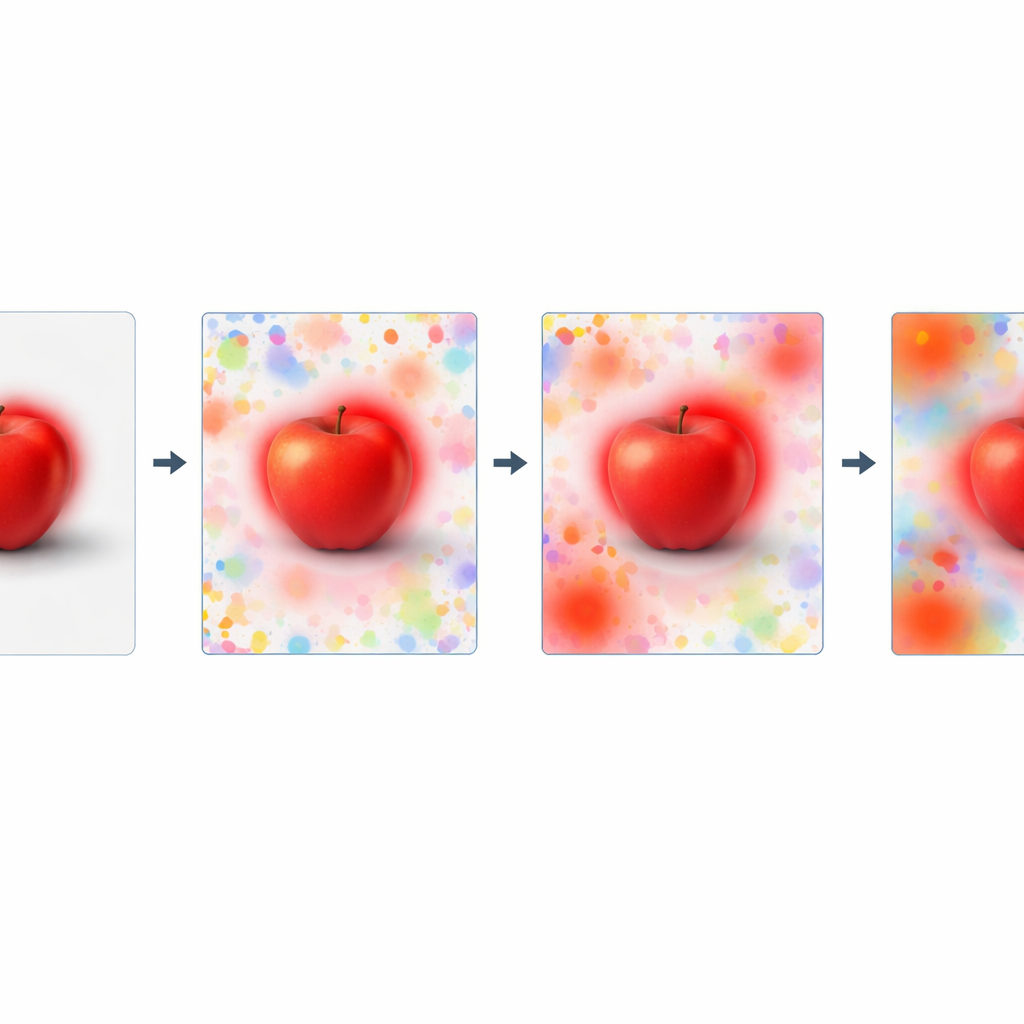
Peering inside the attack mechanism Figure 2.
Visual comparisons of attention heatmaps help explain why ASA transfers so well. Under traditional attacks, the bright focus regions inside the network shift only slightly as iterations proceed, even when the final prediction is wrong; the model’s basic notion of where the object is remains intact, which limits how broadly the perturbation generalizes. Under ASA, repeated application of attentional perturbations radically rewires these maps: attention drains away from the true object and migrates to background areas or irrelevant structures. This wholesale rearrangement of internal focus appears in both ordinary and robust models, and can be strengthened further by combining ASA with existing enhancement tricks such as random input resizing or ensembles of source models.
What this means for safer AI
In plain terms, the paper shows that today’s vision systems share a common “sense of meaning” about what matters in an image—and that carefully targeted noise can scramble that shared meaning across many different models at once. By directly attacking attention rather than only the final label scores, ASA produces adversarial images that are harder for current defenses to shrug off and more reliable for stress‑testing real‑world systems. For defenders, this underscores that protecting AI will require guarding not just the outputs but also the internal pathways of attention that underpin a model’s understanding of the world.
Citation: Wang, P., Liu, J. Attentional semantic attack for enhancing adversarial samples transferability.
Sci Rep16, 10957 (2026). https://doi.org/10.1038/s41598-026-45207-8