Clear Sky Science · en
Study on the impact of industrial intelligence and the digital economy on China’s regional total factor carbon productivity under carbon neutrality
Why smarter industry matters for climate and wallets
As the world races to curb climate change, a central question looms: can countries cut carbon emissions without slowing economic growth? This study looks at China’s answer to that puzzle. It examines how two powerful trends—industrial intelligence (things like smart factories and robots) and the fast-growing digital economy—shape how much economic value China produces for each unit of carbon dioxide it emits, a concept the authors call total factor carbon productivity. Their findings reveal not just whether these technologies help, but how their benefits ripple across regions in very different ways.

Measuring more growth with less carbon
To understand whether China is getting greener while growing richer, the authors track total factor carbon productivity (TFCP) across 30 provincial-level regions from 2010 to 2023. Unlike simple measures such as “emissions per unit of GDP,” TFCP considers capital, labor and energy inputs alongside both economic output and carbon emissions. Using an efficiency tool commonly applied in economics, they compare each region against a best-practice frontier: provinces that generate more economic output with less carbon, given similar inputs, score higher. The result is an index showing who is leading—and who is lagging—in producing prosperity with fewer emissions.
Uneven progress across China’s map
The study finds that China’s overall TFCP rose steadily over the 13-year period, helped by rising environmental awareness and policy attention. But this progress is far from evenly shared. Eastern provinces, many of them coastal and more developed, consistently outperform the national average. Central provinces sit in the middle, while western regions trail behind, widening a pattern the authors summarize as “higher in the east, lower in the west.” Statistical tests show that neighboring regions tend to resemble one another: high-productivity areas cluster together, as do low-productivity ones. That spatial clustering means what happens in one province often affects its neighbors, making carbon productivity a regional, not just local, challenge.
How digital tools and smart factories change the game
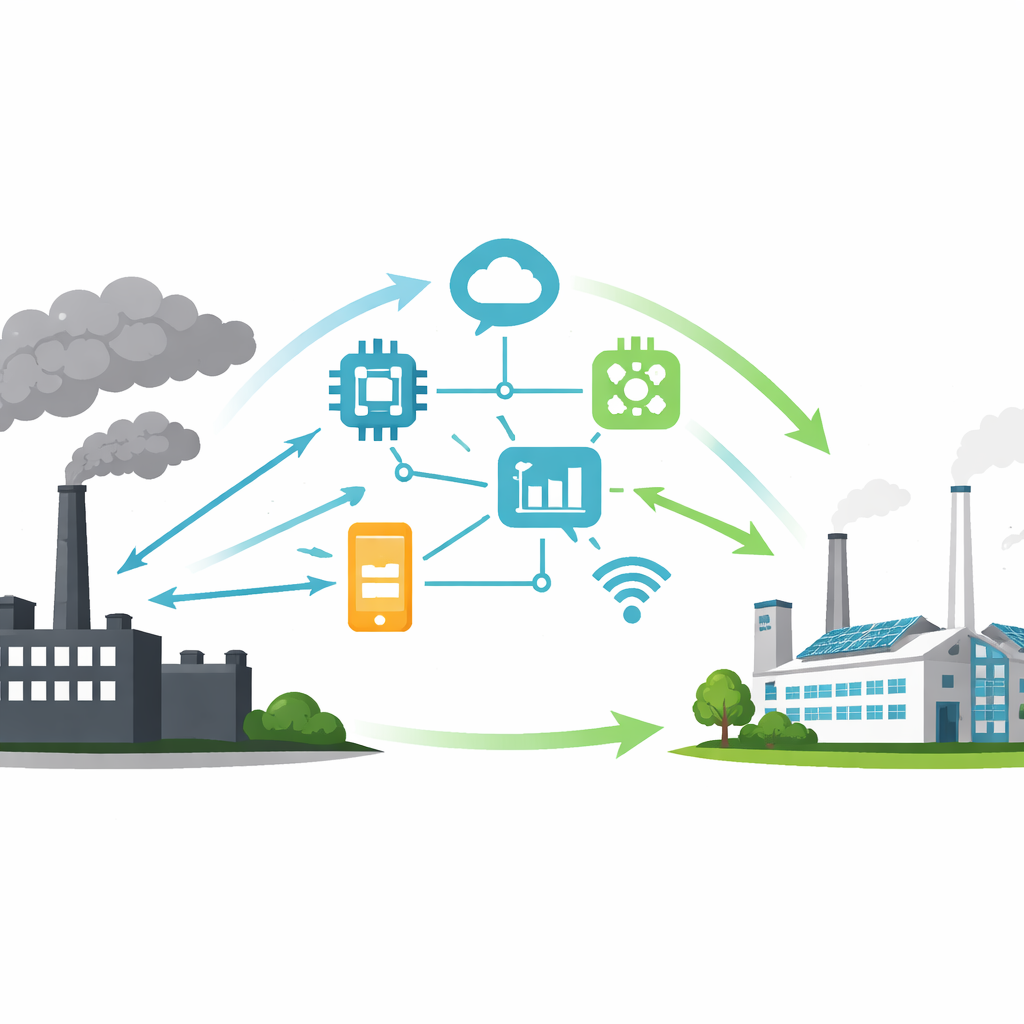
Central to the paper is how industrial intelligence and the digital economy act as “dual engines” for greener growth. The digital economy—built on data, networks, software and online platforms—shows a strongly positive effect. Regions with stronger digital sectors not only improve their own TFCP but also lift nearby areas through technology spillovers, supply-chain links, mobile talent and imitation effects. Industrial intelligence has a more nuanced pattern. Locally, its short-term effect can be slightly negative, because early adoption of smart equipment and systems demands hefty investment and often raises energy use before efficiencies fully materialize. Yet across space, its influence is clearly positive: know‑how, smart production methods and cleaner industrial practices spread along industrial chains, pushing neighboring provinces toward higher carbon productivity. Overall, those positive spillovers outweigh the initial local costs.
Different regions, different pathways
When the authors zoom in by region, a rich picture of contrasts emerges. In the east, industrial intelligence temporarily drags on local TFCP—firms bear the costs of early, large‑scale upgrades—but its benefits strongly spill over to surrounding areas. Here, the digital economy is a powerful double engine, boosting both local and neighboring productivity. In central China, smart manufacturing clearly helps the provinces that adopt it, but weak cross-regional links limit spillovers; the digital economy mainly works as a local driver. In the west, both smart industry and digital activity remain relatively underdeveloped, so direct gains are modest. Yet these provinces benefit strongly from inflows of technology, talent and digital services from the east and center, making spillovers the main source of their green progress.
Other forces that can help or hurt
The study also examines traditional economic factors. A heavy reliance on coal and a secondary‑industry‑dominated economic structure both sharply undermine TFCP, and their negative effects reach beyond provincial borders through traded energy and relocated heavy industry. Green finance—loans, bonds, funds and rights trading tied to environmental projects—shows only weak, statistically insignificant benefits so far, suggesting it is still too small or poorly targeted to shift productivity at scale. Foreign direct investment offers a mixed picture: while it can modestly improve local efficiency, it often shifts pollution‑intensive activities to neighboring regions, echoing the “pollution haven” concern and diluting any net regional gains.
What this means for a cleaner, richer future
In everyday terms, the study concludes that smarter factories and a vibrant digital economy really can help China “do more with less carbon,” but the route is neither simple nor uniform. Digital technologies already act as a broad-based engine for greener growth, especially where infrastructure and skills are strong. Industrial intelligence behaves more like a long-term investment: it may feel costly and even counterproductive at first for the pioneering regions that adopt it, yet its climate dividends become clear when seen across provincial networks. To fully realize these gains, the authors argue, China must pair its twin engines with cleaner energy, a less coal-heavy industrial mix, stronger green finance and policies tailored to each region’s stage of development. Done well, this coordinated approach could allow China—and by extension other countries—to cut emissions without sacrificing economic momentum.
Citation: Xiao, D., Liu, J. Study on the impact of industrial intelligence and the digital economy on China’s regional total factor carbon productivity under carbon neutrality. Sci Rep 16, 14329 (2026). https://doi.org/10.1038/s41598-026-45039-6
Keywords: digital economy, industrial intelligence, carbon productivity, green development, China regional policy