Clear Sky Science · en
Flow-driven patterns of whale shark movement in the Red Sea
Why follow the world’s biggest fish
Whale sharks, the largest fish on Earth, are gentle giants that roam warm oceans in search of tiny plankton. In most places, scientists can predict where these sharks will show up by looking for cooler, nutrient rich waters packed with microscopic life. But in the Red Sea a hot, salty, nutrient poor basin their movements are much harder to explain. This study asks a simple question with big conservation stakes: how do young whale sharks find enough food in such a seemingly empty sea?
Tracking young giants across a desert sea
To answer this, researchers combined satellite tracking of 45 juvenile whale sharks with daily maps of Red Sea conditions. The sharks, each about the size of a small car, had electronic tags that reported their positions over several years. At the same time, computer based ocean models and satellite data supplied information on water temperature, currents, wind, and how deeply the surface waters mixed with deeper layers. By comparing where the sharks actually went with many simulated “ghost tracks” showing where they could have gone by chance, the team could see which features of the sea most strongly guided real shark movements.
Patterns of lingering and passing through
From these tracks, the team measured how persistently each shark moved. Straight, fast paths signaled traveling, while looping, slower paths suggested searching or feeding. A heatmap of the basin revealed that sharks tended to linger in the central and southern Red Sea, but moved more directly through the north. This pattern matches a known gradient: the southern Red Sea, fed by nutrient rich waters from the Gulf of Aden, is generally more productive than the north. Yet the sharks did not simply park in the greenest, most obviously plankton rich coastal zones. Instead, they focused on the basin’s central axis, hinting that less obvious, more dynamic features were at work. 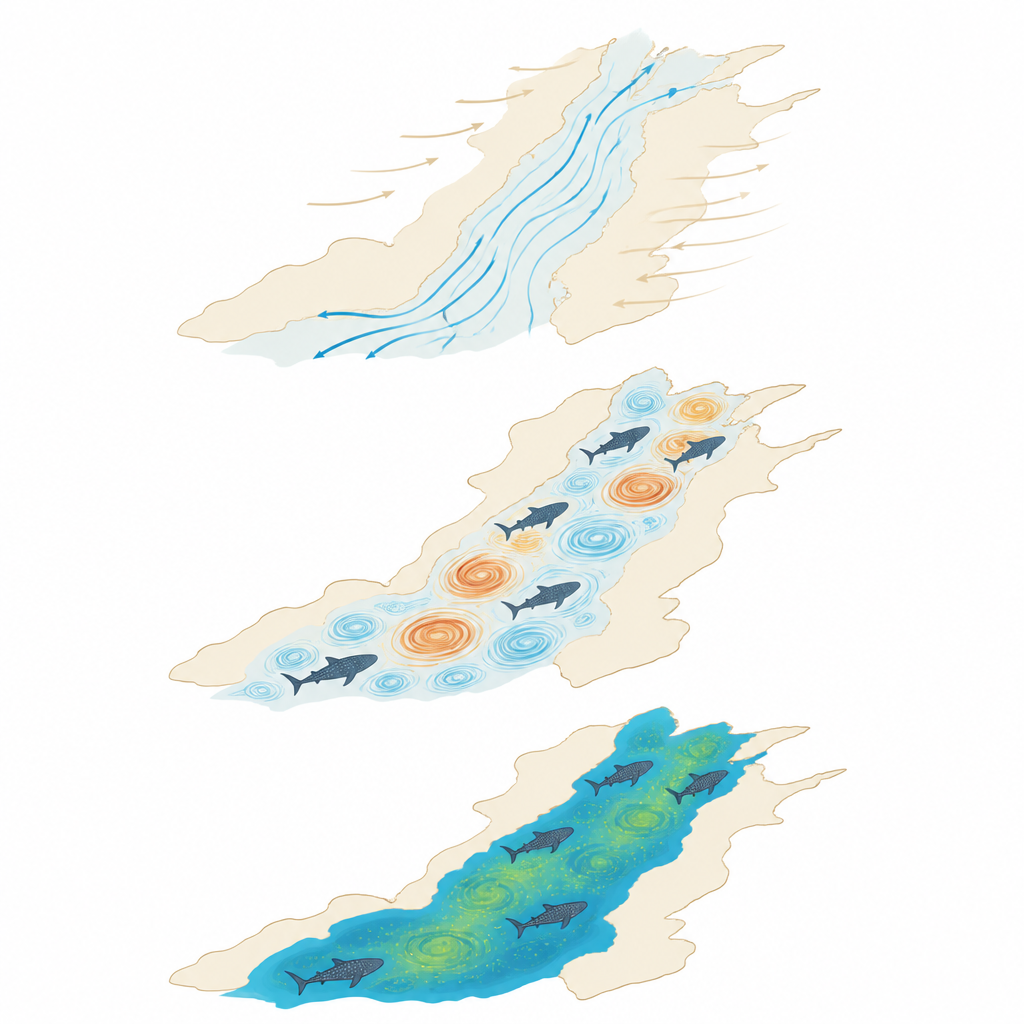
How moving water creates shark dining rooms
Using flexible statistical models, the researchers pinpointed four key environmental drivers linked to shark presence: the depth of the mixed surface layer, wind direction, sea surface temperature, and the strength of north south currents. Sharks were more likely to be found where the mixed layer was either moderately deep or very deep, where winds blew mainly from the northwest, in warmer surface waters above about 29 degrees Celsius, and in areas with stronger northward or southward flows. These conditions go hand in hand with the formation of ocean eddies swirling water masses that can lift nutrients from the depths and trap them for weeks. When the team plotted shark tracks over maps of sea surface height, a common way to spot eddies, they saw the animals repeatedly following both clockwise and counterclockwise eddies, often staying within these features for days.
Why eddies matter for hungry youngsters
In a basin with few rivers and little natural fertilization, eddies act like moving oases. Their spinning motion and associated currents pull cooler, nutrient rich water upward, deepen or thin the mixed layer, and boost the growth and retention of plankton. The study suggests that young whale sharks exploit these temporary hotspots, moving with the eddies as they drift across the Red Sea and its gateway to the Gulf of Aden. Rather than seeking fixed landmarks, the sharks appear to key in on shifting, three dimensional structures in the water itself. The exact cues they use whether subtle temperature changes, chemical traces from prey, or the feel of changing flow remain uncertain, but the behavioral link is clear. 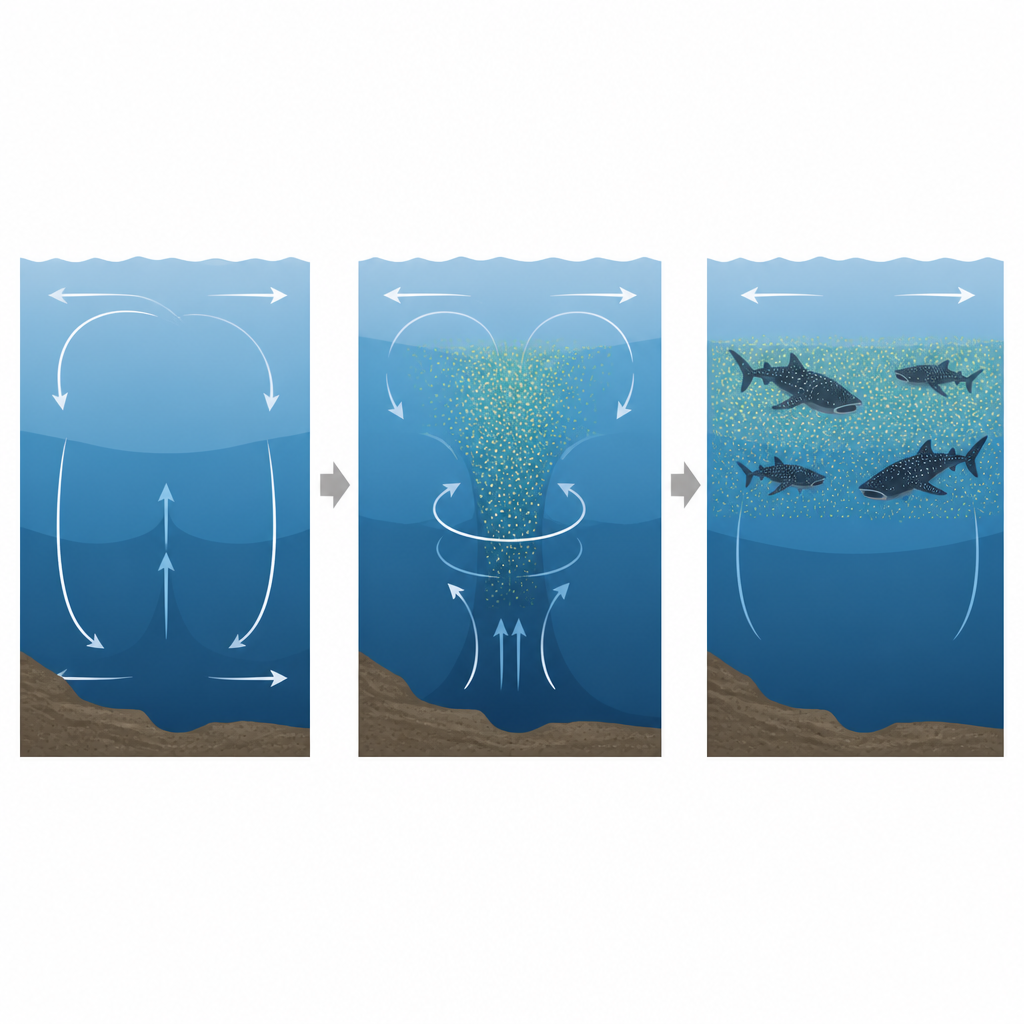
What this means for a warming ocean
For a species already listed as Endangered, understanding how whale sharks use such dynamic features is crucial. The Red Sea, often described as a natural preview of warmer future oceans, shows that whale sharks can adapt by tracking moving patches of productivity instead of relying on stable coastal feeding grounds. As climate change alters winds, currents, and the formation of eddies worldwide, these spinning structures may become increasingly important to whale shark survival. The study’s main takeaway for non specialists is simple: in an ocean that is getting hotter and less predictable, the hidden “weather” of the sea itself swirling eddies, deep mixing, and shifting winds may determine where the world’s biggest fish can still find enough to eat.
Citation: Ostrovski, R.L., Cochran, J.E., Niella, Y. et al. Flow-driven patterns of whale shark movement in the Red Sea. Sci Rep 16, 15773 (2026). https://doi.org/10.1038/s41598-026-45029-8
Keywords: whale shark, Red Sea, ocean eddies, marine movement, plankton hotspots
See more on the researcher's website: https://reefecology.kaust.edu.sa/