Clear Sky Science · en
High-resolution assessment of wind energy resources over the Arabian Peninsula
Winds that keep the lights on
The Arabian Peninsula faces intense heat, fast-growing cities, and heavy demand for air conditioning and desalination. Meeting this demand with cleaner power is a pressing challenge. This study looks upward, asking how much of that energy could come from the wind. By mapping winds high above the ground in fine detail, the authors show where strong, steady breezes can reliably spin turbines and where calm spells or rare storms might get in the way.
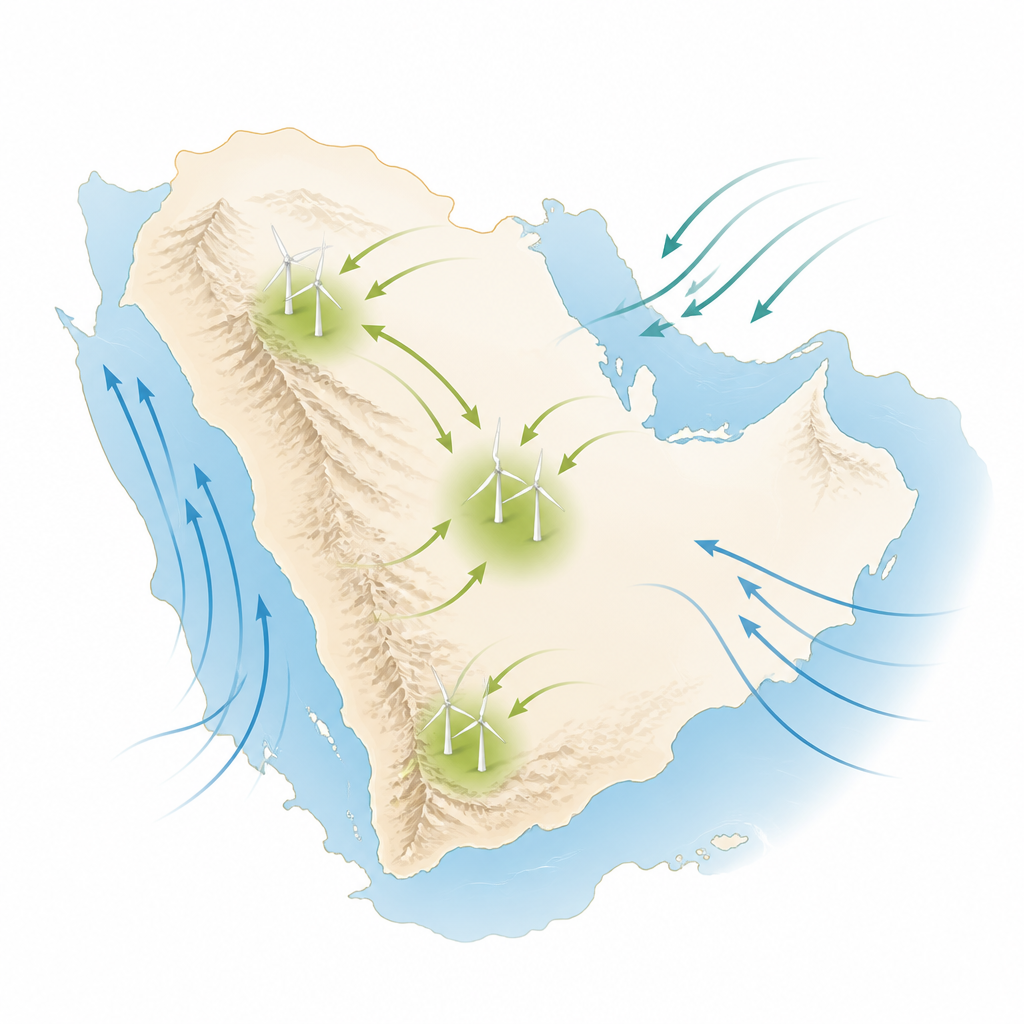
Taking a closer look at desert winds
To answer these questions, the researchers built a high-resolution picture of the atmosphere over the Arabian Peninsula and its nearby seas for the years 1980 to 2019. They used a weather model that covers the region in 5 kilometer grid boxes and directly simulates wind at the height of modern turbine hubs, about the height of a 30 story building. They checked these simulated winds against measurements from tall masts scattered across Saudi Arabia. Along the Red Sea coast, in particular, the agreement was strong, giving confidence that the model can capture real wind behavior over complex terrain and coastlines.
Where the wind blows hardest
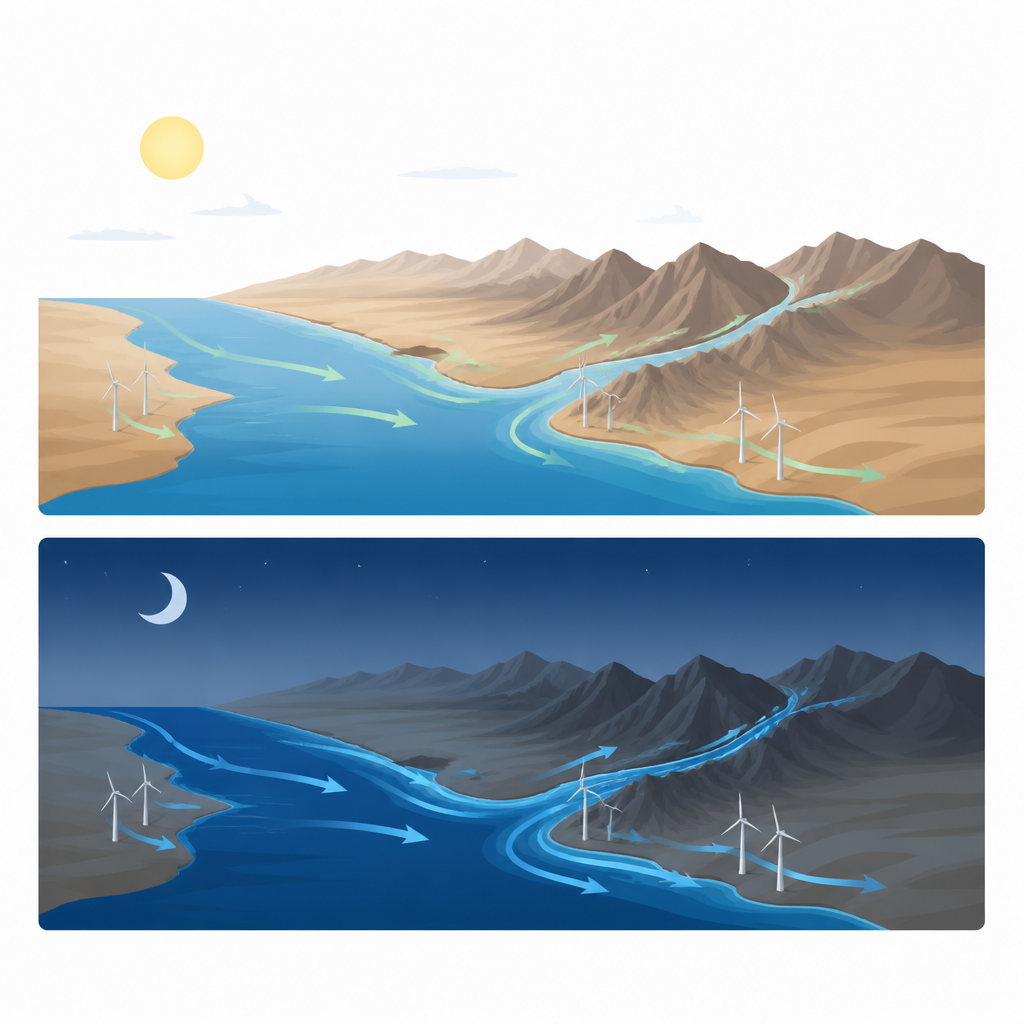
The team found that winds at turbine height change with both season and time of day. Summer stands out as the windiest season across much of the region, especially over central western Saudi Arabia, the Red Sea, and the Arabian Gulf. At night, winds often strengthen over land and sea, while daytime heating tends to stir the air and slow the flow at turbine height. Narrow mountain gaps and steep coastlines act like natural wind tunnels, channeling stronger jets of air. One of the most important of these is the Tokar Gap on the African side of the southern Red Sea, which sends powerful winds across the water toward Saudi Arabia during summer nights.
Calm spells and power-rich hours
Not all winds are useful for power generation. The authors sorted every hour into four simple groups: winds too weak to turn turbines, moderate winds, strong winds that let turbines run at full output, and very strong gusts that would force shutdown for safety. Over the western coastal plains of Saudi Arabia, weak wind hours dominate, limiting the value of offshore projects there. In contrast, the northern and central Red Sea, parts of the Gulf of Aqaba, the Suez Canal region, and central western Saudi Arabia see many hours of strong, power-rich winds in summer. Extreme gusts that could damage turbines are rare across the entire peninsula, which makes the region attractive from a risk standpoint.
How much energy the wind can deliver
Using power curves from two modern onshore turbine designs, the study translates wind speeds into a capacity factor, a measure of how fully a turbine is used over time. Both turbine types show similar patterns: the best conditions cluster along the northern Red Sea, the Suez Canal, and selected inland mountain regions, with moderate potential across central Saudi Arabia and weaker potential along the far southwest coast and southern Arabian Gulf. When the authors estimate how much electricity could be generated if turbines were spaced across suitable land, they find that the theoretical wind power potential over Saudi Arabia alone far exceeds its current annual electricity use, even after accounting for the spacing needed to avoid turbines blocking each other’s wind.
Changing winds in a warming world
The study also looks at how winds have shifted over recent decades. In summer, winds at turbine height have weakened over the northern Red Sea and the northeastern part of the peninsula but strengthened over the central and southern Red Sea and southern Saudi Arabia. These changes line up with shifts in large-scale pressure patterns tied to the Indian summer monsoon: as a key high pressure system over the eastern Mediterranean weakens, some wind corridors lose strength while others gain it. Where winds have slowed, calm periods have become more frequent; where winds have intensified, hours of strong, power-generating flow have increased.
What this means for future clean power
For readers concerned with climate, energy bills, or regional stability, the results offer a hopeful but nuanced message. The Arabian Peninsula holds enough wind to supply a large share of its electricity needs, especially if planners focus on hotspots like the northern and central Red Sea, the Gulf of Aqaba, the Suez Canal, and select inland highlands. At the same time, long term shifts in wind patterns and pockets of frequent calm demand careful planning. By revealing where and when the air reliably moves, this work provides a scientific map for governments and developers seeking to expand wind power while strengthening energy security in one of the world’s most climate stressed regions.
Citation: Gandham, H., Dasari, H.P., Alfadda, A. et al. High-resolution assessment of wind energy resources over the Arabian Peninsula. Sci Rep 16, 15257 (2026). https://doi.org/10.1038/s41598-026-44961-z
Keywords: wind energy, Arabian Peninsula, Red Sea, renewable power, climate change