Clear Sky Science · en
Comparative analysis of compressible solver schemes for underexpanded jet aerodynamics with Schlieren validation
Why fast gas jets matter
From rocket nozzles to industrial vents and even volcanic eruptions, high-speed gas jets shape how thrust, noise, and heat spread into the surrounding air. Predicting exactly how these jets behave is tricky, because waves of compressed and expanded gas form intricate patterns that standard computer tools struggle to track. This study asks a practical question: can a cheaper type of computer solver, usually reserved for slower flows, handle these demanding jet problems without losing accuracy?
Two different ways to solve the same flow
Engineers often rely on computational fluid dynamics (CFD) to explore designs before building them. For high-speed gas flows, a “density-based” solver has been the traditional choice, because it is tailored to handle rapid changes in pressure and density around shock waves. A “pressure-based” solver, in contrast, is widely used for low-speed, nearly incompressible flows and is known for being more economical. In recent years, some researchers have reported that pressure-based solvers can also work well at higher speeds, but their performance for strongly underexpanded jets – where gas leaves a nozzle at much higher pressure than the surrounding air – has remained uncertain.
Building a lab jet and taking pictures of invisible waves
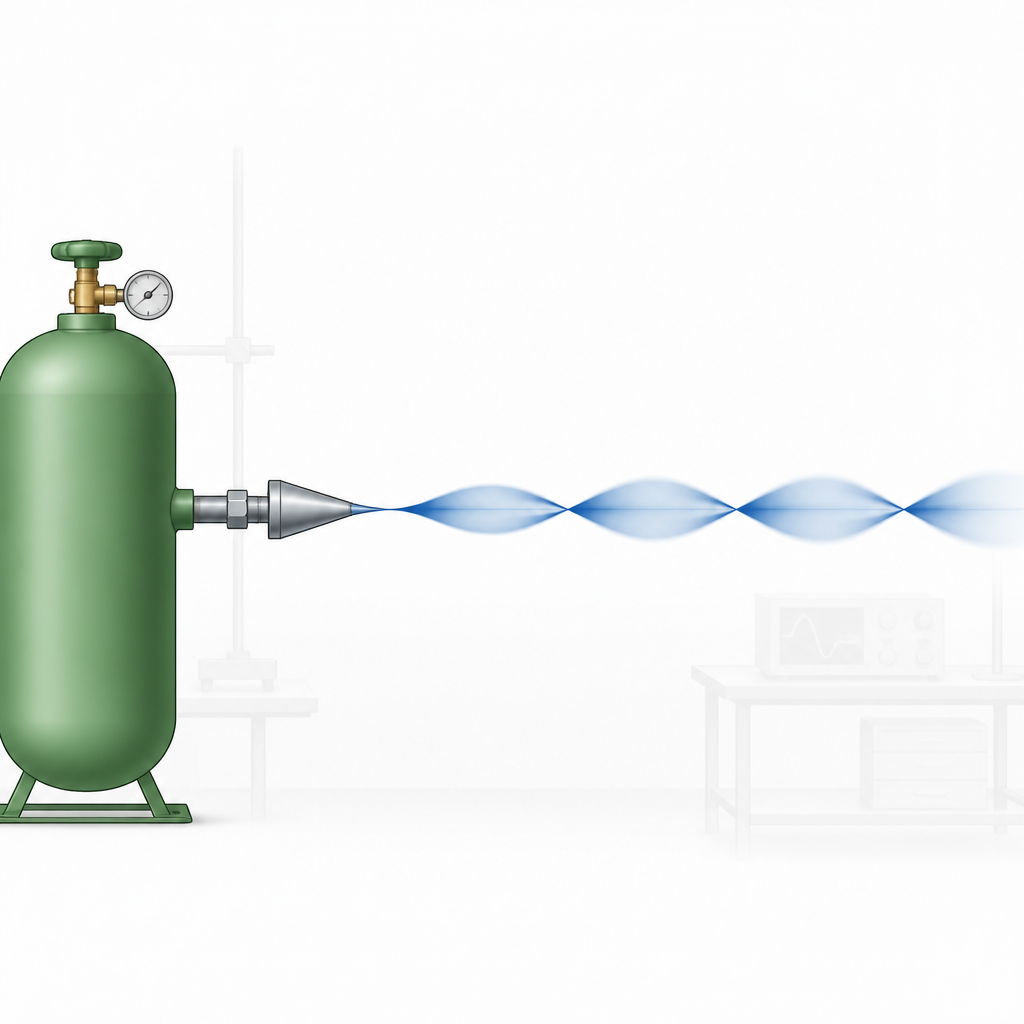
To test both approaches fairly, the authors constructed a simple but carefully controlled experiment. Compressed air was released from a cylindrical storage tank through a small converging nozzle into still room air. By adjusting the supply pressure, they set four pressure ratios between the tank and the atmosphere, from just above the “choked” condition, where gas exits the nozzle at the speed of sound, up to clearly underexpanded jets with strong shock patterns. To see these otherwise invisible structures, they used a Schlieren optical setup: a bright point light, a concave mirror, a razor blade, and a digital camera arranged so that tiny changes in air density show up as bright and dark bands. These images provided a visual map of the shock cells forming downstream of the nozzle.
Putting the computer models to the test
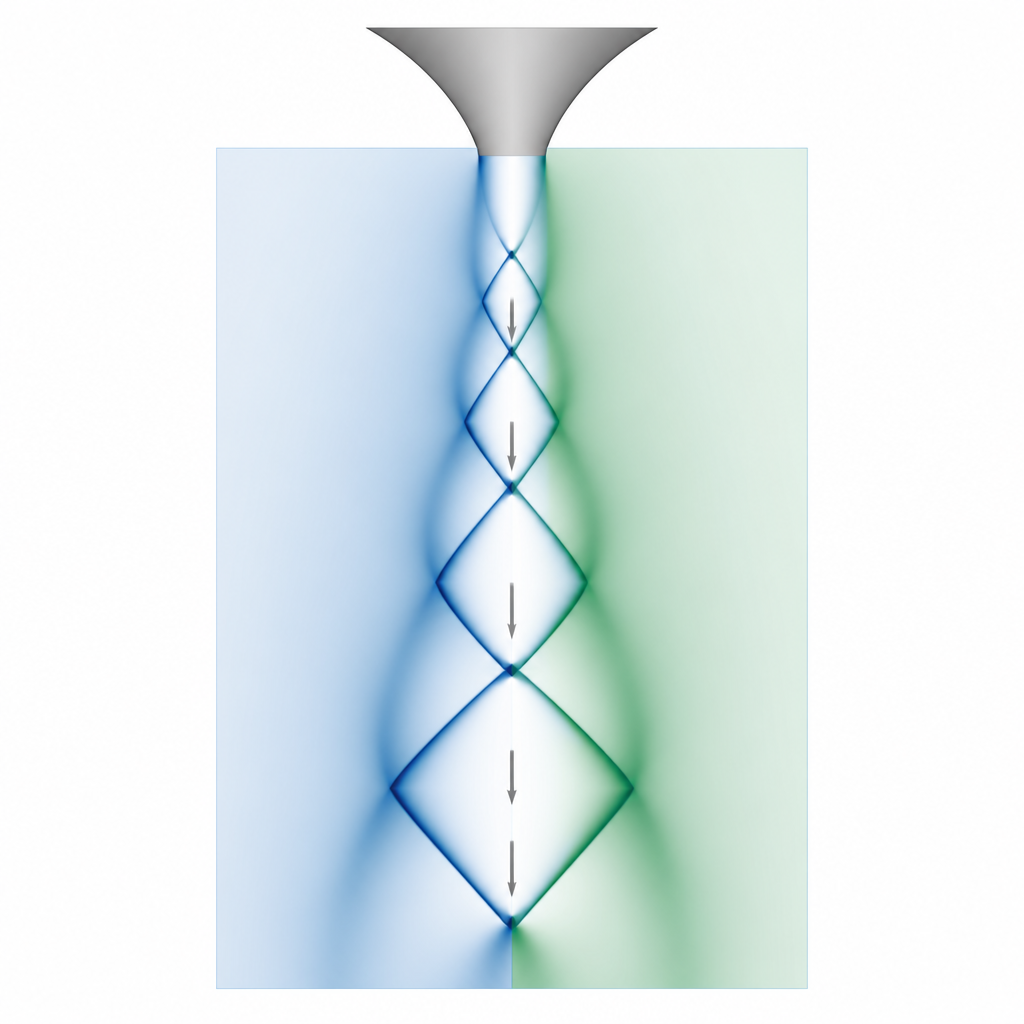
In parallel, the same nozzle and flow conditions were recreated in the CFD code ANSYS Fluent. The researchers used identical meshes, boundary conditions, and turbulence models for both solvers, changing only the core solution scheme. They tracked pressure, speed, and turbulence along and around the jet, and checked how quickly each solver converged to a stable answer. Both tools reproduced key features: the formation of a potential core at the choked condition, the appearance of diamond-shaped shock cells once the jet became underexpanded, and the way these cells grew longer and stronger as the pressure ratio increased. The first major shock, known as the Mach disk, appeared at nearly the same locations in both simulations and in published experimental data, with only a few percent difference in peak speed.
Where the solvers agree and where they differ
Along the jet centerline, the two solvers produced nearly identical oscillations in pressure and Mach number, reflecting the repeated pattern of compression and expansion. Differences emerged farther downstream, where the jet had slowed to subsonic speeds and turbulence dominated. There, the density-based solver tended to predict higher turbulent kinetic energy than the pressure-based solver, in line with known limitations of density-based schemes at low speeds. Despite this, both solvers gave almost the same discharge coefficient, a measure of how effectively the nozzle passes mass flow, with differences of less than 0.2 percent. In terms of computational effort, the pressure-based solver reached the same tight convergence target in about 22 percent less CPU time.
What this means for real-world designs
For engineers who need to simulate high-speed jets from relatively simple nozzles, this study offers reassuring news. A pressure-based solver, though originally designed for slower, incompressible flows, can capture the main shock patterns and performance metrics of underexpanded supersonic jets with accuracy comparable to a more specialized density-based solver, while using less computing time. The authors caution that density-based schemes still have advantages in some regimes, especially where very strong shocks and complex chemistry are involved. But for many practical nozzle problems, the lower-cost pressure-based approach can be a reliable choice, helping designers explore more options without a prohibitive simulation bill.
Citation: Alsaedi, S.S., Al-Sadawi, L.A., Al-Haddad, L.A. et al. Comparative analysis of compressible solver schemes for underexpanded jet aerodynamics with Schlieren validation. Sci Rep 16, 15724 (2026). https://doi.org/10.1038/s41598-026-44651-w
Keywords: underexpanded jet, supersonic nozzle, Schlieren imaging, CFD solver, shock waves