Clear Sky Science · en
Prediction model of lost circulation based on drilling parameters with PSO-BP neural network
Why keeping drilling mud in the hole matters
When companies drill deep into the earth for oil and gas, they rely on heavy mud to keep the well under control. If that mud suddenly vanishes into cracks in the rock, operations must stop, costs soar, and dangerous events like well blowouts become more likely. This paper describes a new way to spot those losses early, using a smart computer model that learns from real drilling data and can warn engineers before small problems turn into serious accidents.
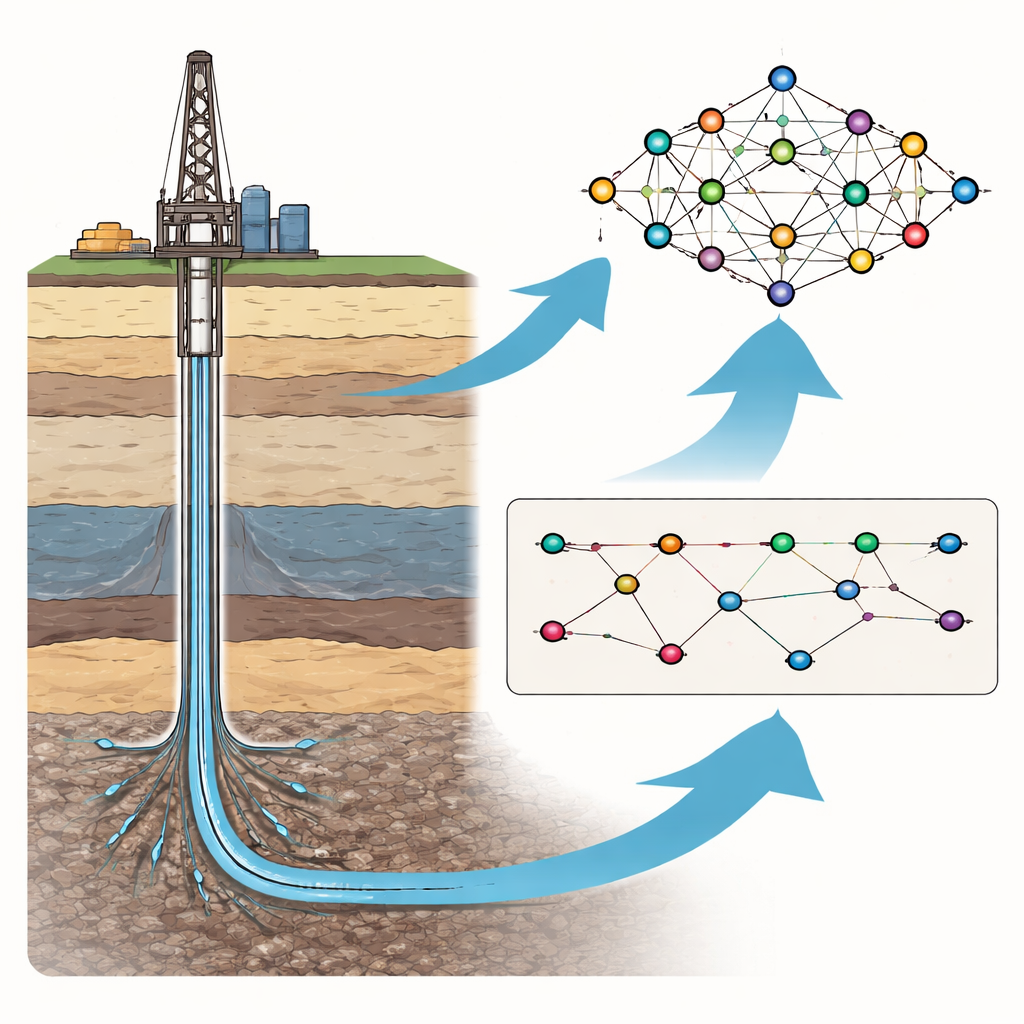
What it means when the well starts to drink
During drilling, pumps send mud down the drill pipe and back up the space between the pipe and the rock, carrying cuttings and balancing underground pressures. Lost circulation happens when this mud escapes into the surrounding rock instead of returning to the surface. It may seep through natural cracks and pores, or force open new fractures if the mud is too heavy. Either way, the surface crew sees less mud coming back, and the well can quickly become unstable, leading to well collapse, pipe sticking, or a kick, where formation fluids rush into the hole.
Reading the mud’s vital signs
In the field, many measurements are recorded every few seconds: how much mud sits in surface tanks, how fast it flows in and out of the well, the pressure needed to push it downhole, how fast the bit drills, and how heavily the drill string is loaded. The authors show that no single reading is enough to reliably detect trouble; instead, patterns across several signals matter. Using both statistics and expert insight from drillers, they narrow a long list of parameters down to a small set that best reflects loss events: total pit volume, standpipe pressure, the difference between flow in and flow out, top drive (or hook) load, rate of penetration, mud density, and wellbore direction. Together, these act like vital signs for the well’s health.
Teaching a digital swarm to spot trouble
The team builds their warning system around a type of artificial neural network, a flexible model that can learn complex relationships hidden in data. On its own, however, this kind of network can learn slowly and get stuck in sub‑optimal solutions. To overcome this, the researchers pair it with particle swarm optimization, an algorithm inspired by flocks of birds searching for food. Each “particle” in the swarm represents one possible set of neural‑network settings. By comparing how well each set predicts past loss events, the swarm collectively moves toward better solutions. In this way, particle swarm optimization is used to tune the neural network’s internal connections before final training, making it faster and more stable.
From noisy field data to early warnings
Real drilling data are messy, with missing values, sensor noise, and occasional bad readings. The authors first clean their dataset from several wells in western China, remove outliers, encode descriptive entries, and scale all numbers into a common range so that no single variable dominates. They then analyze how strongly each parameter relates to loss incidents and keep only those that add distinct information. After training the hybrid model on dozens of recorded mud‑loss and normal intervals, they test it on new sections of wells. The model not only tracks the rise and fall of key parameters but also turns those patterns into a clear prediction of whether a loss is likely.
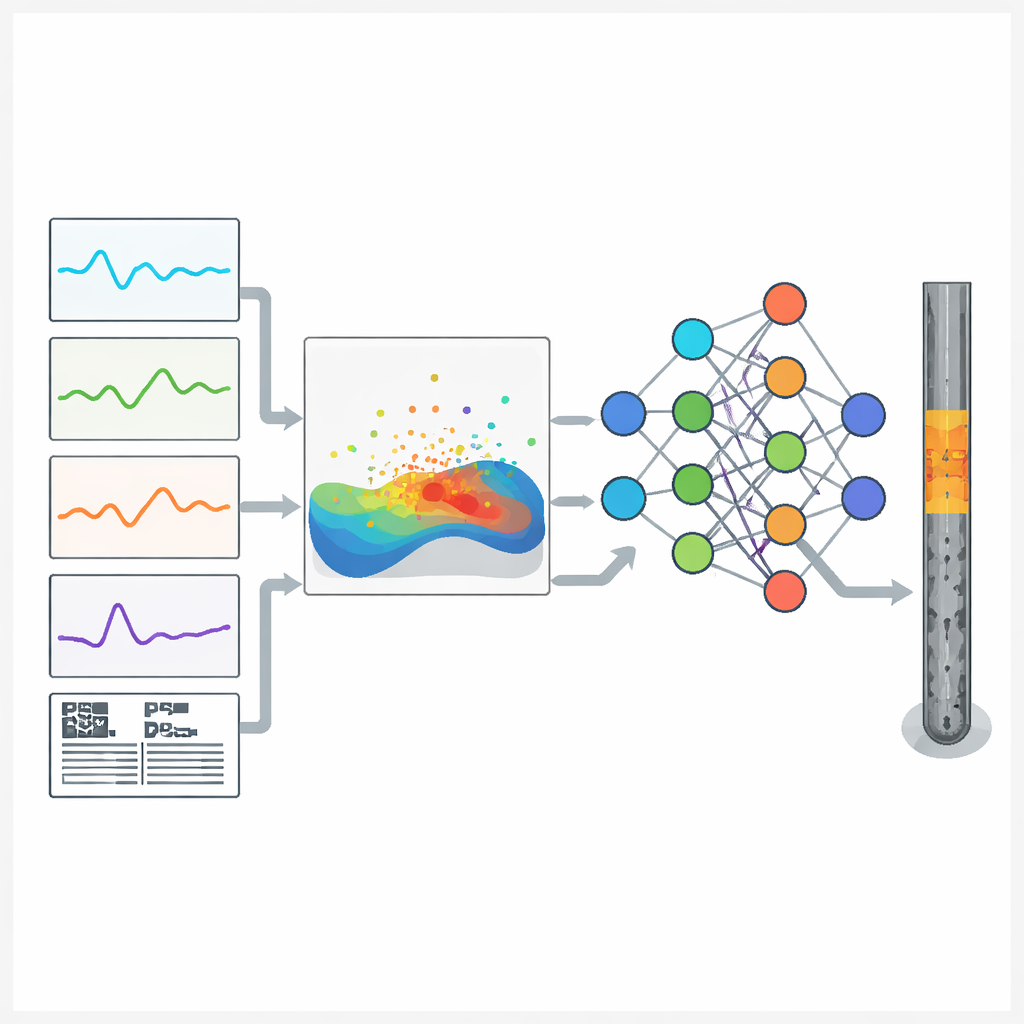
How well the smart watcher performs
To judge whether this new approach is worth using in the field, the authors compare it against several alternatives: a plain neural network, and versions tuned by two other optimization techniques. They use standard measures of error and show that the particle‑swarm‑tuned network predicts lost circulation more accurately than the others, matching real field observations with much smaller discrepancies. In test wells, the model correctly identifies zones where mud will be lost and estimates the extent of the problem, providing a useful heads‑up while drilling is still underway.
What this means for safer, cheaper drilling
In simple terms, the study shows that combining practical drilling know‑how with advanced pattern‑recognition tools can create a reliable early‑warning system for when the well starts “leaking” mud into the rock. By watching a handful of carefully chosen signals and letting a digital swarm fine‑tune the prediction engine, the method reaches high accuracy and avoids missed alarms. If built into real‑time monitoring systems, this approach could help drillers react sooner—adjusting mud properties or operating conditions before severe losses occur—reducing risk, saving time and money, and offering a template for similar safety tools in other underground and structural engineering projects.
Citation: Wang, Z., Yang, M., Du, P. et al. Prediction model of lost circulation based on drilling parameters with PSO-BP neural network. Sci Rep 16, 13976 (2026). https://doi.org/10.1038/s41598-026-44613-2
Keywords: lost circulation, drilling safety, neural network, particle swarm optimization, early warning