Clear Sky Science · en
A comparative GWAS of eye colour in light and dark eye genetic backgrounds defined by HERC2 rs12913832 polymorphism in a Canadian cohort of European ancestry
Why your eye color isn’t as simple as blue or brown
Eye color looks straightforward—blue, brown, green, hazel—but under the surface it is one of the most complex visible traits our genes produce. This study asks a deceptively simple question: why do some people have eye colors that don’t match what their “main” eye-color gene predicts? By digging into the DNA of thousands of Canadians of European ancestry, the researchers show that many other genes quietly nudge eye color lighter or darker, helping to explain why real eyes come in so many shades and rings rather than neat categories.
The usual gene rule, and its many exceptions
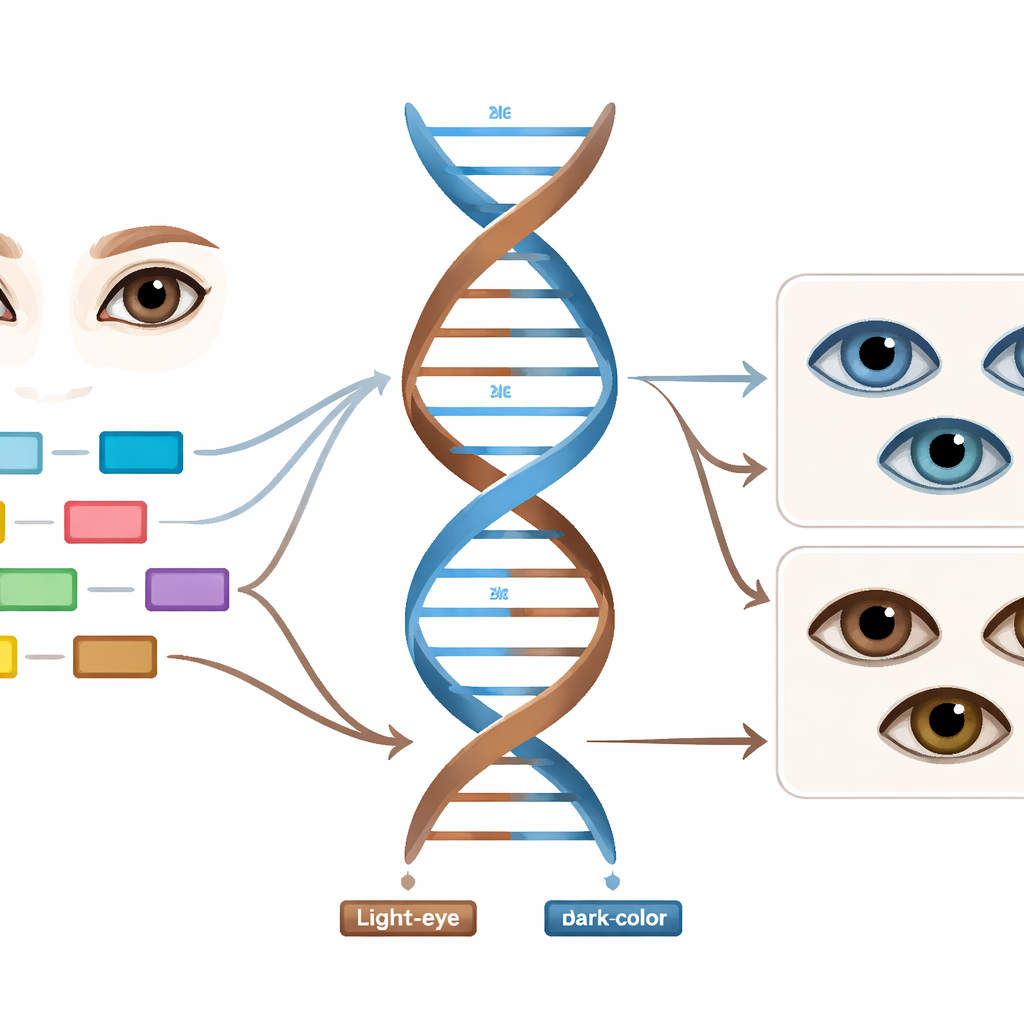
For more than a decade, a single genetic marker—called rs12913832, in a region of DNA between the HERC2 and OCA2 genes—has been treated as the master switch for blue versus brown eyes. People with two copies of one version (the G allele) are usually predicted to have blue eyes, while those with at least one copy of the other version (A) are expected to have brown or hazel eyes. Yet earlier work in a large Canadian health cohort (CanPath) revealed that one third of people with the “blue-eye” GG background reported non‑blue eyes, and nearly one fifth of those with AA or AG reported something other than brown or hazel. These mismatches hint at a larger cast of genetic players that subtly change how much pigment ends up in the iris.
Hunting for hidden eye-color modifiers
The team divided more than 5,400 CanPath participants into two groups based on this key marker: a “blue-eye background” group with the GG genotype, and a “brown-eye background” group with AA or AG. Within each group, they focused on people whose self‑described eye color went against expectations—for example, GG individuals with green or brown eyes, or AA/AG individuals with blue or green eyes. Using a genome‑wide association study, they scanned millions of genetic variants across the genome, while carefully accounting for ancestry, age, and sex. They then combined results from two different genotyping platforms, applied fine‑mapping methods to narrow down likely causal variants, and cross‑checked findings in an independent sample where high‑resolution photographs provided precise color measurements of the iris.
Genes that darken blue-eye backgrounds
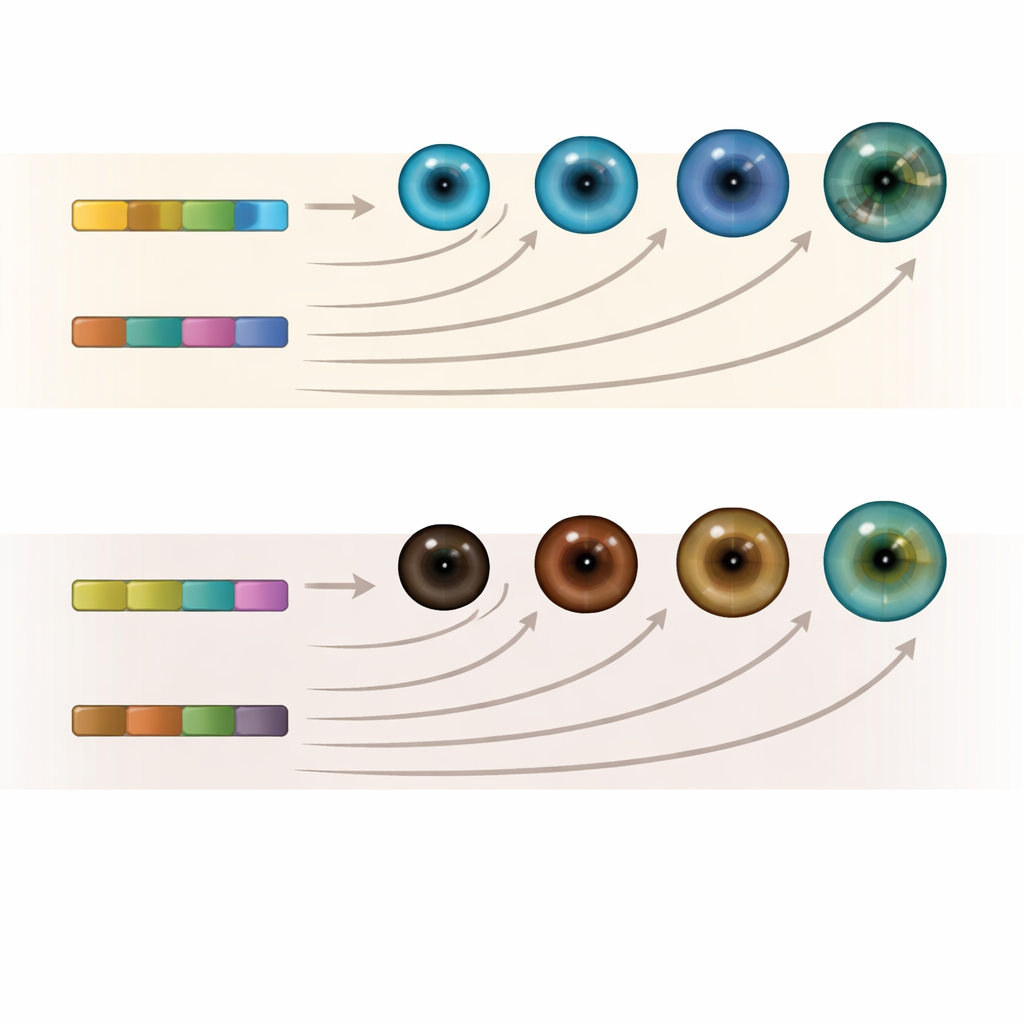
In people whose DNA strongly points to blue eyes (GG) but who report darker colors, the study highlighted variants in several pigment-related genes: SLC45A2, TYRP1, TYR, SLC24A4 and TSPAN10. These genes help build or regulate melanin, the pigment that absorbs light in the iris. Certain versions of these variants were linked to a shift from pale blue toward darker blue, green, or brown tones, effectively “overriding” the usual light-eye signal from rs12913832. Fine‑mapping singled out specific changes, such as a known functional variant in the TYR gene that alters the key melanin‑making enzyme tyrosinase. In an independent image-based dataset, several of these variants also tracked with subtle changes in measured iris color, especially along the blue‑to‑yellow color axis.
Genes that lighten brown-eye backgrounds
For people whose DNA background points to brown eyes (AA/AG) yet who report lighter shades, a different set of modifiers came to the forefront. Variants in IRF4, TYRP1, and multiple sites within the OCA2–HERC2 region were linked to lighter-than-expected eyes. Some of these changes likely reduce the activity of OCA2, a key controller of melanin production inside pigment cells, or alter IRF4, a regulator that influences pigment enzymes. Together, these shifts can draw eye color away from dark brown toward green, hazel, or even blue. In the independent replication sample, these variants were strongly associated with higher “lightness” scores of the iris and, in the case of rs12913832 itself and an IRF4 variant, with central heterochromia—eyes whose inner and outer rings differ in color.
What this means for how we see eye color
To a non‑specialist, the key message is that there is no single “eye-color gene.” Instead, one powerful switch sets a starting point, but numerous additional genes tweak how much pigment is made, how it is stored, and how it is arranged, sometimes creating rings or mixed shades that confuse simple labels. This work pinpoints specific DNA changes that darken eyes in people genetically inclined to be blue‑eyed, and others that lighten eyes in those inclined to be brown‑eyed. Beyond feeding into more accurate forensic and medical prediction tools, the study underscores that our eye color is the visible outcome of many genes working together—one reason the color you see in the mirror can be more unique than any prediction chart suggests.
Citation: Abbatangelo, C.L., Durazo, F.L., Edwards, M. et al. A comparative GWAS of eye colour in light and dark eye genetic backgrounds defined by HERC2 rs12913832 polymorphism in a Canadian cohort of European ancestry. Sci Rep 16, 14610 (2026). https://doi.org/10.1038/s41598-026-44580-8
Keywords: eye colour genetics, iris pigmentation, genome-wide association study, HERC2 OCA2, forensic DNA phenotyping