Clear Sky Science · en
A new isolated fungus Talaromyces sp. MC-F2 efficiently solubilizes phosphate through media-dependent metabolic regulation
Why locked-up plant food matters
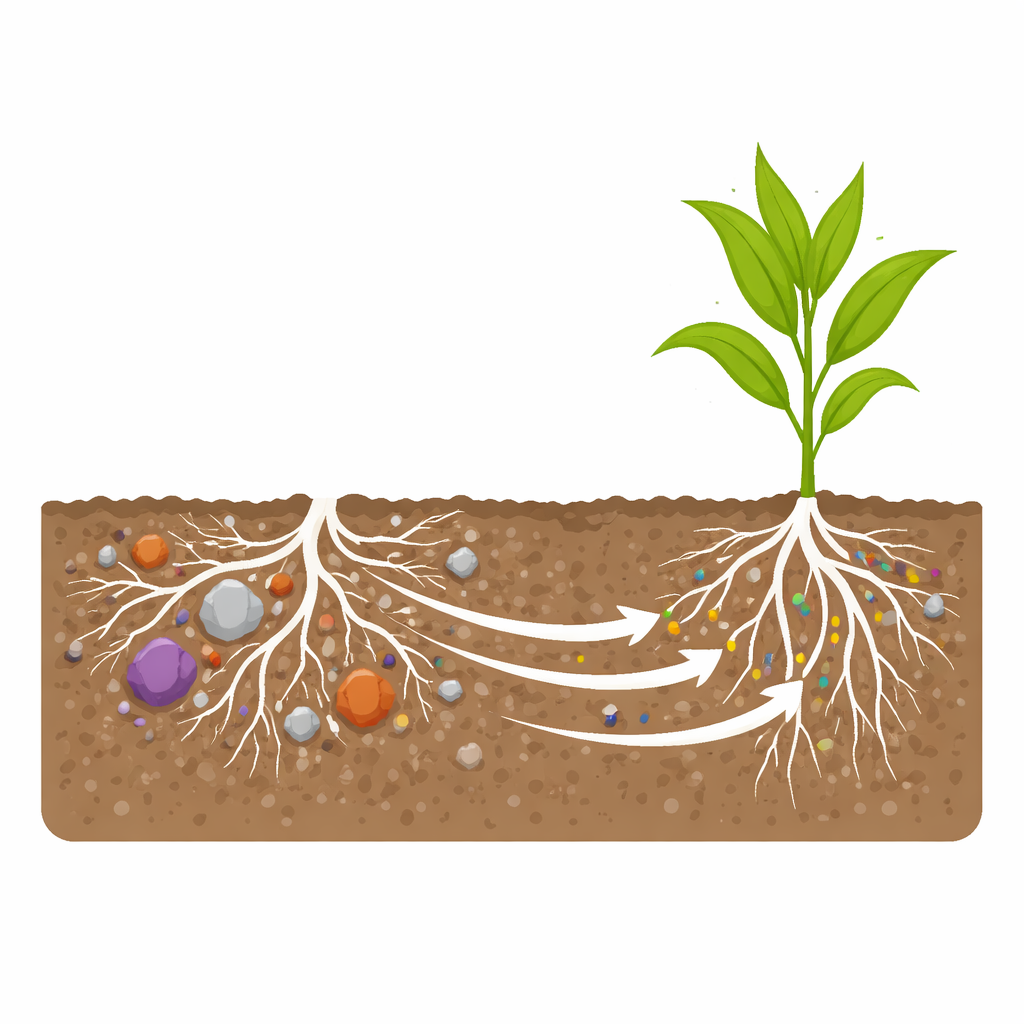
Much of the phosphorus in farm soil is trapped in hard-to-dissolve minerals that plants cannot use, even after years of fertilizer application. This wastes money, harms waterways, and leaves crops undernourished. The study described here introduces a newly discovered soil fungus that can unlock this hidden phosphorus and explains, in unusual detail, how the fungus changes its inner chemistry depending on its surroundings to do the job efficiently.
A new helper from the underground
The researchers collected soil from farmland in eastern China and searched for microbes that could dissolve solid phosphate minerals. They isolated a promising fungus they named Talaromyces sp. MC-F2. On laboratory plates, this strain formed clear halos around its colonies, a visual sign that it was dissolving the mineral tricalcium phosphate in the growth medium. Microscopy and DNA analysis confirmed that the organism belongs to the genus Talaromyces, a group of fungi related to better-known species like Penicillium, but far less studied for their ability to make soil nutrients more available to plants.
Turning rock-bound phosphorus into plant-ready food
To see how well the new fungus could free up phosphorus, the team grew MC-F2 in three standard liquid media: Pikovskaya (PVK), NBRIP, and potato dextrose broth (PDB), each containing different amounts of tricalcium phosphate. Across all conditions, the fungus sharply lowered the acidity (pH) of the liquid and caused large amounts of phosphorus to move from the solid mineral into solution. The strongest performance came in NBRIP medium, where the final levels of dissolved phosphorus were consistently higher than in the other two media at the same mineral load. This shows that both the fungus and the surrounding chemical environment work together to determine how much plant-usable phosphorus is produced.
Acid tools and new crystals
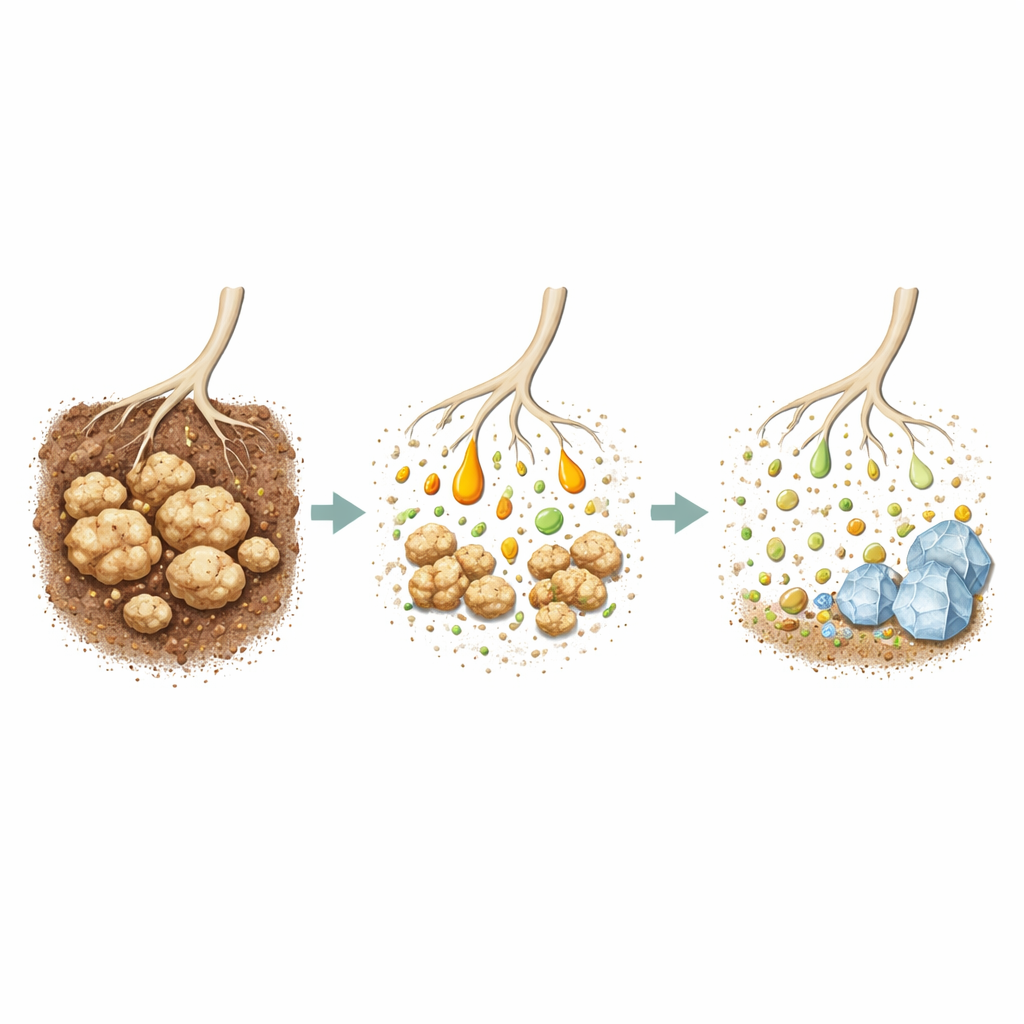
The fungus does most of its work by secreting organic acids—small, sour molecules that attack mineral surfaces. Chemical analyses showed that MC-F2 produced especially large amounts of gluconic acid and malic acid, with the balance between them shifting as the mineral concentration changed. In richer medium with more mineral present, malic acid production surged, while gluconic acid tended to fall. As the acids dissolved the tricalcium phosphate, calcium was released and combined with oxalate produced by the fungus to form new crystals of calcium oxalate hydrates. These secondary minerals, confirmed by X-ray diffraction and electron microscopy, are much less likely to lock phosphorus away again, helping keep it in forms that crops can use.
Inside the fungal factory
To understand how the fungus adjusts its chemistry to different media and mineral loads, the researchers used untargeted metabolomics—a broad survey of hundreds of small molecules inside and around the cells. They found that the mix of nutrients and the amount of tricalcium phosphate strongly reshaped central metabolic pathways. In NBRIP, the cycle that handles much of the cell’s energy and carbon flow (the TCA cycle) was especially activated, with intermediates like malate and citrate rising several-fold. These changes lined up with the observed spikes in malic acid secretion and phosphorus release. Other pathways, including those related to amino acids and transport of molecules across cell membranes, were also tuned up or down depending on how much mineral stress the fungus faced, revealing a flexible strategy rather than a single rigid mechanism.
From lab flasks to greener fields
Altogether, the work shows that Talaromyces sp. MC-F2 is a powerful natural tool for converting rock-bound phosphorus into plant-available nutrients, mainly through the tailored production of organic acids that reshape both the chemistry of the solution and the minerals themselves. By mapping how its metabolism responds to different conditions, the study points the way toward designing media, formulations, or even improved strains that maximize phosphorus release. For farmers and environmental planners, this fungus represents a promising step toward biofertilizers that can reduce dependence on synthetic phosphorus inputs, tap into the “legacy” phosphorus already in soils, and cut pollution, all by harnessing the quiet but sophisticated work of soil microbes.
Citation: Xia, M., Bao, P., He, S. et al. A new isolated fungus Talaromyces sp. MC-F2 efficiently solubilizes phosphate through media-dependent metabolic regulation. Sci Rep 16, 14121 (2026). https://doi.org/10.1038/s41598-026-44554-w
Keywords: phosphate solubilizing fungi, biofertilizer, soil phosphorus, Talaromyces, organic acids