Clear Sky Science · en
DMSTG-AD: an SDN intrusion detection method based on dynamic multi-scale spatio-temporal graph neural network
Why smarter defenses matter for modern networks
Today’s internet backbones, data centers, and clouds increasingly rely on software-defined networking (SDN), in which a central controller decides how data should flow. This makes networks more flexible and easier to manage—but it also creates a tempting single point of failure for attackers launching floods of traffic or trying to disguise themselves inside normal activity. This paper introduces DMSTG-AD, a new artificial-intelligence-based intrusion detector that watches how traffic moves through an SDN over time, spotting coordinated attacks that older tools often miss.

A new kind of map for digital traffic
Traditional security tools usually look at each data flow in isolation or rely on hand-crafted rules. That approach struggles when attackers constantly change tactics. The authors instead represent network traffic as a living map: each device or connection becomes a node, and every communication becomes a link in a graph. As traffic arrives at the SDN controller, these graphs are rebuilt in short time windows, forming a sequence that captures how the network’s structure shifts from minute to minute. Unusual bursts of connections or sudden clusters of talkative machines naturally show up as striking patterns in this evolving map.
Watching space and time at once
Most earlier graph-based detectors focused either on the network’s layout at a single moment or on the behavior of individual machines over time. DMSTG-AD is designed to do both at once. First, it learns how strongly different nodes are related at each instant by building an "adaptive" web of connections that changes with the traffic. At the same time, it tracks how each node’s behavior has evolved over recent windows, using a memory-like module to keep short-term history. These pieces are combined so that every node’s description reflects both where it sits in the network and how its behavior has been changing.
Zooming in on bursts and long-term trends
Attacks can be loud and fast, like a sudden flood of requests that overwhelms a server, or slow and sneaky, spreading over longer periods. DMSTG-AD tackles this by layering several time-viewing lenses. One set of filters is tuned to very short intervals, quickly reacting to sharp spikes in traffic. Others span wider ranges, capturing gradual shifts that might mark a persistent campaign. A bidirectional sequence analyzer then looks both forward and backward along the time axis, tying these short and long views together into a single picture of how the network’s behavior unfolds.
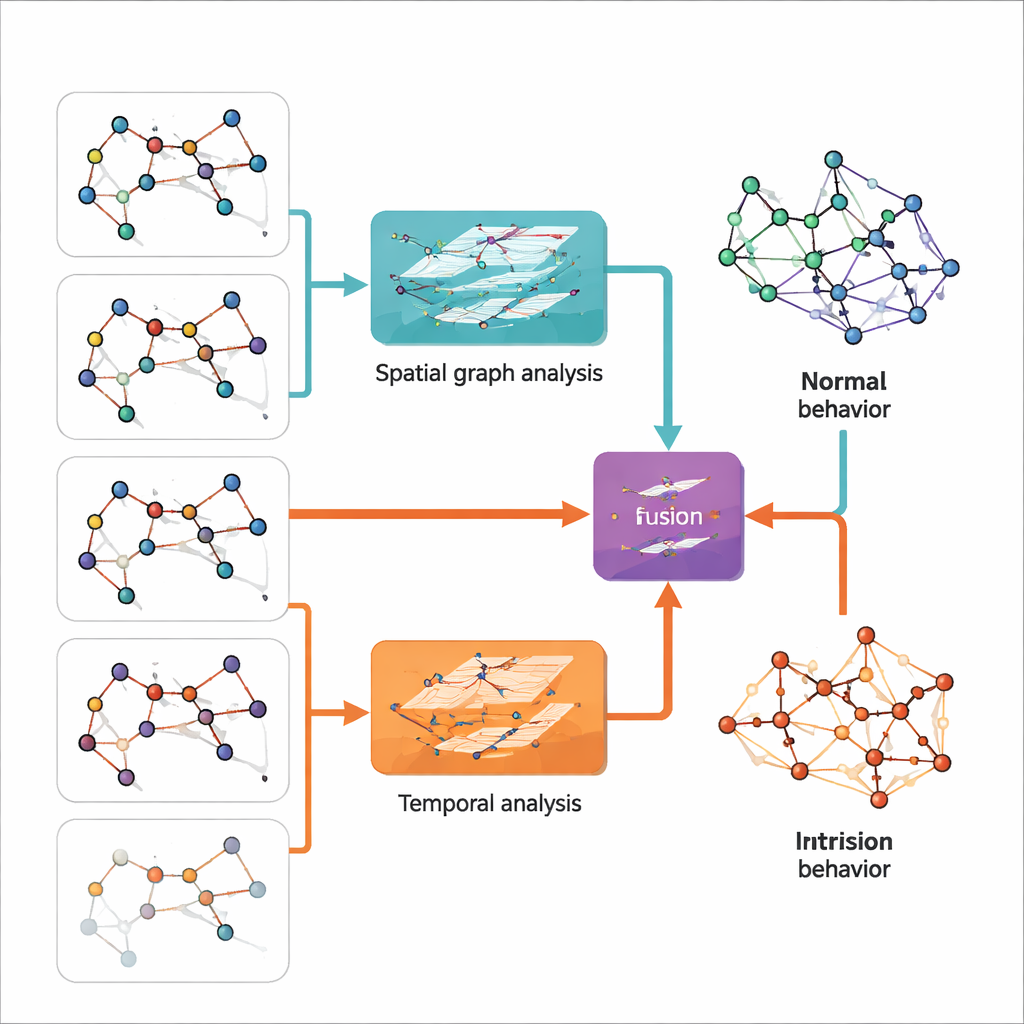
Letting space and time "talk" to each other
Simply gluing together a snapshot of the network and a timeline of activity is not enough. DMSTG-AD uses an attention-style fusion stage that allows spatial and temporal signals to influence each other. For each node, the model asks: given where this node sits in the network, which moments in recent history matter most? The answer becomes a tailored blend of structural context and time patterns. Nodes that suddenly grow tightly connected to other active attackers, for example, receive stronger emphasis from the temporal side, helping the system distinguish genuine threats from harmless fluctuations.
How well the new detector performs
The researchers tested DMSTG-AD on two widely used datasets that mimic realistic SDN environments, containing millions of records and a mix of normal traffic and diverse attacks such as distributed denial-of-service, brute-force logins, scanning, and botnets. Across both simple "attack vs. normal" tests and more demanding multi-attack classification, the new method consistently outperformed existing machine-learning and graph-based systems. On one benchmark it correctly categorized more than 99% of flows into their specific attack types, and it did especially well at recognizing brief but intense floods of malicious traffic. Studies of how the model’s internal connections shift during a real attack show that it automatically tightens links between collaborating attackers exactly when the assault is underway.
What this means for everyday security
For non-specialists, the key takeaway is that DMSTG-AD transforms an SDN from a simple traffic controller into a kind of intelligent observer, one that not only sees who is talking to whom, but also how those conversations change over time. By uniting network structure and timing into a single, adaptable model, it can detect a broad range of attacks with very high accuracy while keeping false alarms low. As SDN-based infrastructures spread through data centers, telecom networks, and the internet of things, approaches like DMSTG-AD point toward defenses that evolve alongside the networks they protect, rather than relying on static rules that quickly go out of date.
Citation: Zhao, J., Zhang, D., He, Q. et al. DMSTG-AD: an SDN intrusion detection method based on dynamic multi-scale spatio-temporal graph neural network. Sci Rep 16, 14528 (2026). https://doi.org/10.1038/s41598-026-44360-4
Keywords: software-defined networking security, graph neural network intrusion detection, spatio-temporal network modeling, DDoS and network attacks, dynamic traffic analysis