Clear Sky Science · en
PEO-sheathed liquid jets increase sample delivery stability for serial femtosecond X-ray crystallography
Sharper Movies of Molecules
Understanding how life’s machinery works often means filming proteins in action with X-ray “cameras” that fire a million times per second. But to take these atomic‑scale movies, scientists must feed a steady stream of tiny crystals into the beam without wasting precious samples or clogging fragile hardware. This paper shows how wrapping fast liquid jets in a thin layer of a common polymer, polyethylene oxide (PEO), makes those streams far more stable, opening new windows into the ultrafast motions of complex proteins.
Why Tiny Jets Matter
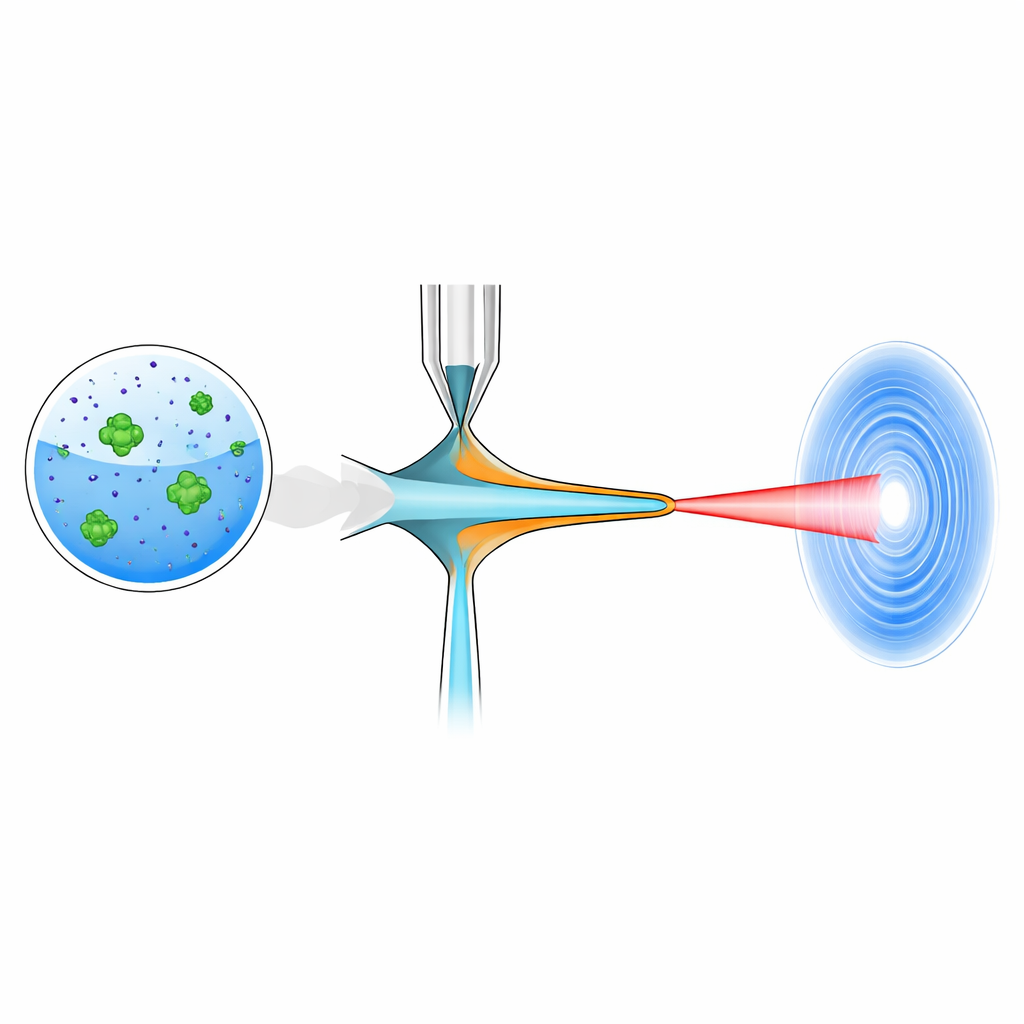
Modern X-ray free‑electron lasers can deliver incredibly bright flashes lasting only a few dozen femtoseconds—short enough that a protein crystal diffracts before it is destroyed. In serial femtosecond crystallography, millions of these flashes each hit a fresh microcrystal carried across the beam in a hair‑thin liquid jet. The more often an X-ray pulse actually strikes a crystal (the “hit rate”), and the more of those hits can be interpreted into structure (the “indexing rate”), the faster scientists can build complete 3D pictures. However, the jet must be thin, fast, and remarkably stable, especially at megahertz repetition rates where pulses arrive less than a microsecond apart.
Limits of Today’s Liquid Streams
Standard injectors squeeze a single liquid stream with a surrounding gas (gas dynamic virtual nozzles), or add a second liquid layer as a stabilizing sheath (double‑flow focusing nozzles). These approaches work well for watery samples, but many of the most interesting membrane proteins only grow as crystals in thick, syrup‑like solutions rich in polyethylene glycol (PEG). Such viscous mixtures resist being pulled into a fine jet, leading to wiggling, break‑up, and a higher risk of clogs. Attempts to stabilize them with an ethanol sheath help lengthen the jet but often force researchers to lower the sample flow rate, which in turn cuts the hit rate and lengthens data‑collection times.
A Polymer Coat for Superstable Streams
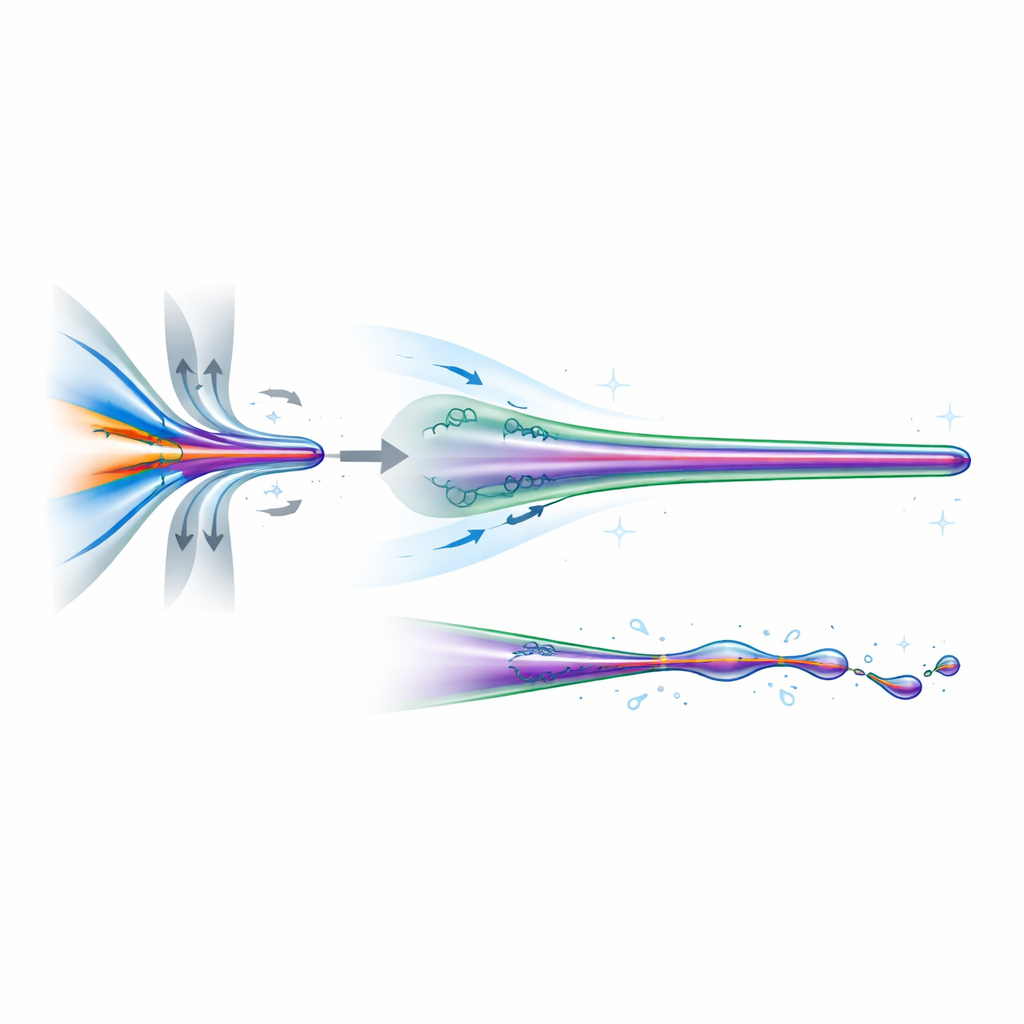
The authors tested a different strategy: surrounding the crystal‑bearing liquid with a dilute PEO solution instead of ethanol. Under the extreme stretching forces near the nozzle tip, the long PEO chains straighten and form a viscoelastic shell around the core stream. This shell makes the jet much thinner and more than four times longer than comparable water or ethanol‑sheathed jets, while still producing very low background scattering—essential for clear diffraction images. Long jets, sometimes exceeding one millimeter, allow pump–probe experiments with time delays of tens of microseconds, filling a gap between the fastest XFEL studies and slower synchrotron measurements.
Real‑World Protein Tests
To see whether this works with real biological targets, the team delivered microcrystals of a small model enzyme (lysozyme) and of photosystem II, a large membrane complex at the heart of photosynthesis. For lysozyme in both low‑ and medium‑viscosity buffers, PEO‑sheathed jets maintained good hit and indexing rates at substantially reduced sample flow, meaning complete datasets could still be collected in just a few minutes. For photosystem II in particularly thick PEG‑rich buffer—conditions that are notoriously hard to jet—the PEO shell produced long, straight jets and yielded the best liquid‑jet data so far at the European XFEL, even though the hit rate remained modest. Simulations of crystal probabilities in the jet confirmed that, with appropriately matched X-ray beam size and crystal size, hit rates of 3–5% should be routinely achievable.
Mixing Reactions on the Fly
Building on this success, the researchers designed a new “triple‑flow” nozzle that combines micromixing and PEO sheathing in a single 3D‑printed device. Two inner channels bring together a protein suspension and a reactant solution, allowing molecules to start reacting as they diffuse into one another over tens of milliseconds in a narrow mixing channel. A third channel then adds the PEO solution, and gas flow focuses everything into a single viscoelastic jet. This compact injector is tailored for “mix‑and‑inject” experiments, where scientists track how enzymes or other proteins change shape after binding a substrate or undergoing a redox reaction.
Clearer, Faster Views of Life in Motion
In simple terms, the study shows that giving liquid jets a flexible polymer coat makes them behave far better under the harsh conditions of high‑speed X-ray experiments. The stretched PEO chains act like microscopic shock absorbers, keeping the jet intact long enough for many pulses to probe fresh crystals, even in sticky, PEG‑rich solutions that previously caused trouble. As a result, researchers can use more realistic sample conditions, explore a wider range of time delays, and collect high‑quality structural data more efficiently. This improved control over tiny liquid streams brings us closer to routinely filming the fastest steps of photosynthesis, enzyme catalysis, and other fundamental biological processes in unprecedented detail.
Citation: Vakili, M., Bajt, S., Bielecki, J. et al. PEO-sheathed liquid jets increase sample delivery stability for serial femtosecond X-ray crystallography. Sci Rep 16, 10497 (2026). https://doi.org/10.1038/s41598-026-44308-8
Keywords: serial femtosecond crystallography, liquid jet sample delivery, polyethylene oxide sheath, X-ray free-electron laser, time-resolved protein crystallography