Clear Sky Science · en
Endophytic Beauveria bassiana in maize: influence of genotype, fungal source, inoculation methods, and time on colonization and fitness of Fall armyworm
Why this matters for farmers and food security
Across Africa and much of the world, the Fall armyworm has become a notorious maize pest, chewing through leaves and cobs and threatening a key staple food. Chemical sprays are costly and often fail because the caterpillars hide deep in the plant. This study explores a very different strategy: turning a naturally occurring fungus, Beauveria bassiana, into a living bodyguard that grows inside maize plants and quietly weakens the pest over time.
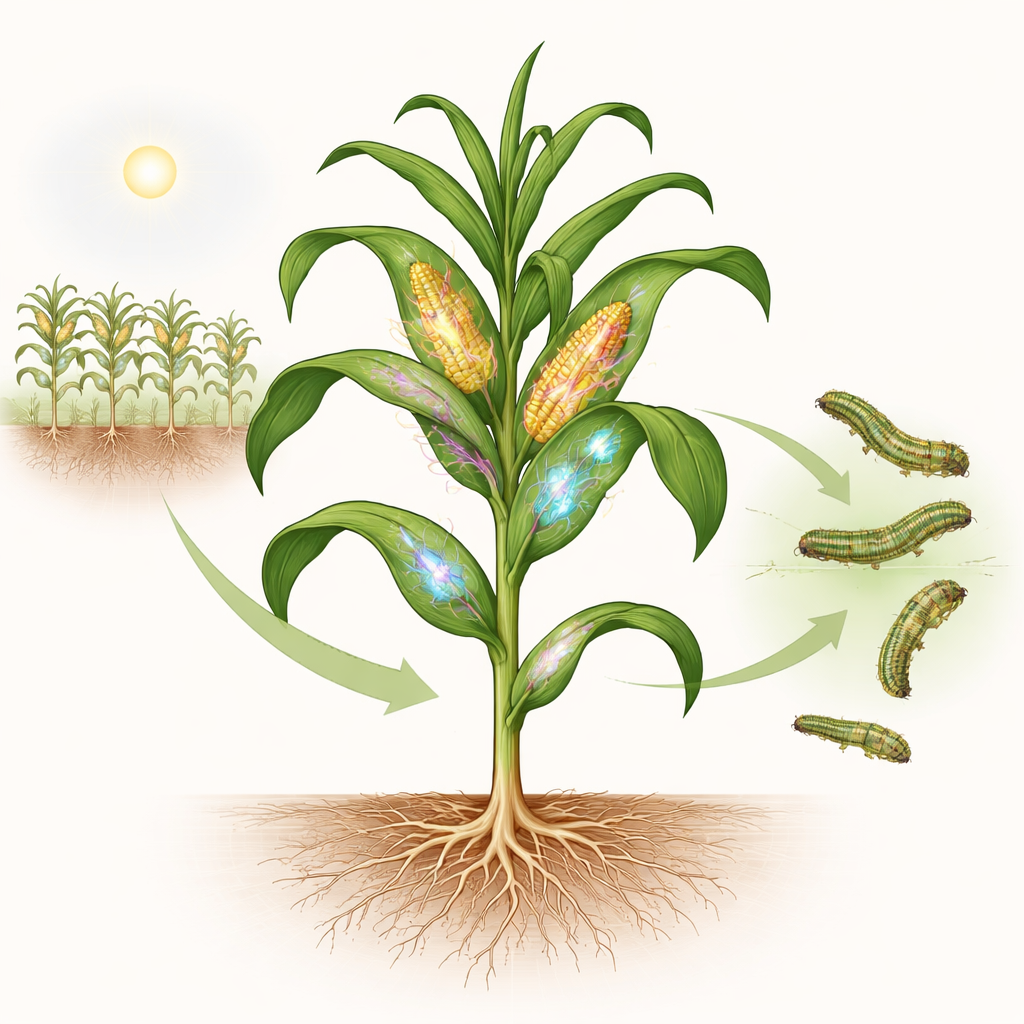
A fungus that lives inside the plant
The researchers worked with three local strains of Beauveria bassiana, a fungus already known for infecting insects, and asked it to behave as an “endophyte” – a microbe that lives harmlessly inside plant tissues. They introduced the fungus into four maize varieties, two traditional landraces and two modern improved lines, using two methods: spraying young plants with a fungal suspension and coating seeds before planting. They then checked whether the fungus had settled in leaves, stems, and roots using both classic petri-dish culturing and DNA-based tests. Within a week, all treated plants showed internal colonization, confirming that the fungus could move systemically through maize without visibly harming the crop.
Plant variety and timing shape fungal success
Colonization was far from uniform. One insect-derived strain, called Bb115, was especially good at spreading through plants, often reaching all tissues in the first week. Traditional landraces, particularly Kokoli Daneri, tended to support stronger and more reliable colonization than the improved varieties. Over time, fungal recovery from leaves and stems generally declined, while roots remained a more stable refuge. The way the fungus was introduced also mattered: foliar sprays quickly colonized above-ground parts, whereas seed coating favored roots and worked best in landraces. Statistical analyses showed that maize genotype, fungal strain origin, inoculation method, and time after treatment all interacted in complex ways to determine where and how long the fungus persisted.
How the hidden fungus affects the pest
To see what this meant for the Fall armyworm, the team selected the best-performing combinations and fed caterpillars with leaves from colonized and non-colonized plants. The pests never contacted the fungus directly; instead, they ate plant tissue that contained it. Larvae feeding on colonized maize grew more slowly and ended up lighter in almost every stage of development. Their pupae were smaller and shorter, and fewer individuals survived to become adults. Those adults that did emerge were less productive: females laid substantially fewer egg batches, and overall emergence of both males and females was reduced. These effects were moderate rather than dramatic, but they accumulated across the life cycle, especially in the landrace–fungus pairings.
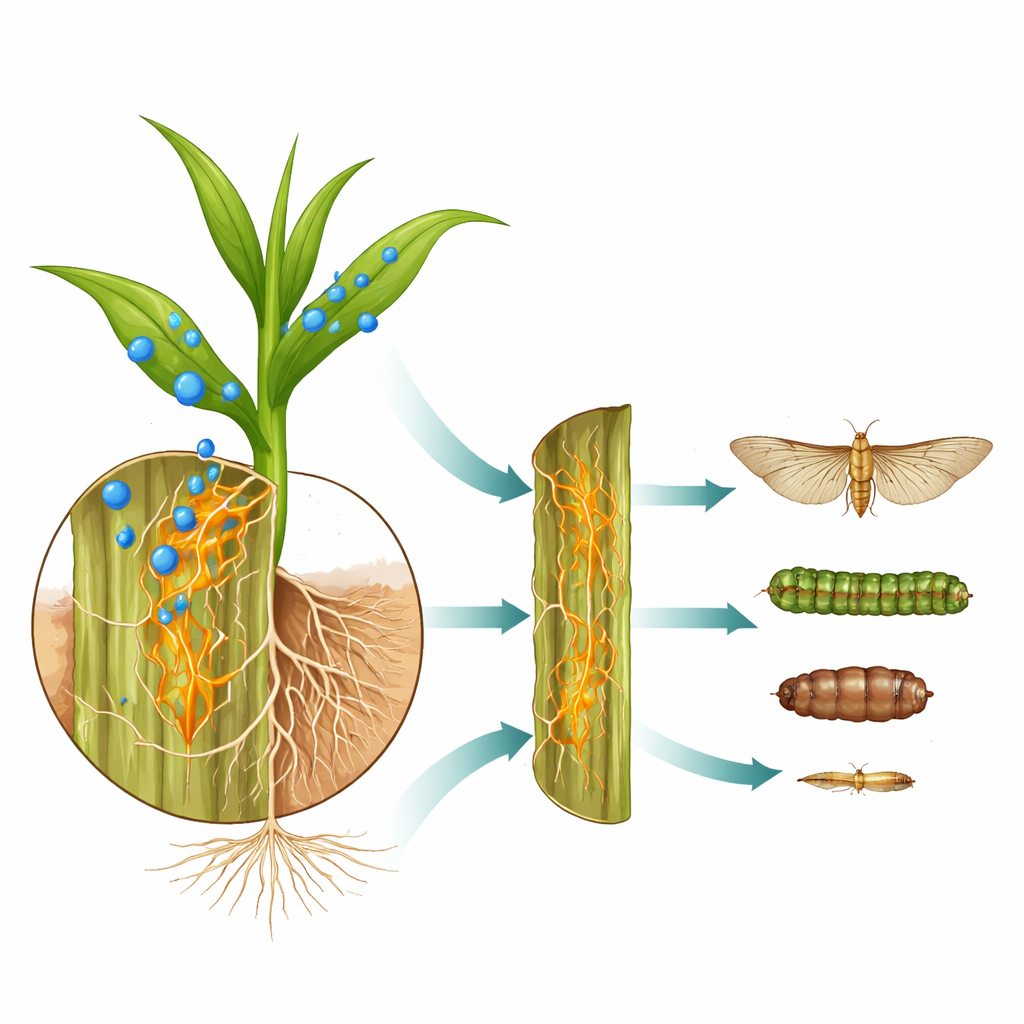
Why the plant’s own traits still matter
The study also highlights that maize is not a passive partner. Traditional landraces carried a richer community of native fungi inside their tissues, some of which are known to compete with or inhibit other microbes. This resident microbiome likely shaped how well Beauveria bassiana could establish and persist. At the same time, breeding for high-yield modern varieties has often weakened the plant’s natural inducible defenses against insects. The results suggest that combining the right maize genetics with a compatible fungal strain and a suitable inoculation method can tip the balance in favor of the crop and against the pest.
A step toward gentler pest control
In plain terms, the authors show that it is possible to “vaccinate” maize plants with a friendly fungus that quietly makes life harder for the Fall armyworm: caterpillars die somewhat more often, grow less, and leave behind fewer offspring. While this is not a stand-alone silver bullet, it could become an important piece of integrated pest management, especially where pesticides are expensive or losing effectiveness. Matching fungal strains to locally adapted maize varieties and fine-tuning how and when they are applied could help farmers protect yields in a more sustainable, biology-based way.
Citation: Tossou, T.H., Dannon, E.A., Schleker, A.S.S. et al. Endophytic Beauveria bassiana in maize: influence of genotype, fungal source, inoculation methods, and time on colonization and fitness of Fall armyworm. Sci Rep 16, 9840 (2026). https://doi.org/10.1038/s41598-026-44290-1
Keywords: fall armyworm, maize, Beauveria bassiana, endophytic fungi, biological control