Clear Sky Science · en
Quantitative prediction and degradation mechanism of CFRP–TC4 adhesive joints under hygrothermal aging
Why this hidden glue problem matters
Modern planes, trains, and electric vehicles rely on lightweight but incredibly strong materials glued together rather than joined by bolts or welds. One common pairing is carbon fiber reinforced plastic (a black, fabric-like composite) bonded to titanium alloy. These invisible joints help save weight and fuel, but they must survive years of changing heat and humidity. This study asks a simple but crucial question: how fast do such joints weaken in hot, damp conditions, and what exactly is happening inside the glue as they age?
Glued seams in advanced vehicles
Instead of traditional metal-only structures, engineers increasingly combine carbon fiber and titanium to get both lightness and strength. Rather than drilling holes for bolts, which can create weak spots, they often join parts with structural adhesives—tough epoxy glues designed to spread loads smoothly across an overlap. The team focused on a common joint type called a single-lap joint, where two flat strips overlap and are bonded in the middle. They used a commercial epoxy adhesive to glue carbon fiber plates to titanium plates, carefully prepared the surfaces to ensure good bonding, and then cured the joints under controlled conditions to mimic high-quality industrial production.
Simulating years of hot, wet service
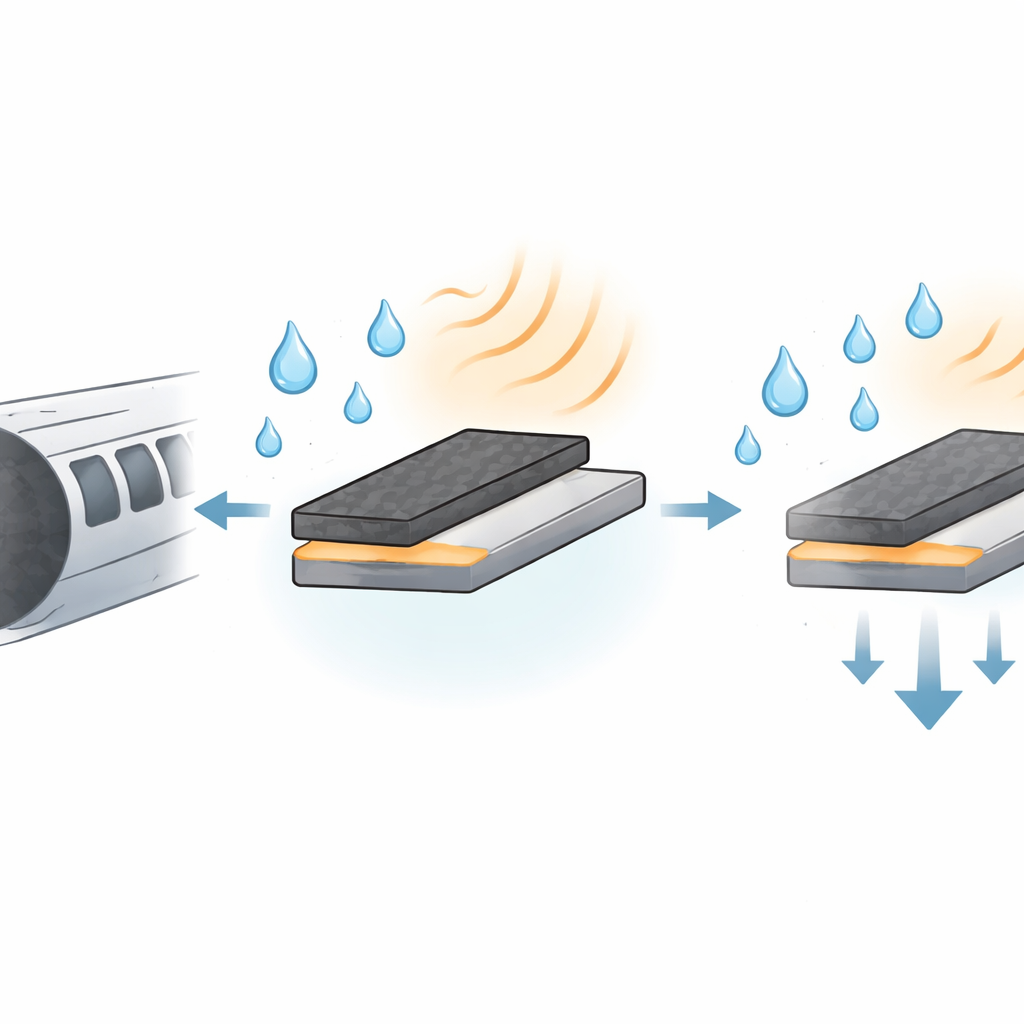
To mimic harsh service environments, the researchers exposed these joints to combinations of heat and moisture for up to 720 hours (about a month), using temperatures of 40, 60, and 80 degrees Celsius and very high humidity (95% relative humidity or full water immersion). After different exposure times, they pulled the joints apart in a testing machine to measure how strong and stiff they remained, and how much energy they could absorb before breaking. The results were sobering: both strength and stiffness steadily fell as temperature, humidity, and time increased. Under the harshest condition—80 degrees Celsius in water—the joints lost more than 40 percent of their original strength after 720 hours, and their ability to resist cracking dropped continuously rather than leveling off.
Cracks, softening, and changing break patterns
Breaking strength alone does not explain how damage develops, so the team examined fracture surfaces with a scanning electron microscope. Early in aging and under milder conditions, failures tended to occur near the boundary between the carbon fiber and the adhesive, or within the carbon fiber matrix itself, with rough, brittle-looking surfaces. As exposure became harsher and longer, the break gradually moved into the body of the adhesive, and the surfaces looked more torn and ductile, with voids and step-like features. This shift showed that moisture and heat were softening and weakening the glue layer, allowing it to stretch more before failing but at a much lower load. At the highest temperature and full immersion, the adhesive became heavily pitted and eroded, with many pores and cracks forming much earlier in the aging process, a clear sign of severe internal damage.
Chemistry inside the glue tells the story
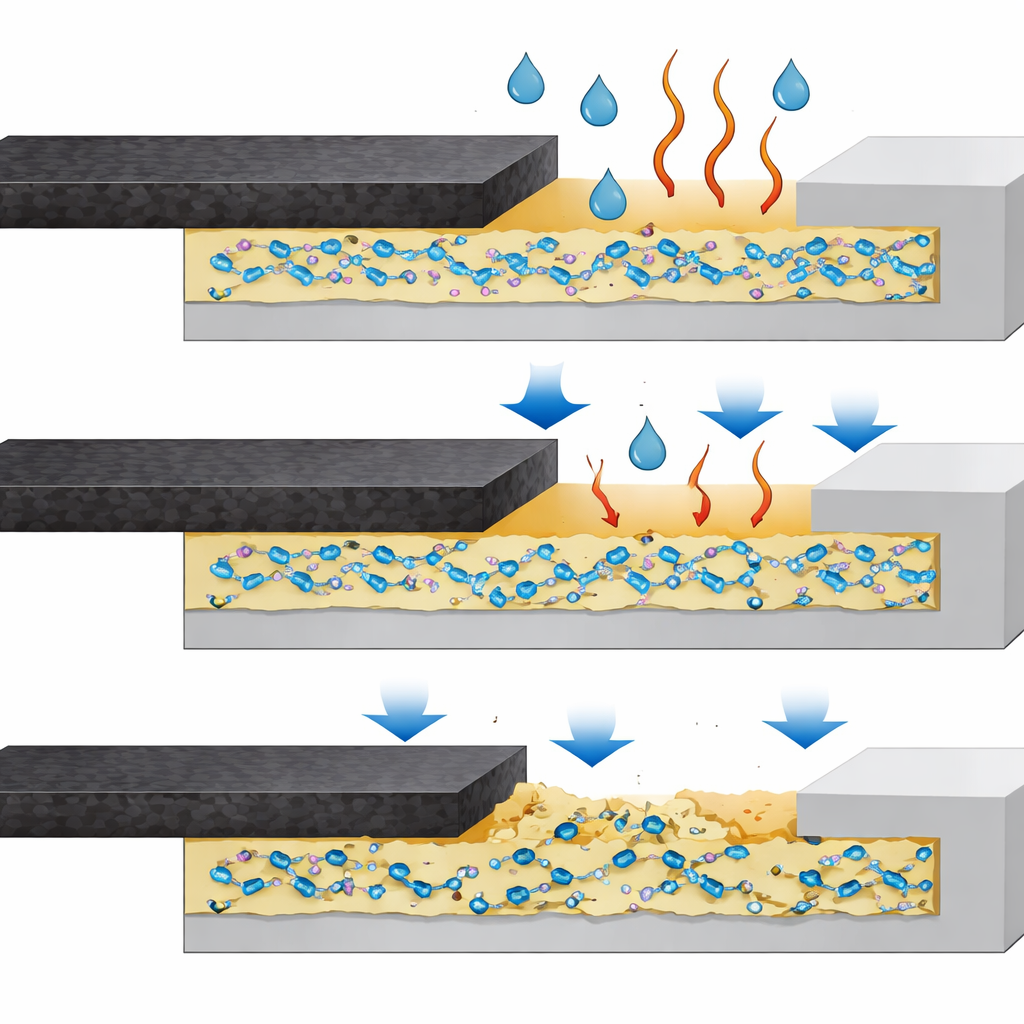
To see what was happening on a molecular level, the researchers used infrared spectroscopy, a technique that reads the “fingerprints” of chemical bonds in the adhesive. They found that water was not just soaking into the glue; it was reacting with certain chemical groups. Bonds known as esters gradually broke apart in the presence of moisture and heat, forming new carbonyl and ether groups and increasing the amount of hydrogen-bonded water inside the material. These changes signal that the adhesive’s network is being cut and rearranged, which makes it softer and easier to deform and crack. The more humid and hotter the environment—especially at 80 degrees Celsius in water—the faster these chemical shifts appeared, matching the rapid loss of mechanical performance seen in the strength tests.
From measurements to prediction
Beyond describing what went wrong, the team built a statistical prediction model to capture how temperature, humidity, and exposure time together control strength loss. Using response surface methodology—a structured way to fit a curved surface through experimental data—they derived an equation that predicts the remaining strength of the joint within the tested range. By analyzing this model, they ranked the importance of each factor and found that humidity had the largest effect, followed by temperature and then time. Extra tests at new times but the same environmental conditions showed that the model’s predictions were typically within about 7 percent of the measured values, suggesting it can serve as a practical tool for estimating joint durability in similar settings.
What this means for real-world structures
For non-specialists, the central message is that the “super glue” holding advanced carbon fiber–titanium structures together is highly sensitive to hot, wet environments, and that water-driven chemical reactions inside the adhesive are a key cause of long-term weakening. The joints do not simply get a bit damp; their internal bonds are gradually cut and reshaped, leading to softer, more crack-prone glue and changing the way the joints fail. By quantifying how quickly this happens and by identifying humidity as the main driver, the study provides engineers with both warning signs and a predictive tool. This knowledge can guide better material choices, surface treatments, and safety margins so that the lightweight vehicles of the future can remain both efficient and reliably held together over their entire service lives.
Citation: Liu, H., Liu, R., He, C. et al. Quantitative prediction and degradation mechanism of CFRP–TC4 adhesive joints under hygrothermal aging. Sci Rep 16, 14234 (2026). https://doi.org/10.1038/s41598-026-44026-1
Keywords: carbon fiber adhesive joints, hygrothermal aging, titanium composite bonding, epoxy degradation, structural durability