Clear Sky Science · en
Effect of multilayer laser cladding on the microstructure and wear resistance of SiC/Ni60A coatings
Making Train Parts Last Longer
Modern trains depend on heavy-duty steel parts—axles, gears, and bearings—that are hammered by high loads, impacts, and harsh environments. Replacing these large components outright is expensive and wastes material. This study explores a way to rebuild worn steel surfaces with a laser-applied protective skin, aiming to make repairs stronger, longer lasting, and more economical for rail and other heavy industries.
Building a New Skin with Light
The researchers focus on a repair method called laser cladding, where a powerful laser melts a stream of metal powder onto the surface of damaged steel, creating a tightly bonded coating. They use a common structural steel (AISI 1045) and cover it with a nickel-based alloy called Ni60A, mixed with very hard silicon carbide (SiC) particles. Instead of just one pass, they stack up to four layers of this composite coating to reach the thickness needed when the original damage is deep—on the order of a millimeter or more. The central question is how adding more layers changes the internal structure and, ultimately, how well the repaired surface resists wear.
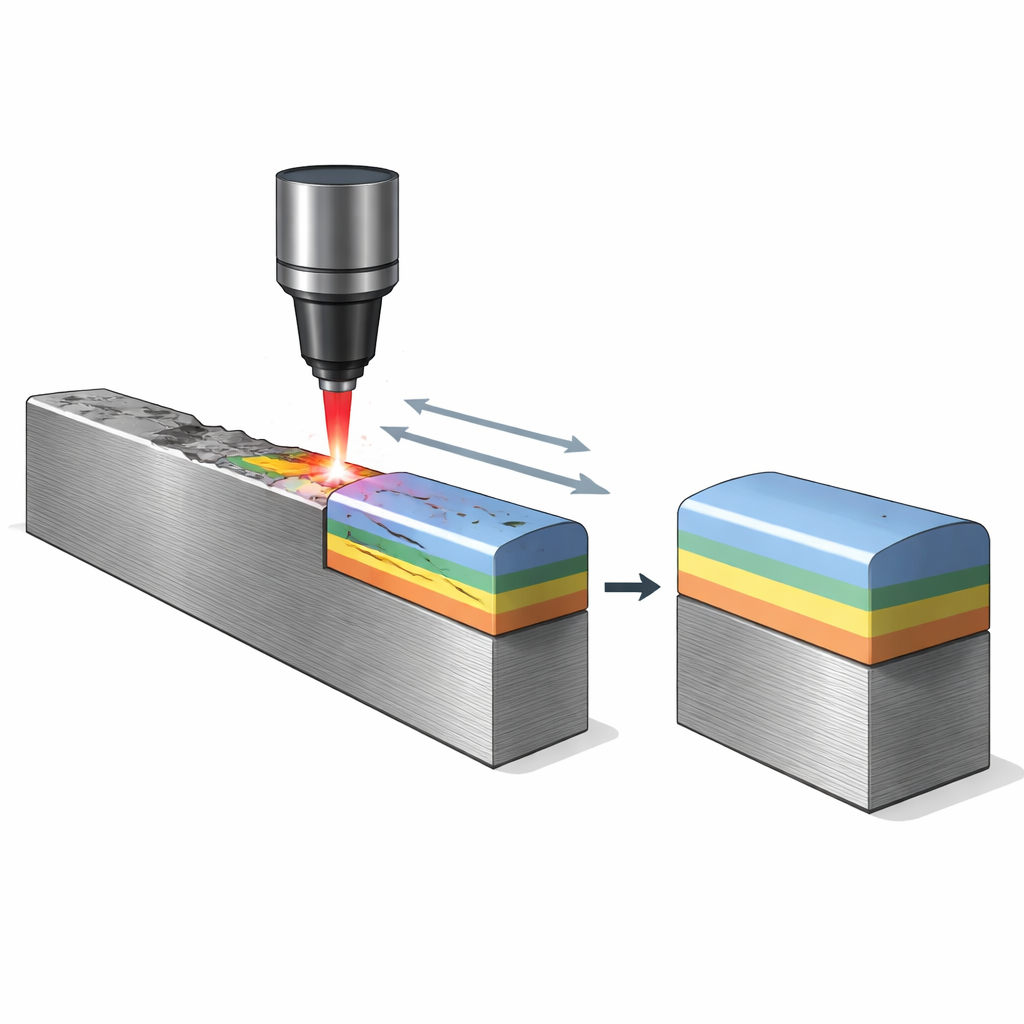
What Happens Inside the Coating
By cutting and polishing cross-sections of the repaired steel, and examining them with microscopes and X-ray analysis, the team reveals that the coating is far from simple. Under the intense heat of the laser, the SiC particles partly break down, and their elements react with nickel, iron, and chromium from the powder and the steel below. This creates a mix of extremely hard microscopic particles—carbides and silicide compounds—embedded in a nickel-rich metal matrix. In single-layer coatings, the structure is dominated by small, roughly block-shaped crystals. When a second and third layer are added, tree-like crystal patterns, known as dendrites, become more common, and hard particles tend to cluster at grain boundaries and within cracks.
Cracks, Pores, and Hidden Stresses
Stacking more layers means each new pass repeatedly reheats the earlier ones. These repeated heat cycles act like a series of rapid, uneven heat treatments. The result is a build-up of locked-in (residual) stresses and the formation of tiny internal defects. Measurements show that tensile stresses—those that pull the material apart—are especially high at the interfaces between layers, reaching around 350 megapascals between the first and second layers. At the same time, the number of pores and the width and count of cracks all rise significantly when moving from one to four layers. In the thickest coatings, cracks follow straight paths through brittle, hard-particle-rich regions, a sign that the local structure has become strong but fragile.
Hardness, Wear, and the Sweet Spot
The team then probes how these internal changes affect performance by measuring hardness across the coating and running wear tests with a hard ceramic ball sliding over the surface. A single or double layer is extremely hard compared with the original steel, but adding more layers gradually softens the overall coating. Each new layer partly tempers—essentially softens—the ones below, and the extra heat encourages more brittle phases and more defects. The two-layer coating stands out: its average hardness is about 4.3 times that of the base steel, and its weight loss in wear tests is roughly one-fifth that of the uncoated material. With three and four layers, wear loss increases again as cracks, pores, and brittle particles promote local flaking under sliding contact. Across all coatings, the main wear mode is adhesive wear, where microscopic patches of material briefly weld together and tear apart, with some abrasive scratching superimposed.
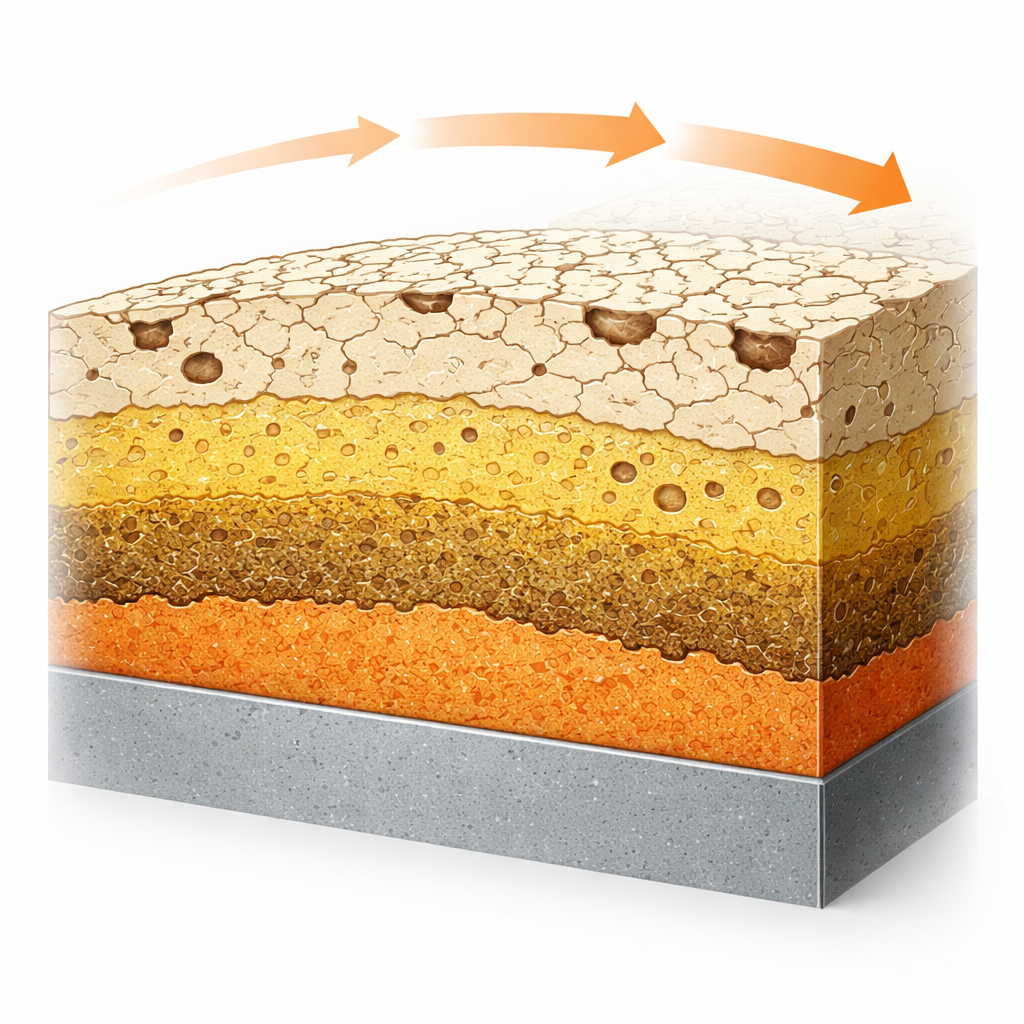
Finding a Practical Repair Strategy
For engineers looking to repair deeply worn train parts rather than replace them, this work suggests a clear design rule. Laser-cladded SiC/Ni60A coatings can dramatically improve hardness and wear resistance, but more layers are not always better. For damage deeper than about half a millimeter, two or at most three layers—giving a coating thickness of 1.5 to 2.5 millimeters—offer the best balance between strong protection and manageable cracking and stress. Beyond that, added thickness brings diminishing returns and growing risks of defects. In short, carefully controlled multilayer laser cladding can turn tired steel surfaces into robust, long-lived components, provided the number of layers is chosen with the coating’s internal stresses and microstructure in mind.
Citation: Wang, Z., Qi, C. & Wang, K. Effect of multilayer laser cladding on the microstructure and wear resistance of SiC/Ni60A coatings. Sci Rep 16, 13761 (2026). https://doi.org/10.1038/s41598-026-43832-x
Keywords: laser cladding, wear-resistant coatings, railway components, nickel-based alloys, silicon carbide reinforcement