Clear Sky Science · en
Optimization of an additively manufactured self-supporting lattice-filled clevis component under combined loading
Making Strong Parts with Less Material
From airplanes to electric cars, engineers are under constant pressure to shave off weight without sacrificing safety. One promising way to do this is to hollow out bulky metal parts and replace the solid interior with an intricate internal framework made by 3D printing. This paper explores how such lightweight “lattices” can be designed and optimized so that a critical connector piece, called a clevis bracket, stays strong even when it is pulled, pushed, and twisted at the same time.
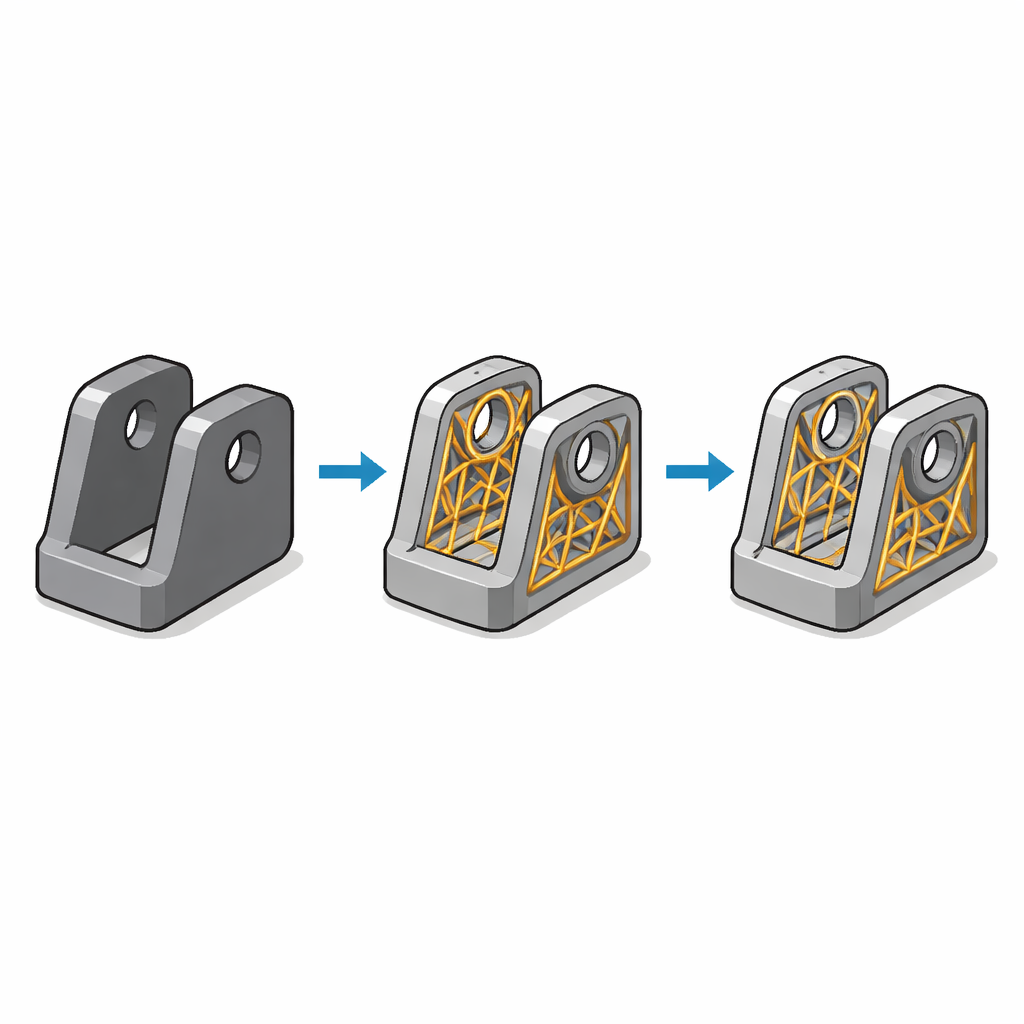
Why Hidden Frameworks Matter
Many modern structures use thin outer shells—think of an airplane fuselage or a car body—to save material. But wherever these shells must connect to other parts, such as at bolt holes or joints, the design suddenly needs to be thick and solid to handle high loads. Traditionally, the volume inside these “hard points” is wasted space because conventional manufacturing cannot easily shape what is hidden from view. Additive manufacturing, or 3D printing, changes that. It can build complex internal frameworks layer by layer, turning empty space into a carefully engineered lattice that carries load efficiently while keeping overall weight low.
Designing a Self-Supporting Inner Skeleton
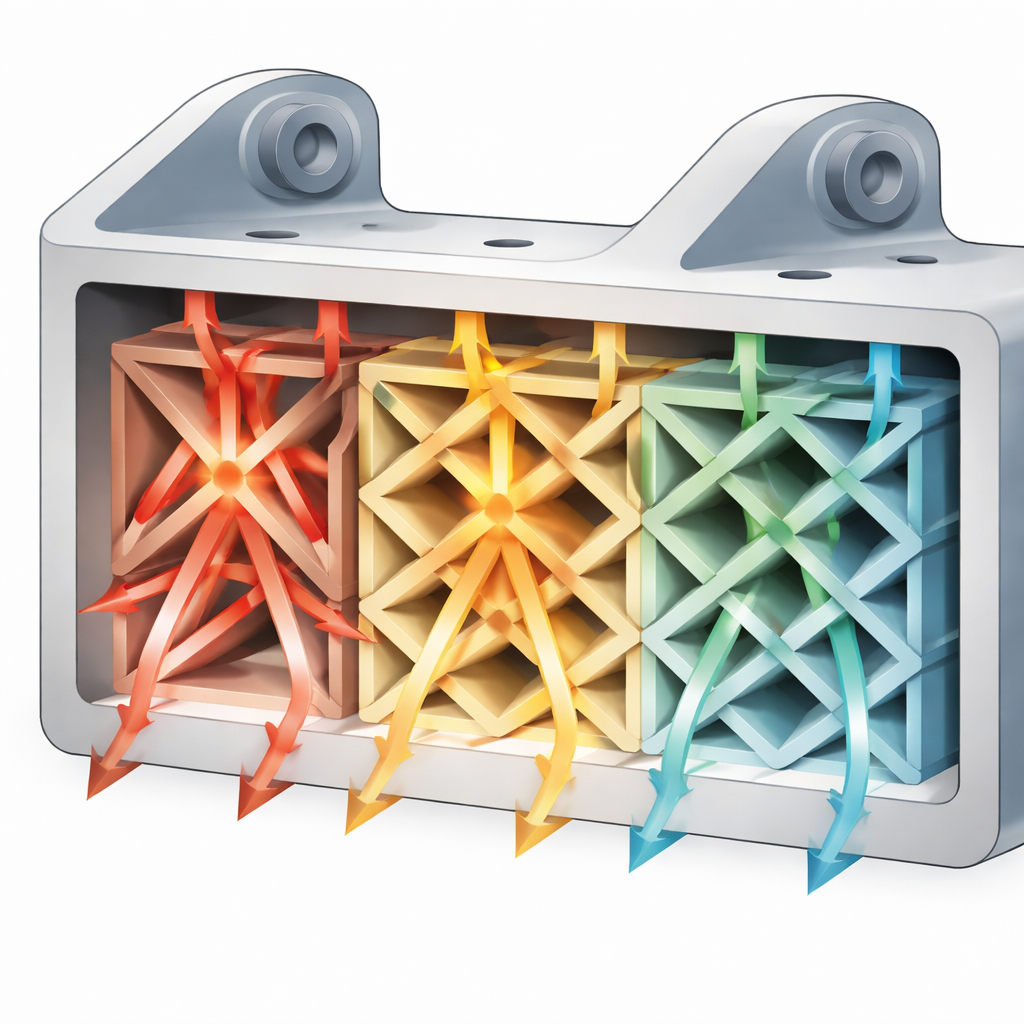
The authors focus on a clevis bracket—a common fork-shaped connector—and fill its interior with three different kinds of strut-based lattices, each with three, four, or six struts meeting at a node. Because the internal volume cannot be reached for cleanup after printing, the lattice must be “self-supporting”: its struts must be angled steeply enough, typically above 45 degrees, so that they can be printed without extra temporary supports. The team systematically varies three geometric features of the lattice: the thickness of the struts, their length (or height), and the angle they make with the horizontal. All parts are printed in a common plastic (PLA) using a desktop-style fused filament printer, making the work relevant to practical, cost-conscious applications.
Putting the Brackets to the Test
Real components rarely feel a simple force in just one direction. To mimic real service conditions, the researchers load the clevis specimens in two combined ways: compression plus shear (pushing while sliding) and tension plus shear (pulling while sliding). They record how much force each design can carry and how much it deforms before failing. In parallel, they simulate the same tests with a finite element model, adjusted with an energy-based correction so that a relatively simple, linear computer model can still match the more complex behavior seen in experiments. The comparison shows good agreement, confirming that the simulations can be trusted to explore a wide range of design options without building and breaking hundreds of parts.
Letting an Algorithm Search for the Best Design
Because there are many possible combinations of lattice type, strut thickness, height, and angle, the authors turn to Bayesian optimization, a strategy that treats the problem as a “black box” and learns from each simulation result which designs to try next. They set two goals at once: reduce the peak stress in the clevis and reduce its weight. To compare different designs fairly, they scale and rank each one in terms of both stress and weight saving, then look for configurations that balance these competing aims. After hundreds of iterations, the algorithm identifies preferred regions in the design space and highlights which variables matter most under each loading condition.
What the Study Reveals About Smart Lattices
The results show that not all lattices are equal. Clevis brackets filled with 3-strut lattices consistently offer the best mix of strength and lightness, especially under the combined compression–shear loads that many real parts see. Designs with 6-strut lattices perform worst, mainly because their joint layout and density do not transmit forces as effectively. Across all types, thicker struts are the most powerful lever for reducing stress, particularly when the part is mainly in compression, while strut height and overhang angle play a larger role when tension is more important. The analysis also reveals that there is a “sweet spot” for strut length: too short and the structure is heavy and stiff; too long and the slender struts buckle or bend more easily.
Implications for Lighter, Safer Structures
For non-specialists, the key message is that the internal geometry of a 3D-printed part can be tuned much like the trusses of a bridge, and that smart algorithms can help find designs that are both lighter and safer. This study demonstrates that self-supporting, strut-based lattices can significantly cut the weight of a clevis bracket while still handling realistic combinations of pushing, pulling, and shearing loads. In particular, a well-designed 3-strut lattice gives engineers broad flexibility to trade a little extra material for much higher strength where needed. As 3D printing of structural parts becomes more common, such geometry-aware optimization could help bring lighter aircraft, more efficient vehicles, and other high-performance machines from the lab into everyday use.
Citation: Ture, M.O., Evis, Z. Optimization of an additively manufactured self-supporting lattice-filled clevis component under combined loading. Sci Rep 16, 13107 (2026). https://doi.org/10.1038/s41598-026-43826-9
Keywords: additive manufacturing, lattice structures, lightweight design, structural optimization, 3D-printed joints