Clear Sky Science · en
Development of β-CD metal organic frameworks loaded with olaparib: a novel approach for the treatment of cervical cancer
Why a smarter cancer pill delivery matters
Cervical cancer remains a major threat to women’s health worldwide, and many patients still rely on treatments that can damage healthy tissue as well as tumors. Researchers are searching for ways to deliver modern targeted drugs more efficiently, so that more of the medicine reaches cancer cells and less is wasted or causes side effects elsewhere. This study explores a new way to package the cancer drug olaparib inside a tiny, sponge-like carrier made from a sugar-based framework, with the goal of making the drug more stable, better absorbed, and more lethal to cervical cancer cells in the lab.

A new home for a modern cancer drug
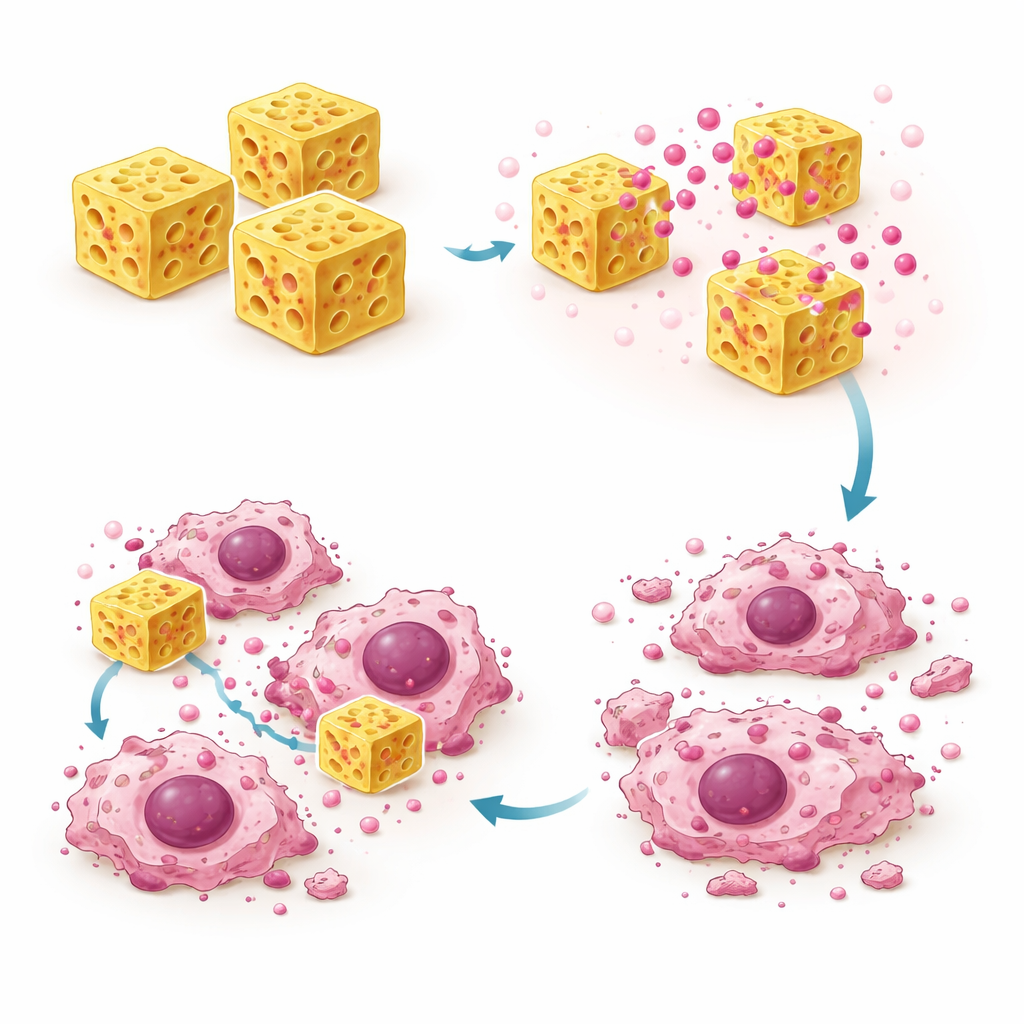
Olaparib is a pill used to treat cancers that struggle to repair damaged DNA, such as certain ovarian and breast cancers, and it may also help in cervical cancer. But by itself, olaparib has drawbacks: it dissolves poorly, is cleared quickly from the body, and can affect healthy tissues. To address this, the authors built a highly porous “metal–organic framework” (MOF) using beta-cyclodextrin, a ring-shaped sugar molecule already used in many medicines, combined with potassium ions. This scaffold behaves like a microscopic sponge, full of tiny cavities and tunnels that can trap drug molecules. The team then loaded olaparib into these β‑CD MOF particles, creating a solid powder containing drug-filled microsponges.
Probing the tiny sponges
The researchers first had to confirm that their carrier really trapped the drug and changed its behavior. They measured how much olaparib the framework could hold and found a high encapsulation efficiency of about 76%, meaning most of the drug ended up inside the pores rather than remaining free. Using a suite of physical tests—including heat-flow measurements, weight-loss-on-heating analysis, infrared light absorption, and X‑ray diffraction—they observed that the sharp crystalline signal of pure olaparib became muted or disappeared once it was housed in the framework. This shift showed that the drug was no longer present as large crystals but instead was dispersed within the MOF’s porous structure, which can improve its stability and how easily it dissolves.
How the carrier releases and protects the medicine
Next, the team studied how olaparib escaped from the framework in fluids that mimic bodily conditions. Compared with the free drug, olaparib inside the β‑CD MOF dissolved more completely and continued to be released steadily over 24 hours, especially at mildly acidic conditions similar to those around many tumors. These findings suggest that the porous sugar-based scaffold can regulate how fast the drug seeps out, preventing an initial burst and instead providing a more even, sustained exposure. Thermal tests also showed that drug-loaded frameworks were more resistant to heat-driven breakdown than the free drug or the empty carrier, indicating that encapsulation offered extra protection to the olaparib molecules.
Stronger attack on cervical cancer cells
To see whether this smarter delivery translated into better cancer killing, the authors exposed TC‑1 cervical cancer cells grown in dishes to either free olaparib or the drug loaded into the β‑CD MOF. Using a standard cell-viability test, they found that the MOF formulation reduced cancer cell survival more strongly at the same doses. The concentration needed to kill half the cells (IC50) was roughly cut in half—from about 28 nanomolar for free olaparib to about 14 nanomolar for the MOF-loaded version. Microscopy confirmed that treated cells shrank, rounded up, and detached from the surface, classic signs of stress and programmed cell death. Measurements of two key death-related proteins, p53 and caspase‑9, showed that their activity rose more in cells exposed to the MOF-loaded drug than to olaparib alone, supporting the idea that the new formulation triggers stronger apoptosis, or controlled cell suicide.
What this could mean for future treatments
In simple terms, this work shows that packaging olaparib inside tiny, sugar-based sponges can make it more potent against cervical cancer cells in the lab while offering steadier release and improved stability. Although these findings are limited to test-tube and cell-dish experiments and do not yet prove benefits in patients, they point toward a promising strategy: using biocompatible porous frameworks to carry modern targeted drugs directly to tumors and release them gradually. If further animal and clinical studies confirm these advantages, such formulations could help lower doses, reduce side effects, and expand the usefulness of olaparib and similar drugs in the fight against cervical cancer.
Citation: Alsulays, B.B., Anwer, M.K., Hatata, M.N. et al. Development of β-CD metal organic frameworks loaded with olaparib: a novel approach for the treatment of cervical cancer. Sci Rep 16, 12911 (2026). https://doi.org/10.1038/s41598-026-43779-z
Keywords: cervical cancer, olaparib, drug delivery, metal-organic frameworks, cyclodextrin