Clear Sky Science · en
Detail-preserving simplification of textured mesh models for natural objects
Why simpler 3D worlds still need rich detail
From video games and virtual reality to digital twins of cities and forests, modern 3D scenes are built from vast numbers of tiny triangles. To keep them running smoothly on everyday hardware, artists and engineers must strip away many of those triangles without making the scene look worse. This paper introduces a new way to simplify detailed 3D models of natural objects—such as animals, rocks, and statues—so that they remain visually convincing even when their underlying geometry is heavily reduced.
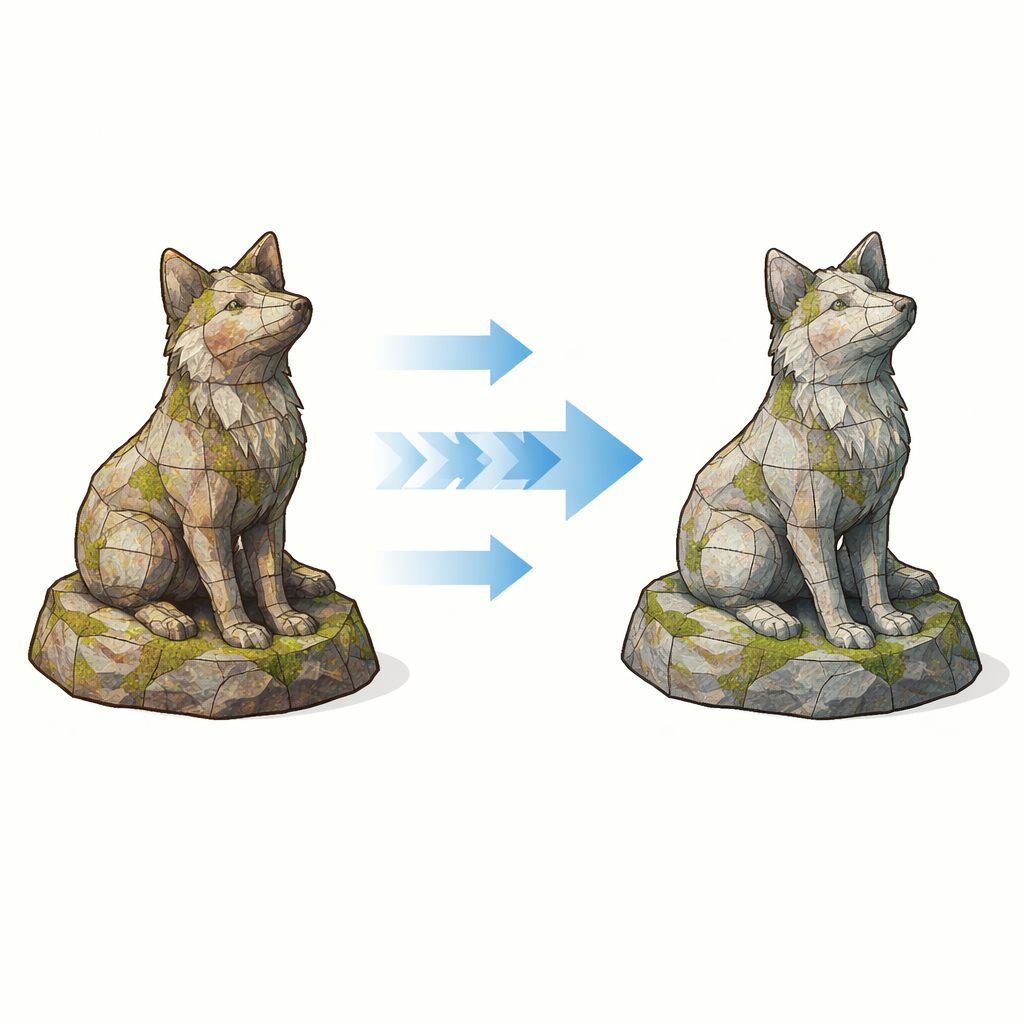
The challenge of trimming 3D models
Most 3D models used in entertainment and industry are triangular “meshes” wrapped in high‑resolution images called textures. When these meshes are simplified, a common method known as Quadric Error Metrics (QEM) collapses edges and removes triangles while trying to keep the overall shape close to the original. However, natural objects often have complex, stitched‑together textures with visible seams, as well as fine geometric features like sharp horns or crisp statue bases. Standard QEM and its popular variants tend to blur these subtle structures and mangle textures around seams, producing stretched patterns, cracks, or misaligned color patches that are immediately obvious to the human eye.
A smarter way to collapse edges
The authors redesign the simplification process around how textures are actually laid out on a 3D surface. They first classify each mesh edge by its relationship to texture regions: edges deep inside a continuous patch, edges lying exactly on a seam, and edges that merely touch a seam at one end or both. For interior edges, the classic QEM strategy is kept, because each vertex there has a single, well‑defined texture coordinate. At texture boundaries, however, they avoid introducing new texture coordinates, and instead “slide” one vertex onto another in a one‑sided collapse. Some especially delicate edges, where seams both run along and intersect, are not allowed to collapse at all. This tailored set of rules makes the algorithm behave very differently in calm, uniform regions than in fragile seam zones.
Measuring how much a seam might suffer
To decide which boundary edges can safely be removed, the method introduces a new quantity called seam angle error. Along a texture seam, some vertices are part of neat, almost straight runs, while others sit at tight bends or junctions of multiple texture patches. Collapsing an edge near a straight, smooth section tends to cause little distortion, but touching a sharp corner can shred the texture. The seam angle error captures this by looking at the angles formed by neighboring seam edges and by counting how many distinct texture coordinates share a vertex. It then feeds this information into the cost of collapsing an edge, so that the simplification algorithm naturally prefers operations that keep seams straight and continuous, and strongly penalizes choices that would twist or break them.
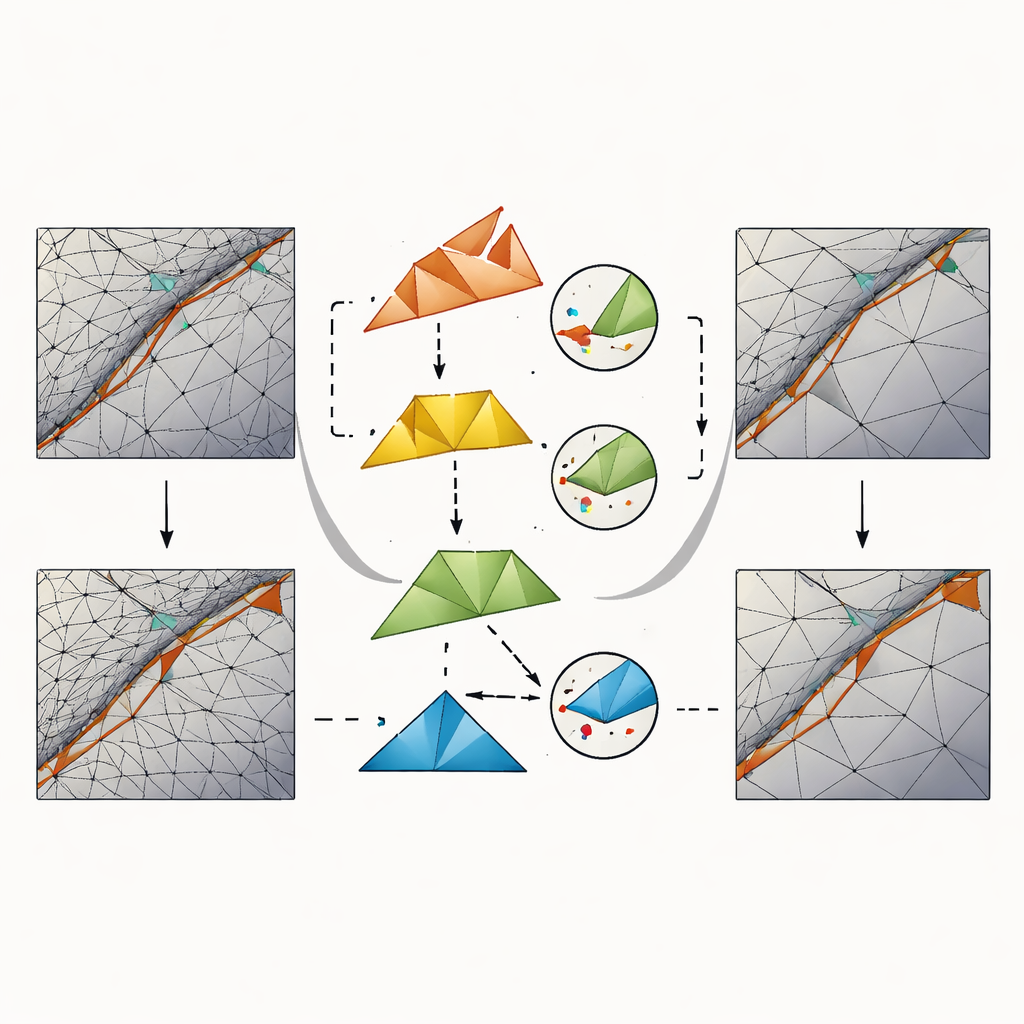
Protecting sharp shapes and busy patterns
Textures are not the only source of fine detail. Natural and man‑made objects alike contain folds, ridges, and protrusions that define their character. The authors therefore add two more safeguards. First, they compute a vertex sharpness measure, based on how much the surface bends around each point. Vertices along sharp edges or at pronounced bumps get higher values, making it more “expensive” for the algorithm to simplify them away. Second, they measure texture complexity in a small neighborhood by counting how many distinct texture coordinates are present. Areas with intricate patterns, like fur, stone grain, or carved ornament, receive higher protection. These geometric and textural weights are combined with the seam angle error and the original QEM term into a single cost that steers which edges are collapsed and in what order.
What the experiments show in practice
The researchers test their method on four kinds of models: two animals with complicated texture stitching, a detailed statue with sharp artificial edges, and a textureless cow model that emphasizes pure shape. Across a range of simplification levels, they compare their results against several widely used techniques, including classical QEM, a texture‑aware extension, and the MeshLab implementation familiar to many practitioners. Visually, the new method produces far less distortion along texture seams and better preserves crisp boundaries and small features. Quantitative measurements confirm this: at an 80% reduction in triangles, the new algorithm cuts texture error at seams by about three‑quarters compared with a popular texture‑aware approach, although its average geometric error over the whole surface is slightly higher. On the cow model, where only shape matters, it keeps recognizable details like horns much longer than competing methods, even under aggressive simplification.
Balancing speed and visual quality
These gains in visual fidelity come with a modest cost: because the algorithm performs extra checks around seams, sharp edges, and complex textures, it runs slower than more basic schemes—on some large, intricate models, several times slower than standard QEM. The authors argue that this is an acceptable trade‑off for offline tasks such as preparing levels of detail for games, simulations, and digital twins, where avoiding flickering seams and preserving characteristic features is more important than squeezing out every last millisecond. In essence, their work shows that 3D models can be made dramatically lighter for real‑time use while still looking convincingly rich to human observers.
Citation: Bo, L., Liu, Y., Shaohua, L. et al. Detail-preserving simplification of textured mesh models for natural objects. Sci Rep 16, 13698 (2026). https://doi.org/10.1038/s41598-026-43736-w
Keywords: 3D mesh simplification, texture seams, level of detail, digital twins, computer graphics