Clear Sky Science · en
Thermodynamics study of chlordecone solubility in water
Why this hidden pesticide still matters
Decades after it was banned, the pesticide chlordecone continues to haunt the French West Indies, where it lingers in soils and can enter rivers and the sea. This study takes a close look at how readily chlordecone dissolves in water over a wide range of temperatures, a basic property that turns out to be crucial for understanding how it moves through the environment and reaches people through food and water.
A long lasting pollutant in island communities
Chlordecone, once widely used on banana plantations, is now known as a highly toxic pollutant that can disrupt hormones and has been linked to prostate cancer, pregnancy complications and effects on infant development. Because it breaks down very slowly, large amounts remain trapped in soil. For years, scientists believed chlordecone barely dissolved in water, which suggested it would stay put in the ground. Those early estimates, however, were based on indirect calculations rather than direct measurements, leaving a major gap in our understanding of how easily this pesticide can spread.
Measuring how much really dissolves
To close this gap, the researchers performed careful laboratory experiments, stirring solid chlordecone in pure water at temperatures from just above freezing to close to boiling. After each mixture reached a stable state, they removed the remaining solid and used a sensitive gas chromatography and mass spectrometry method to measure how much chlordecone had moved into the water. At the commonly used reference temperature of 25 °C, they found a solubility of 10.69 milligrams per liter, nearly four times higher than the long accepted value of 2.7 milligrams per liter. This means more chlordecone can enter water, and ultimately the food chain, than previously assumed. 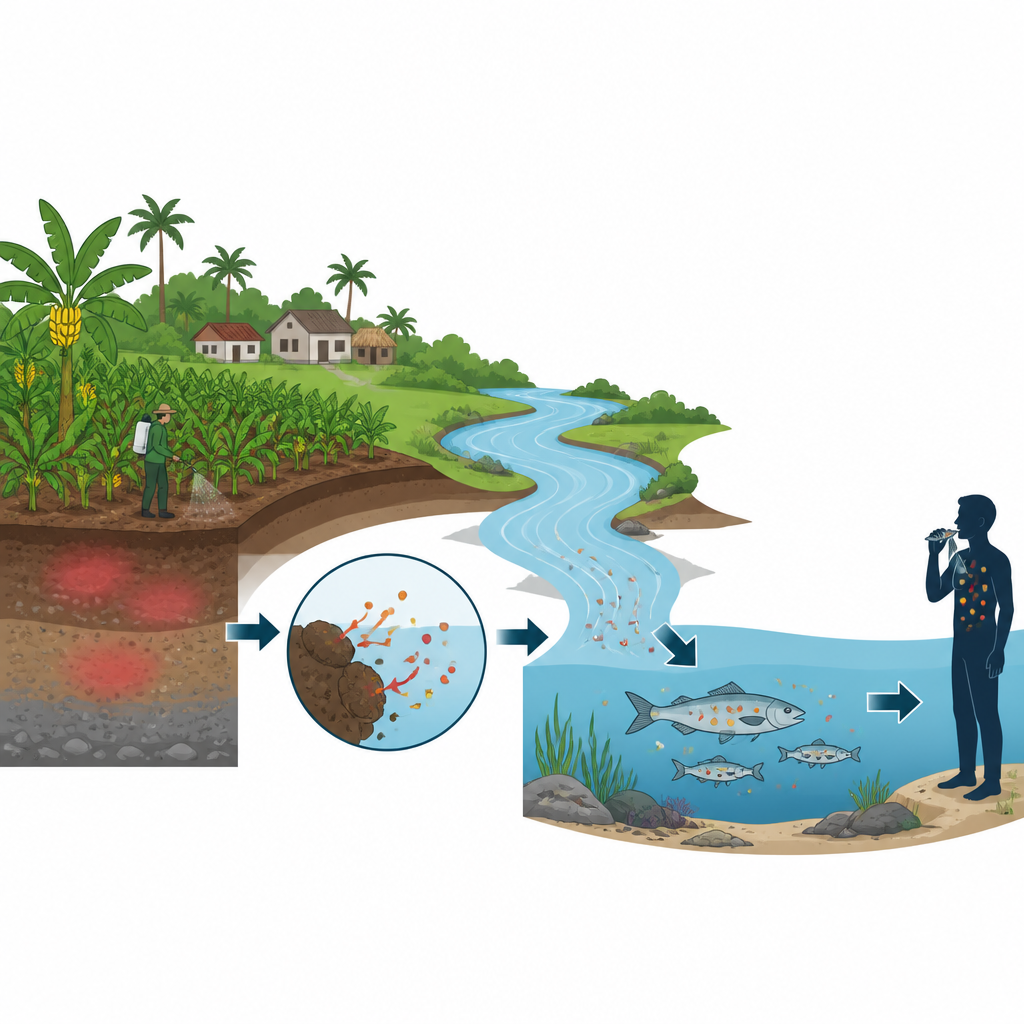
What heat reveals about the process
The team also studied how solubility changes with temperature to uncover the underlying thermodynamics, the rules that describe how energy and disorder change during dissolution. As the water warmed, chlordecone became more soluble, showing that heat helps the process along. By analyzing the temperature dependence, the authors calculated that dissolving chlordecone in water absorbs heat, meaning it is an endothermic process, and that it is strongly opposed by a drop in disorder. In simple terms, water molecules become more ordered around the pesticide, reflecting its water hating, or hydrophobic, character. This encourages chlordecone molecules to cluster together or attach to particles such as sediments and organic matter instead of spreading evenly through the water.
Using models to predict real world behavior
To test whether common mathematical models can describe this behavior, the researchers fitted their data with two widely used equations that relate solubility to temperature and molecular interactions. The Apelblat model reproduced the measurements very well and allowed them to estimate key quantities such as changes in energy and heat capacity during dissolution. They also applied the Non Random Two Liquids (NRTL) model, which is often used to describe mixtures of unlike molecules. This model captured the overall trend of the data and suggested that, on average, chlordecone and water molecules are arranged in a largely random way, even though the pesticide interacts only weakly with the surrounding liquid. 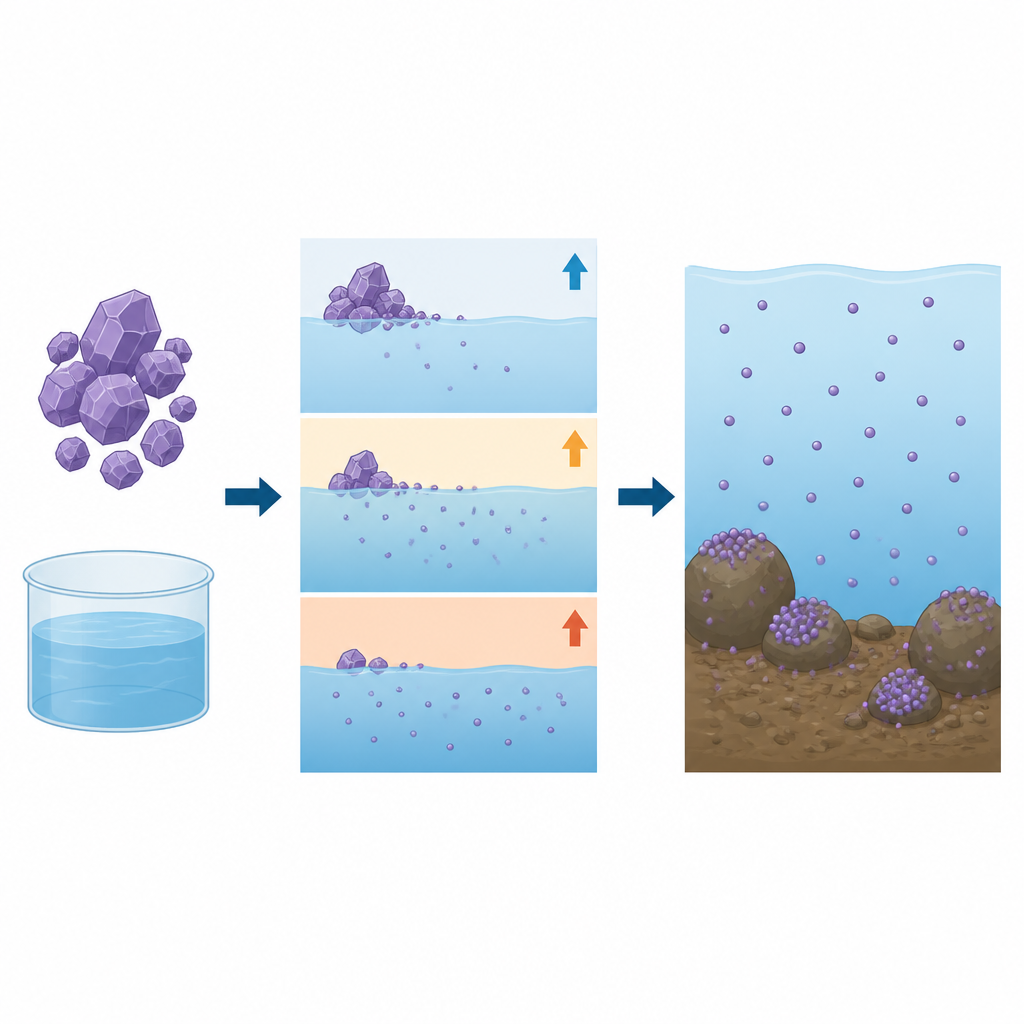
What it means for people and ecosystems
Overall, the study shows that chlordecone is more soluble in water than previously thought, particularly at warmer temperatures typical of tropical climates. At the same time, its reluctance to mix evenly with water and its tendency to bind to sediments and organic material explain why it can both move through rivers and remain stored in soils and mud for long periods. For affected communities and regulators, these new measurements and models provide a more solid basis for predicting where chlordecone will travel, how long it will persist and which cleanup strategies are likely to be most effective.
Citation: Buric, D., Chaspoul, F., Prinderre, P. et al. Thermodynamics study of chlordecone solubility in water. Sci Rep 16, 15912 (2026). https://doi.org/10.1038/s41598-026-43690-7
Keywords: chlordecone, pesticide pollution, water solubility, soil contamination, bioaccumulation