Clear Sky Science · en
Land use induced variations in soil fertility and physicochemical properties across surface and subsurface layers
Why the Ground Beneath Our Feet Matters
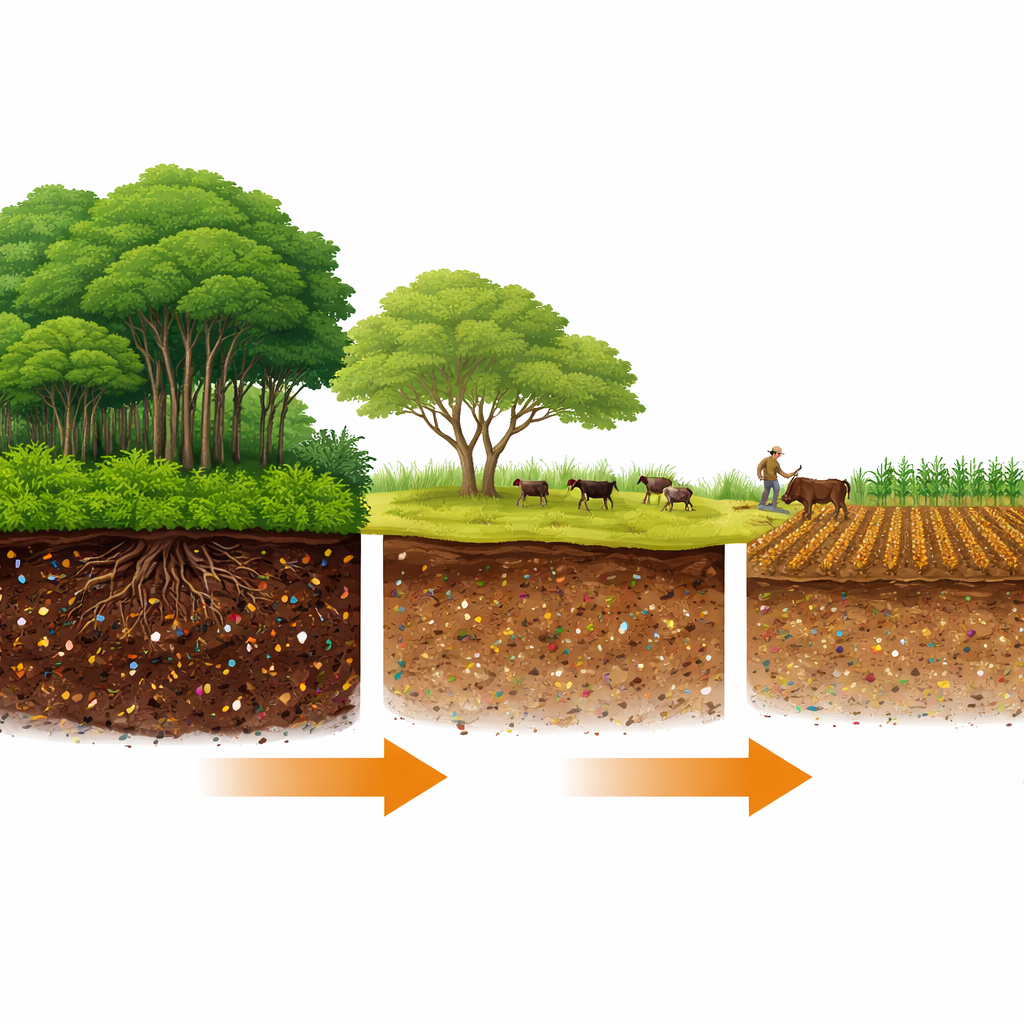
For families in Ethiopia’s highlands, the soil is more than dirt—it is the foundation of food, income, and daily life. As forests are cleared for crops and animals graze the same hillsides year after year, the underground health of the land slowly changes. This study peels back the surface to see how different ways of using land—keeping forest, grazing, or farming—alter the richness and structure of the soil from the top layer down, and what that means for long-term harvests and land degradation.
Three Ways People Use the Same Hillsides
The researchers focused on a small highland watershed in central Ethiopia where forest patches, communal grazing areas, and intensively cultivated fields lie side by side. Using a carefully planned sampling design, they collected soil from two depths: the top layer (0–20 cm), where plant roots, fallen leaves, and soil life are most active, and a deeper layer (20–40 cm), which supports roots but receives fewer fresh inputs. They then compared key features of the soil, such as how acidic it was, how much organic matter and nitrogen it contained, and how well it could hold on to nutrients that crops require.
Forest Soils: Quiet Guardians of Fertility
Soils under forest turned out to be the quiet champions of fertility. They were less acidic and richer in organic carbon, nitrogen, and available phosphorus than soils under grazing or crops. Forest soils also held more of the nutrient-carrying particles that bind and store positively charged nutrients like calcium, magnesium, and potassium. Because tree roots and leaf litter are constantly feeding the soil, and the ground is rarely disturbed, these areas maintain thick, spongy topsoil packed with life and nutrients. The study shows that forest patches act as reservoirs of soil health in a landscape increasingly dominated by farming.
Grazing and Cropland: Hidden Costs of Everyday Use
In contrast, grazing and cultivated lands showed clear signs of wear and tear. Grazing areas had more compact soil and a coarser texture, consistent with long-term trampling by livestock and loss of fine particles through erosion. Croplands, tilled and harvested year after year, had the lowest levels of organic matter, nitrogen, and nutrient-holding capacity. Their soils were also more acidic, a sign that nutrients have been washed away or removed in harvests faster than they are replaced. While both land uses still support production, the results reveal an ongoing downward slide in the very properties that make soils fertile and resilient.
What Happens as We Go Deeper
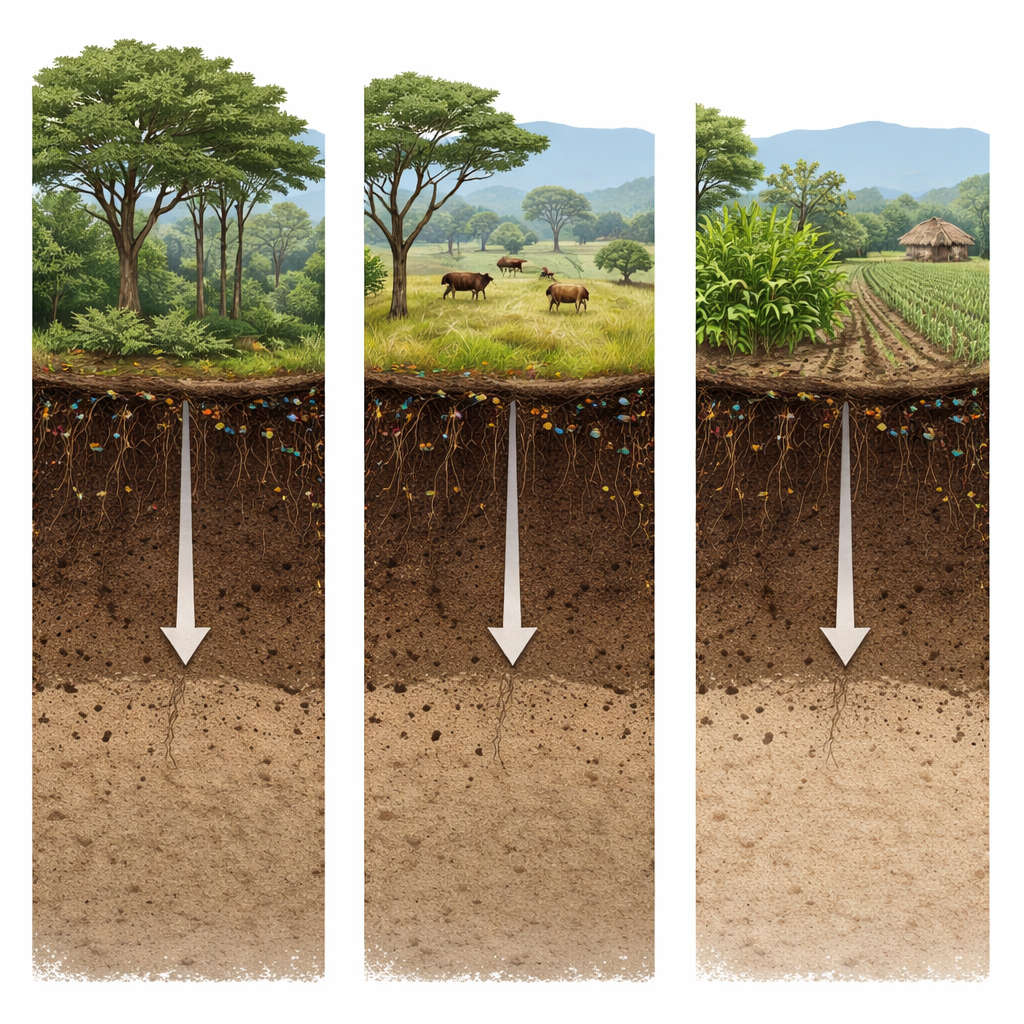
Looking below the surface, the study found a consistent pattern across all land uses: the top 20 centimeters of soil were richer than the layer beneath. Organic carbon, nitrogen, and nutrient-holding capacity dropped sharply with depth, while bulk density—an indicator of compaction—increased. This means that most of the soil’s “bank account” of nutrients is concentrated near the surface, where it is most vulnerable to erosion, over-cultivation, and mismanagement. The limited transfer of organic matter downward suggests that once the thin fertile layer is depleted, the subsoil offers little backup for sustaining crop yields.
What This Means for Farmers and the Future
Put simply, the study shows that turning forests into grazing land or cropland steadily drains the soil’s natural savings. Forest soils store more life-giving carbon, nitrogen, and nutrients, while farmed and heavily grazed soils become thinner, more compact, and more acidic, especially below the surface. For farmers, this translates into rising fertilizer needs and greater risk of crop failure over time. The authors argue that protecting remaining forest patches, reducing overgrazing, and rebuilding organic matter through practices like adding compost, planting trees with crops, and conserving water and soil on slopes are crucial steps. By treating the soil as a living resource rather than an exhaustible one, communities in the Ethiopian highlands can help secure both their harvests and their landscapes for generations to come.
Citation: Gebre, B., Beyene, Y., Zhang, X. et al. Land use induced variations in soil fertility and physicochemical properties across surface and subsurface layers. Sci Rep 16, 13653 (2026). https://doi.org/10.1038/s41598-026-43519-3
Keywords: soil fertility, land use change, Ethiopian highlands, forest versus cropland, soil degradation