Clear Sky Science · en
Rethinking ratio-based normalization towards model-based approaches in heart weight analysis
Why Heart Size Is Harder to Judge Than It Seems
Doctors and researchers often rely on the weight of the heart to judge whether it is healthy or diseased. To make fair comparisons between large and small bodies, they usually divide heart weight by body weight or by the length of a leg bone. This seems straightforward, but this study shows that such simple ratios can quietly distort the picture, sometimes even flipping the apparent result. By re‑examining how heart size changes with body size in tens of thousands of mice, the authors argue for a smarter, model‑based way to compare hearts across individuals.

A Massive Look at Mouse Hearts
The researchers drew on an unusually large and carefully standardized collection of data from the International Mouse Phenotyping Consortium: more than 25,000 healthy mice of the same genetic background, tested in multiple labs. For each animal they recorded heart weight, body weight, and the length of the tibia, a leg bone that reflects overall skeletal size. They examined males and females separately and also compared young adult mice to older adults. This rich dataset let them ask a basic, but rarely tested, question: does heart weight truly grow in lockstep with these measures of body size, as ratio methods assume?
When Simple Ratios Go Wrong
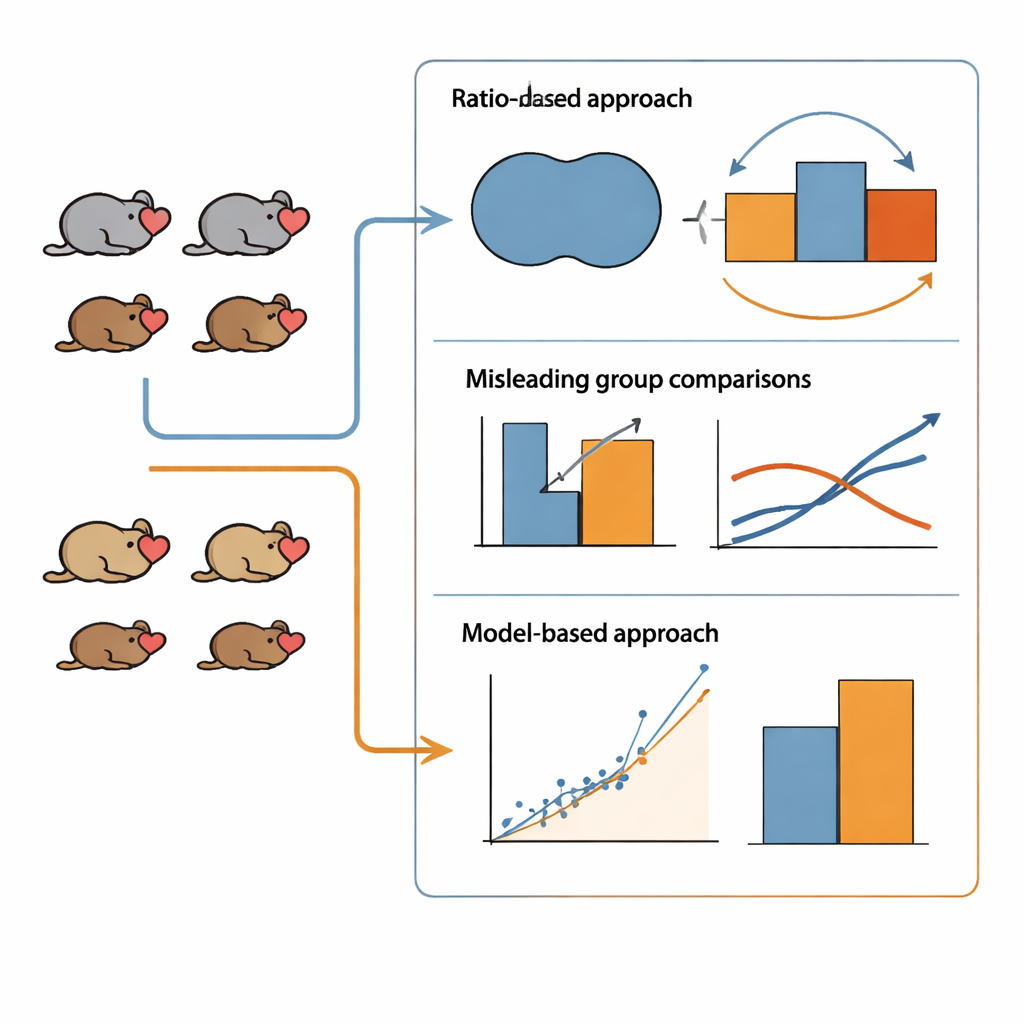
If heart and body grew in strict proportion, heavier animals would consistently have hearts that are a fixed multiple of their body size, and plots of heart weight against body weight would fall neatly on a straight line through the origin. Instead, the team found only weak links: heart weight and body weight, and heart weight and tibia length, were barely to modestly correlated in all groups. As mice aged, the relationship flattened further rather than tracing a tidy straight line. This means that dividing heart weight by body weight or tibia length does not simply "correct" for size; it mixes together biological variation in a way that can blur or even misrepresent true differences between groups.
Testing the Math Behind the Ratios
To see how badly ratios can mislead, the authors ran controlled computer simulations. They created imaginary datasets where they knew exactly how two measurements were related and then compared groups using both raw values and ratios. In one scenario, the two measures were related but not in perfect proportion. Ratios still showed a significant difference between groups—but in the opposite direction from the real underlying effect. In another scenario, the two measures were completely unrelated, yet the ratio produced a fake group difference out of thin air. Only when the relationship was perfectly proportional did the ratio behave as intended. These tests reveal that the problem is not random bad luck but a built‑in flaw of using ratios when their strict assumptions are not met.
A Better Way to Describe Growing Hearts
Rather than relying on division, the researchers turned to statistical models that explicitly describe how heart weight changes with body size. First, they used standard linear models, which estimate how much heart weight tends to increase for each unit of body weight or bone length, while allowing for a baseline offset. Then they used allometric models, which capture the curved, power‑law patterns common in biology. In these models, the key number is an exponent that tells whether the heart grows faster, slower, or in direct step with the body. In the mouse data, this exponent was clearly below one for both sexes, meaning hearts grew more slowly than bodies as animals became larger—a pattern known as negative allometry that matches decades of work across many species.
What This Means for Interpreting Heart Size
For non‑specialists, the main message is that "heart weight divided by body weight" is not a neutral yardstick. Unless heart and body truly scale in a rigid proportion, ratio measures can hide real changes in heart size or manufacture differences where none exist. By contrast, model‑based approaches that fit lines or curves to the data respect how organs actually grow and allow researchers to adjust fairly for sex, age, and other factors. The authors therefore recommend that ratios be used only when their strict mathematical conditions are clearly satisfied, and that most studies instead adopt linear or allometric models. This shift may sound technical, but it has practical consequences: it can sharpen our ability to detect genuine heart disease and to distinguish harmful enlargement of the heart from harmless variation in body size.
Citation: Oestereicher, M.A., da Silva-Buttkus, P., Gailus-Durner, V. et al. Rethinking ratio-based normalization towards model-based approaches in heart weight analysis. Sci Rep 16, 9231 (2026). https://doi.org/10.1038/s41598-026-43503-x
Keywords: heart weight, allometric scaling, mouse cardiology, statistical normalization, body size