Clear Sky Science · en
High-fidelity numerical framework for crashworthiness evaluation of passenger car body structures under full-frontal impact
Why this matters for everyday driving
When a car hits a solid wall in a head‑on crash, a fraction of a second decides whether people inside walk away or suffer serious injury. Automakers increasingly rely on detailed computer simulations instead of dozens of physical crash tests to design safer, lighter vehicles. This study shows how a highly detailed digital model of a car’s bare metal skeleton can accurately predict what happens in a severe frontal crash, offering a faster and cheaper way to improve safety before any prototype is built. 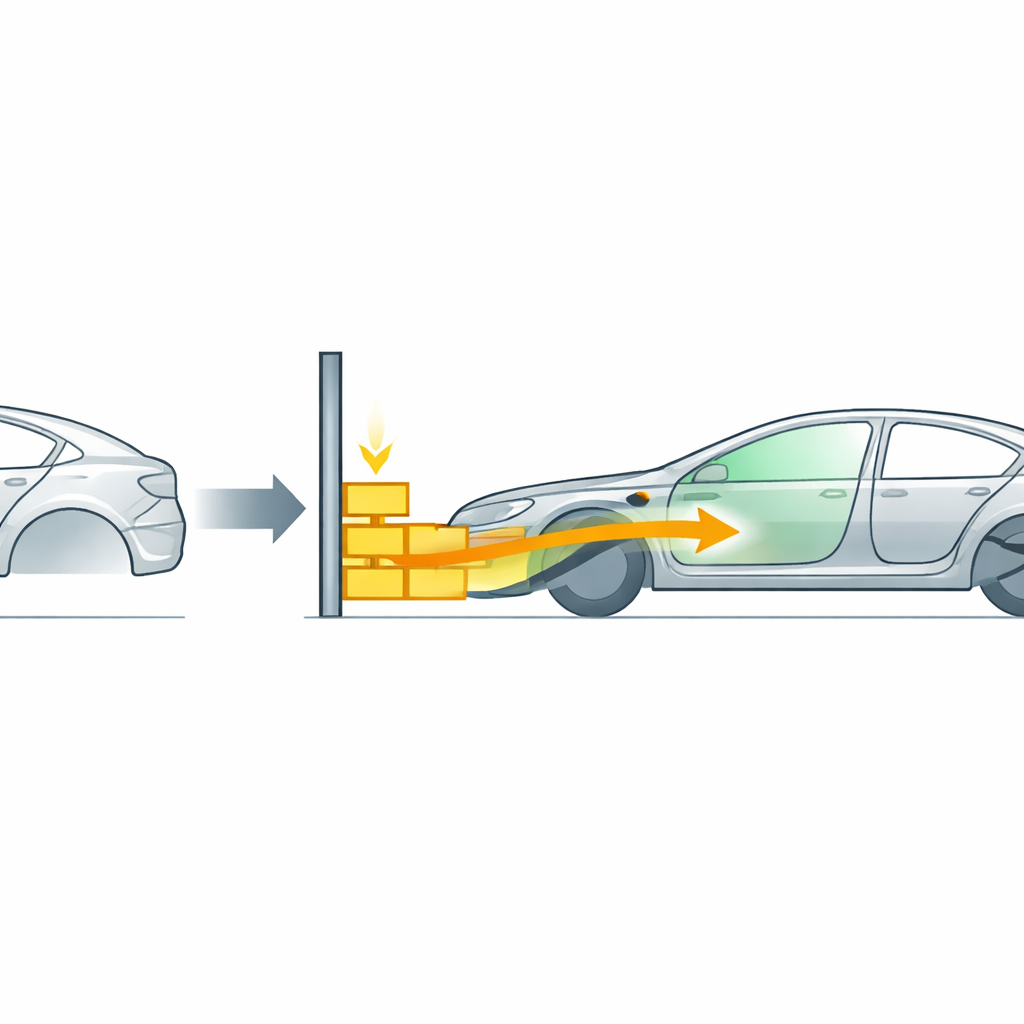
The hidden skeleton of your car
Beneath the paint, glass, and seats, every car has a welded steel frame called the body‑in‑white. It includes the long beams at the front that crumple in a crash, the floor and firewall that protect your feet, and the pillars that hold up the roof. The research team built a full digital version of this structure for a mid‑size passenger car, breaking it into hundreds of thousands of tiny shell elements—thin plates that mimic real metal panels. The model focuses only on the metal skeleton, leaving out parts like the engine and seats, to clearly see how the structure alone manages crash forces.
Recreating a full‑speed crash on a computer
The virtual car was fired straight into a rigid barrier at 64 kilometers per hour, the same severe test used in many New Car Assessment Program (NCAP) ratings. The digital crash tracked how energy moved from the car’s motion into bending and folding of the front beams, how far the footwell pushed backward, and how quickly the front pillar region decelerated—key clues to potential injury risk. The model was carefully checked for numerical health: almost all of the car’s initial motion energy, more than 92 percent, was soaked up as plastic deformation in the metal, while numerical artifacts stayed below 5 percent. These checks show the computer crash behaves like a real physical event rather than a flawed calculation.
Where the metal really goes to work
To see which areas of the structure work hardest, the authors used what they call “shotgun” plots: color maps showing where the steel is pushed beyond a chosen strain level. These maps revealed that the front crash boxes and rails do most of the heavy lifting in a frontal hit. About two‑thirds of the elements in the crash boxes and over half in the front rails exceeded a high strain threshold, confirming that these zones are the primary “sacrificial” regions designed to crumple and absorb energy. In contrast, the toe‑pan under the front occupants and the base of the front pillars showed significant but more limited deformation, flagging them as critical spots where added reinforcement could better protect legs and maintain cabin space. 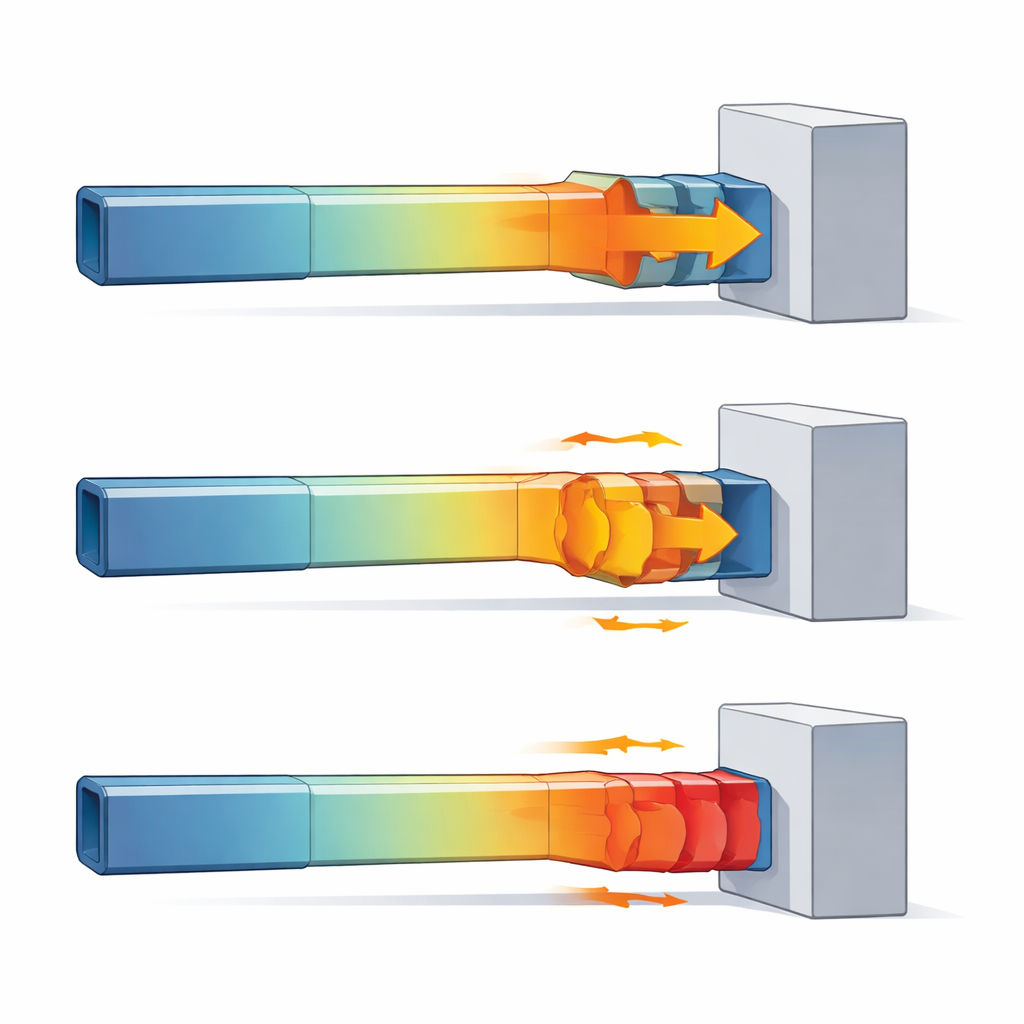
How well the digital crash matches real tests
A crucial question is whether such a detailed simulation can be trusted without running a matching physical crash. The researchers compared their results against publicly available NCAP crash pulses and published models. The peak deceleration at the front pillar region reached about 32 times the force of gravity, and the crash pulse lasted around 87 milliseconds—both comfortably inside typical NCAP ranges. The maximum inward movement of the toe‑pan was 123 millimeters, also in line with reported test data. Even the time‑integrated crash forces matched the expected change in vehicle momentum to within just over one percent, a tight check that the overall force history makes physical sense.
A digital path to safer, lighter cars
Viewed from a layperson’s perspective, the study shows that carefully built computer models can now mimic a violent head‑on crash with impressive fidelity, without crushing a single real car. By linking big‑picture measures—such as deceleration and cabin intrusion—to fine‑scale maps of where metal stretches and folds, the framework helps engineers decide exactly where to add or remove material to improve safety and reduce weight. The authors argue that this validated, simulation‑only approach can become a standard starting point for future work that brings in new materials, lighter designs, and even virtual human body models, speeding up the design of safer next‑generation vehicles before they ever leave the drawing board.
Citation: Ponnusamy, B. High-fidelity numerical framework for crashworthiness evaluation of passenger car body structures under full-frontal impact. Sci Rep 16, 10563 (2026). https://doi.org/10.1038/s41598-026-43474-z
Keywords: frontal crash, vehicle safety, finite element simulation, energy absorption, car body structure