Clear Sky Science · en
Cost-effective, open-source, automated apparatus for testing transitive inference in mice
Teaching Mice to Make Logical Leaps
Imagine being able to ask a mouse a logic question—if A is better than B, and B is better than C, which is better, A or C? This kind of reasoning, called “transitive inference,” is a basic building block of human thinking and is disrupted in conditions like schizophrenia and Alzheimer’s disease. The paper introduces AutoTI, a low-cost, fully automated setup that lets scientists probe this kind of reasoning in mice with far more precision, speed, and scale than before.
A Simple Box for Complex Thought
At the heart of the study is a small clear box containing six nose-poke ports: five on the front wall that act as “items” and one on the back wall that starts each trial. When the mouse pokes the back port, two of the front ports light up, and the animal must choose one. Poking the “better” port earns a small water reward and a short tone, while the wrong choice triggers a burst of noise and a brief timeout. By carefully controlling which pairs of ports light up and which one pays off, the researchers teach the mice a hidden order among the five ports, like A>B>C>D>E, without ever showing the full sequence at once. 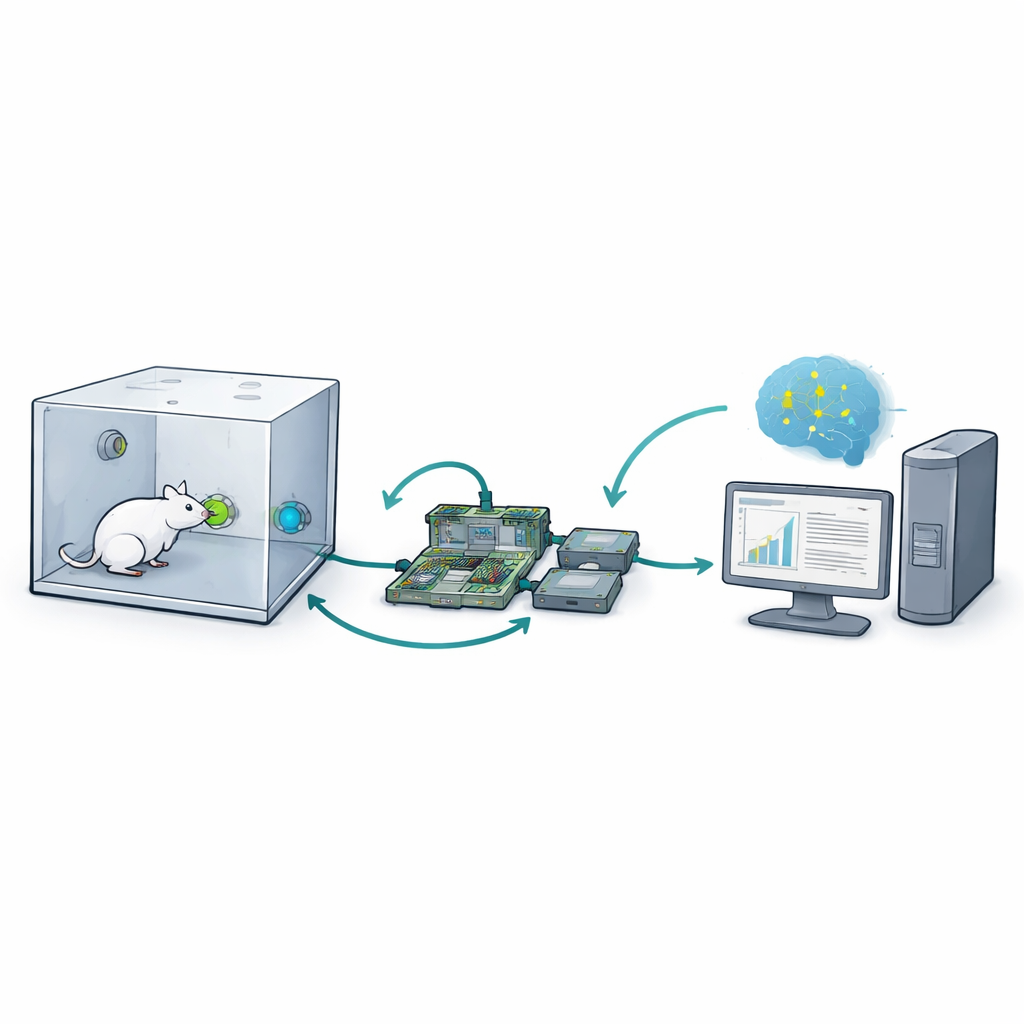
Open-Source Hardware Behind the Scenes
AutoTI runs entirely on open-source electronics and software, keeping the price of a full chamber to about the cost of a basic laptop. A small microcontroller board interfaces with the nose ports, valves, and speaker, while a separate program controls an overhead webcam that records every move the mouse makes. The task logic is written in freely available code, and all hardware designs can be downloaded and either hand-assembled or ordered from vendors. This means any lab, not just well-funded ones, can build multiple chambers and run many mice in parallel, making large, carefully controlled experiments on reasoning in animals much more practical.
Probing Mouse Logic Without Human Hands
Using AutoTI, the team trained dozens of mice on overlapping pairs of port choices—first learning that A beats B, then that B beats C, and so on. After several weeks of short, fully automated sessions each day, many mice learned these building-block comparisons with high accuracy. The crucial test came when the animals were asked to choose between B and D, a pair they had never seen together before. To do well, the mouse has to mentally stitch together past experience—if B beat C, and C beat D, then B should beat D. Most mice did exactly that, choosing B far more often than expected by chance, and many got nearly every such trial correct from the very first attempt. This behavior mirrors human results and shows that the animals were not just memorizing specific port pairs, but had formed an internal sense of order.
When Space Helps—and When It Hides the Story
The researchers also explored how the physical layout of the ports shapes what the mice learn. In one version, the five ports were arranged so that the hidden order matched their left-to-right positions; simply favoring one side could help the animal win. In another version, the same five ports were rearranged so that the order could not be read directly from space. With the straightforward layout, mice learned the task faster, but their behavior lacked two classic hallmarks of true hierarchical knowledge: they did not show stronger performance for pairs that were far apart in the hidden order, nor the characteristic pattern where “end” items in the sequence are easiest to judge. Those signatures only appeared when the spatial shortcut was removed, suggesting that in the more challenging layout the mice really were constructing an internal mental map of the relationships rather than relying on a simple side bias.
Reading Minds Through Movement
Because AutoTI continuously records video, the team could go beyond simple right-or-wrong scores and study how the mice moved in the chamber. High-performing mice took quick, direct paths from the initiation port to the correct choice, largely ignoring the port that was never rewarded. Lower-performing animals wandered more, covering longer distances and taking less efficient routes. The best reasoners also showed more frequent head-scanning movements, a behavior linked in past work to deliberation in rodents. These subtle motion patterns provide a new behavioral window into when a mouse is “thinking through” a choice, opening the door to linking specific brain signals with different stages of reasoning. 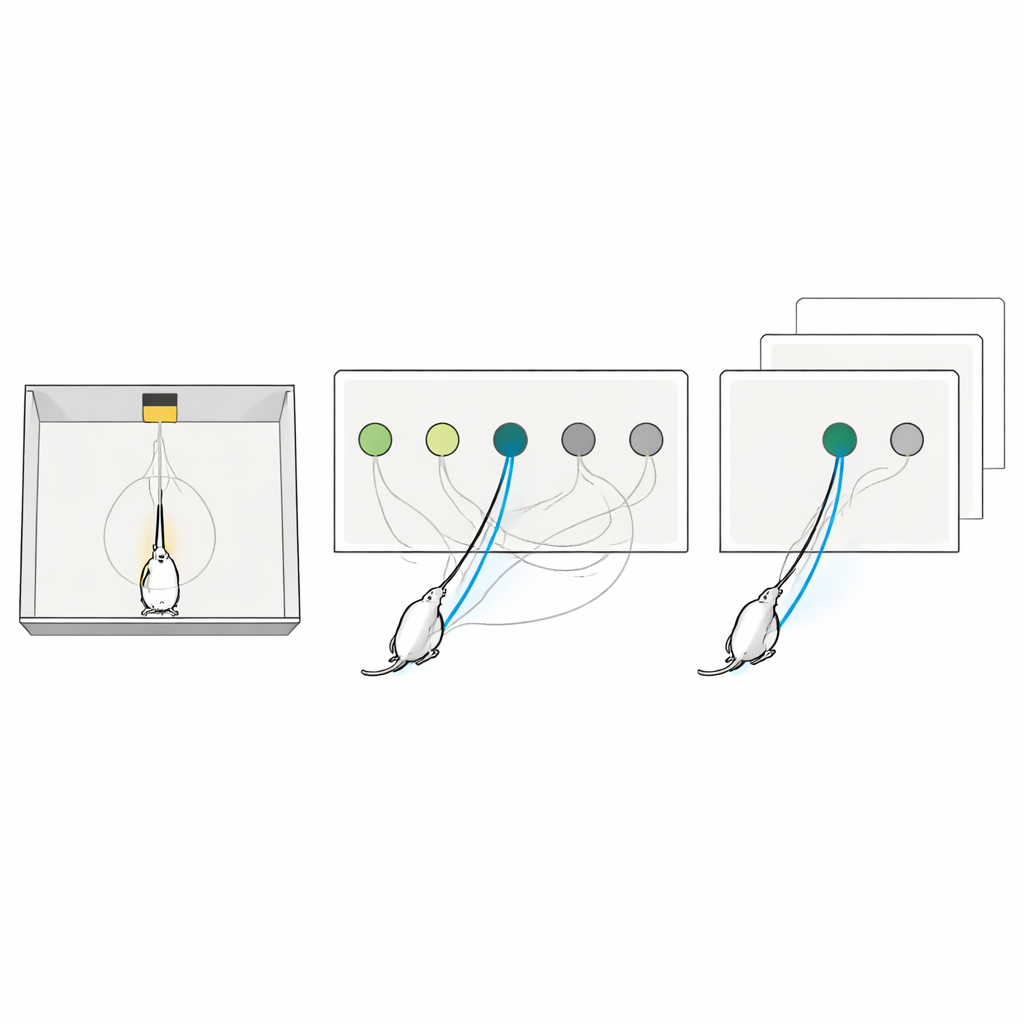
Why This Matters for Brains and Machines
In the end, AutoTI is less about clever hardware and more about what that hardware makes possible. With an inexpensive, scalable, and hands-off way to test logical reasoning in mice, researchers can now combine this task with tools that record or manipulate brain activity cell by cell. That will help reveal how brain regions like the hippocampus and prefrontal cortex work together to build internal maps of knowledge and use them to make inferences in new situations. Because similar reasoning is impaired in several psychiatric and neurodegenerative disorders—and is a key challenge for artificial intelligence systems—the AutoTI approach offers a powerful bridge between basic neuroscience, disease research, and the quest to build machines that can reason more like brains do.
Citation: Margarian, S., Chen, Y., Waheed, J. et al. Cost-effective, open-source, automated apparatus for testing transitive inference in mice. Sci Rep 16, 13071 (2026). https://doi.org/10.1038/s41598-026-43430-x
Keywords: transitive inference, mouse cognition, automated behavior, relational memory, open-source neuroscience