Clear Sky Science · en
Investigation of finite element simulation-based bond-slip effect for seismically vulnerable school reinforced concrete building frame
Why School Buildings and Hidden Cracks Matter
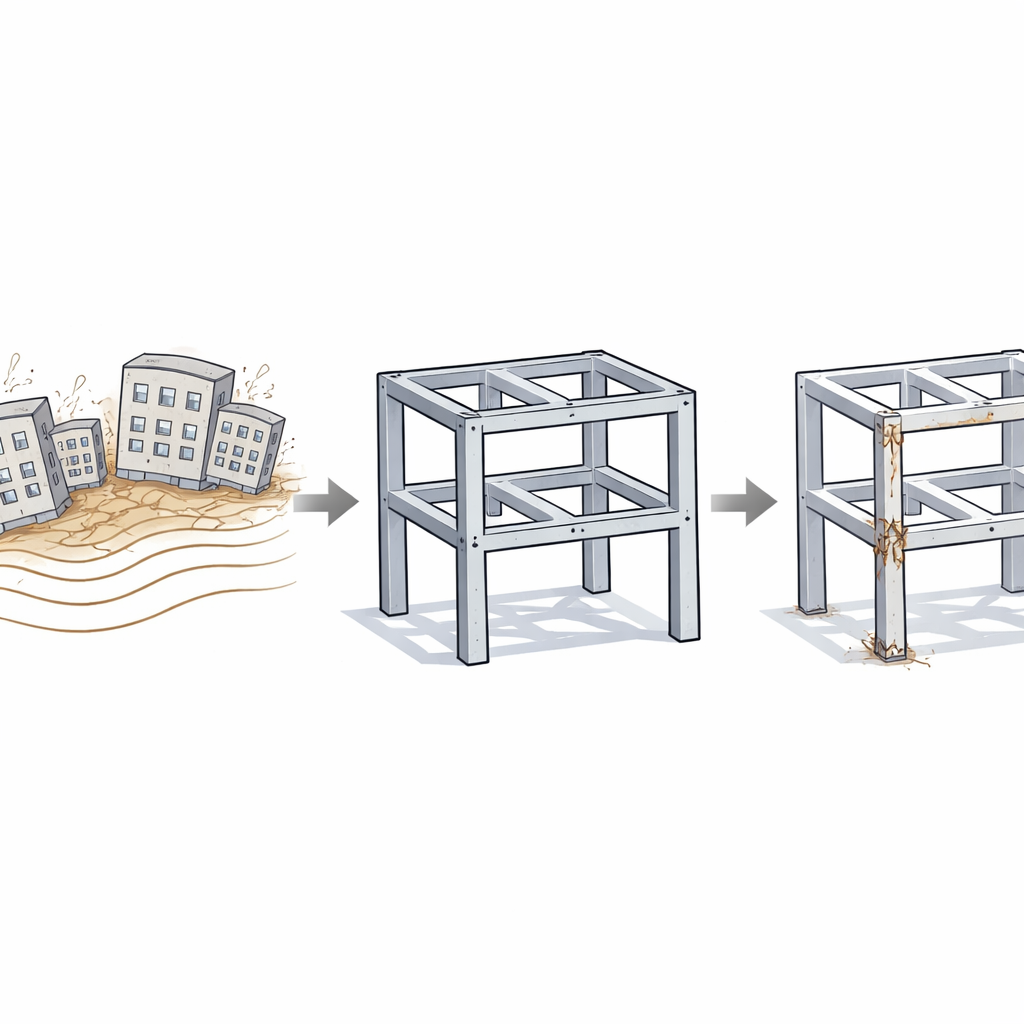
Across the world, earthquakes have repeatedly damaged or collapsed school buildings, turning classrooms into dangerous places. Many of these schools are made of reinforced concrete, where steel bars are embedded inside concrete columns and beams. Engineers usually assume that steel and concrete are perfectly glued together, moving as one. In reality, during strong shaking, the steel can slip inside the concrete, changing how the whole building behaves. This study explores how that hidden slipping—called bond-slip—affects the way vulnerable school buildings respond to earthquakes, and how better computer models can prevent us from overestimating their safety.
Lessons from Past Earthquakes
Several destructive earthquakes in Italy, China, and South Korea exposed a common weakness: older school buildings were not designed with modern seismic rules in mind. Their columns and joints often have thin and widely spaced stirrups, sharp 90-degree hooks, and overly thick concrete cover. These details reduce how well the concrete can hold the steel bars and resist shear forces. In past events, damage concentrated in the lower stories, especially at column bases and beam-column joints, where bending, shearing, and bond failure between steel and concrete combined to create soft stories and partial or total collapse. Because many similar buildings remain in service, understanding and simulating these failure patterns is crucial for realistic seismic safety assessments and retrofit design.
From Laboratory Frames to Digital Twins
To ground their models in reality, the authors used test results from a two-story reinforced concrete school frame built at two-thirds full scale, following 1980s Korean school design standards that lacked seismic provisions. The specimen was pushed back and forth in a controlled manner while a constant vertical load mimicked the weight of the building. Instruments tracked lateral displacements and internal steel strains. The frame developed flexural, vertical, and diagonal cracks, with severe damage at first-story columns and joints. Vertical cracks along the steel bars and early loss of stiffness showed that slipping between steel and concrete occurred before the bars themselves yielded, underscoring that bond behavior—not just steel strength—can dominate how these structures degrade.
Three Ways to Model the Invisible Slip
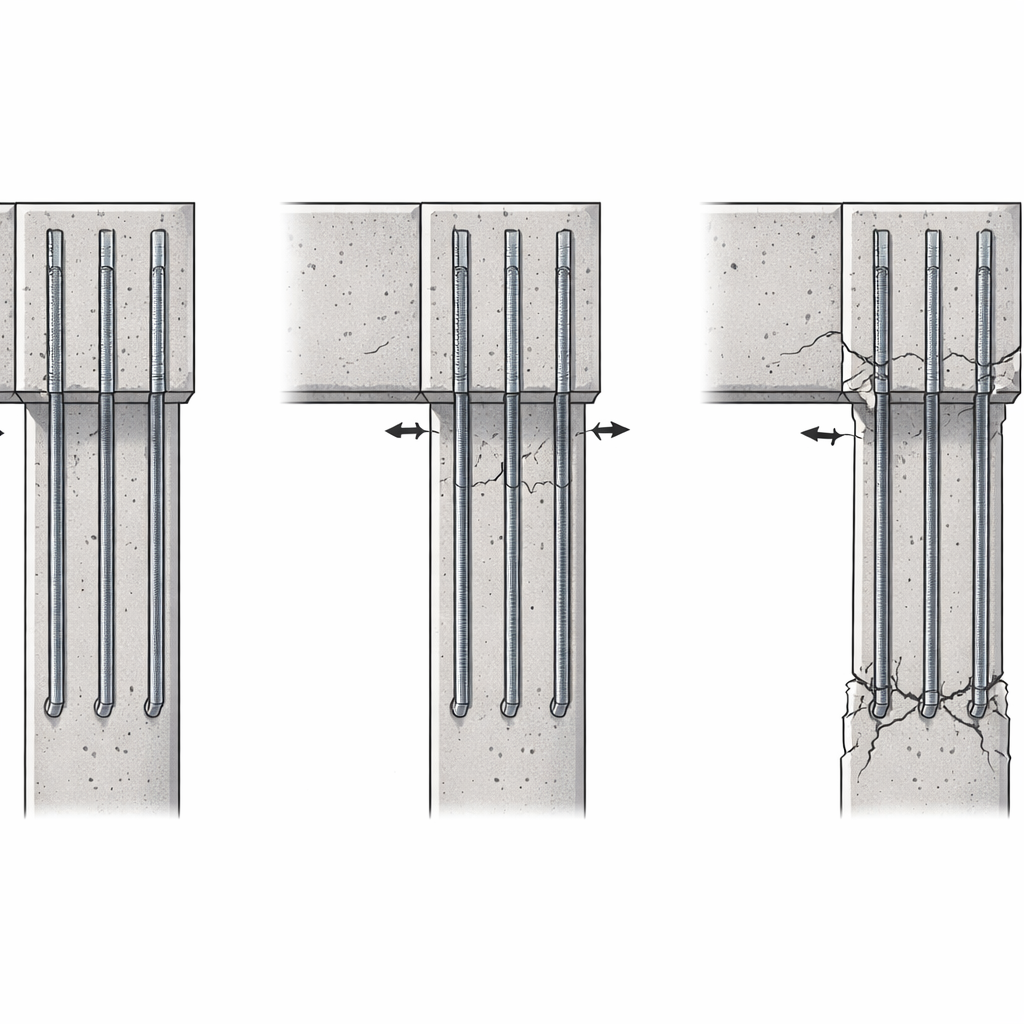
The researchers then built a detailed finite element model of the columns, joints, and the full two-story frame using the LS-DYNA software. They tested three different ways to represent the connection between steel bars and surrounding concrete. In the "perfect bond" model, steel and concrete share the same nodes, enforcing no slip at all. In the "linear-elastic" model, spring-like links allow some relative movement with constant stiffness, capturing friction but not true bond failure. In the "nonlinear-inelastic" model, the springs follow a realistic bond–slip curve taken from design recommendations: bond strength increases with small slip, peaks, and then gradually softens as damage accumulates. This last approach was applied especially to the first-story column reinforcement, where experiments showed bond failure had the greatest impact on the overall frame behavior.
What the Simulations Revealed
By comparing simulated and measured hysteresis curves—plots that show how force and displacement loop during back-and-forth loading—the team evaluated three key performance measures: effective stiffness, maximum strength, and energy dissipation. The traditional perfect-bond model consistently made the structure look stronger and tougher than it really was, overestimating maximum strength by about 38% and energy dissipation by more than 50% in the full frame. The linear-elastic bond model reduced these errors but still exaggerated strength and energy by around 25–40%, because it did not allow bond strength to drop after cracking. In contrast, the nonlinear bond-slip model closely matched the tests: effective stiffness, maximum strength, and energy dissipation all differed from experiments by less than about 8%, and the predicted crack patterns and damage locations at column bases and joints mirrored what was seen in the laboratory.
What This Means for Safer Schools
For non-specialists, the key message is that standard computer models, which assume steel and concrete never slip apart, can give a false sense of security for older reinforced concrete school buildings. They tend to underestimate how quickly stiffness and strength degrade and how much energy the structure truly can absorb before severe damage. By explicitly modeling how steel bars gradually break free from concrete, engineers obtain more realistic predictions of damage and collapse risk. The study suggests that even simplified versions of the nonlinear bond-slip approach could significantly improve routine seismic assessments and retrofit designs, helping ensure that when the next earthquake strikes, school buildings behave more like the carefully validated models—and far less like the unexpectedly fragile structures seen in past disasters.
Citation: Kang, H., Lee, K., Shin, S. et al. Investigation of finite element simulation-based bond-slip effect for seismically vulnerable school reinforced concrete building frame. Sci Rep 16, 12809 (2026). https://doi.org/10.1038/s41598-026-43419-6
Keywords: reinforced concrete school buildings, earthquake performance, bond-slip modeling, finite element simulation, seismic retrofitting