Clear Sky Science · en
Habituation and sensitization learning in adult solitary ascidians
How a Simple Sea Creature Sheds Light on Learning
When we think about learning and memory, we usually picture brains packed with billions of neurons, like those of humans or other mammals. Yet even much simpler animals must decide what to ignore and what to fear in their surroundings. This study explores learning in an unlikely candidate—the solitary sea squirt Polycarpa mytiligera, a bag-like marine animal fixed to rocks on the sea floor. By showing that these creatures can learn from experience and remember over days, the work offers a new window into how basic learning processes may have evolved in our own distant ancestors.
Meeting the Sea Squirt
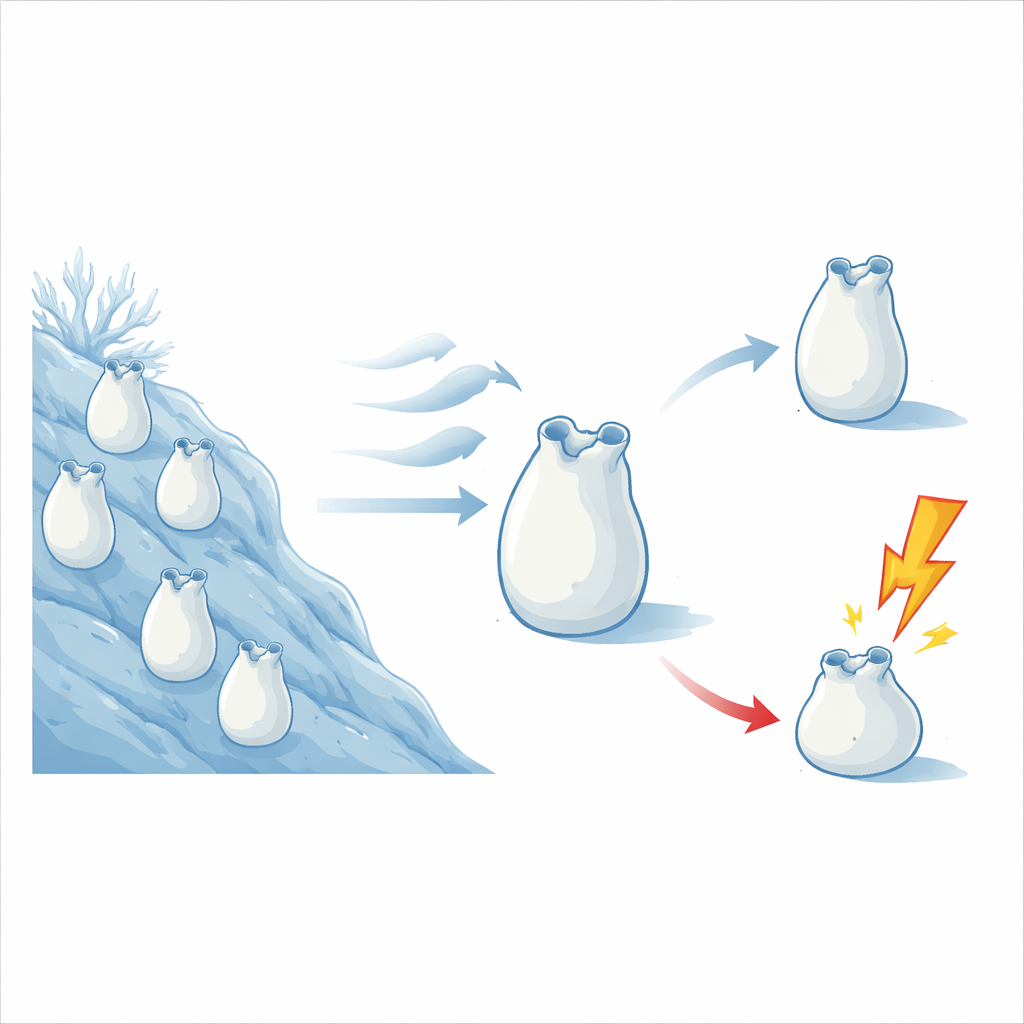
Sea squirts are small, soft-bodied filter feeders that spend their adult lives anchored in place, drawing seawater in through one opening and pushing it out through another. These openings, called siphons, are essential for breathing and feeding, but also leave the animal exposed to potential threats. Their main defense is simple and swift: when touched or disturbed, the siphons snap shut and the body contracts. Polycarpa mytiligera, common in the Red Sea, is especially interesting because it is a chordate—a member of the same broad group that includes all vertebrates—as well as a champion of whole-body regeneration. Although its nervous system consists of only about 10,000 neurons, it nonetheless supports complex behaviors that can now be probed in detail.
Learning to Ignore Harmless Touch
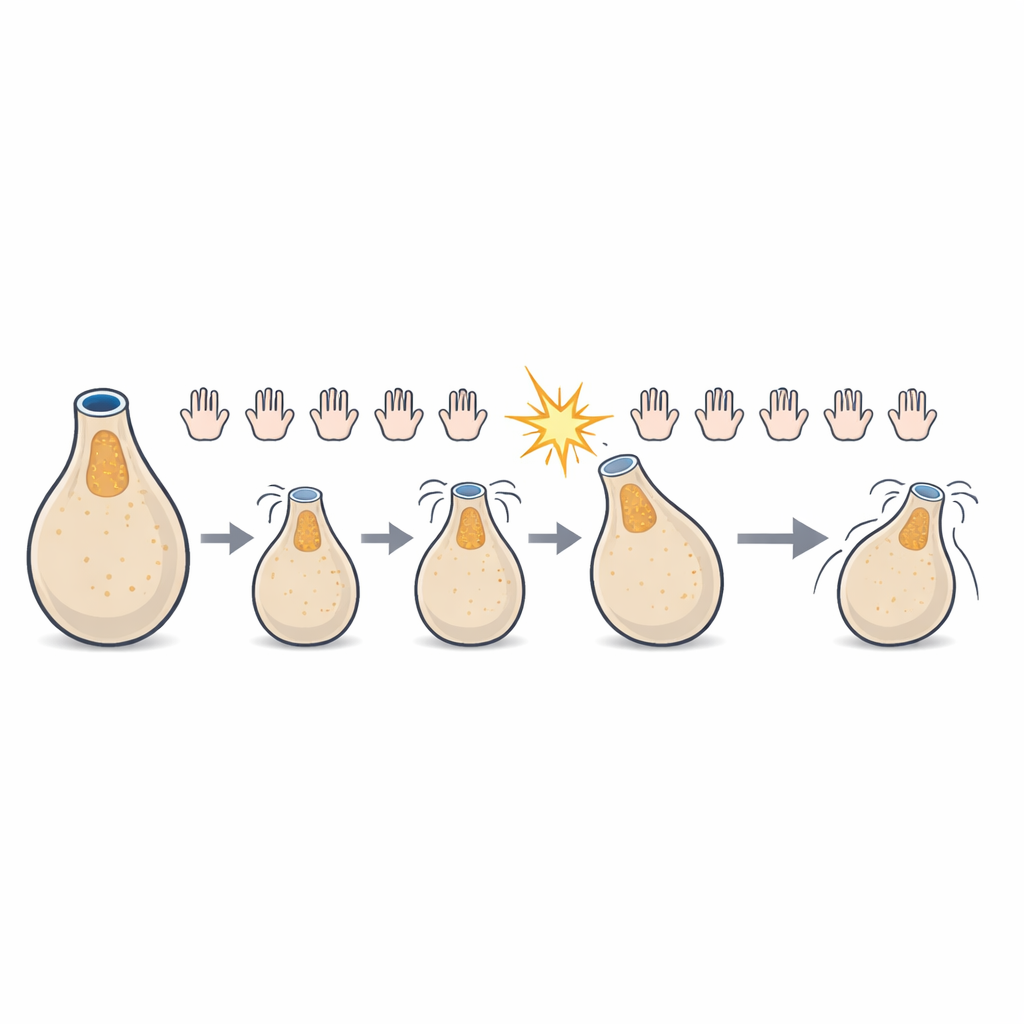
The researchers focused on a basic kind of learning called habituation: the gradual fading of a response to a repeated, harmless stimulus. They gently brushed the area near the sea squirt’s oral siphon once a minute, in ten-trial sessions repeated over six days. A camera recorded how much the siphon opening shrank after each touch, and specialized tracking software converted the movement into a numerical index of contraction strength. Over days of training, the sea squirts’ defensive reaction steadily weakened. By about the third day, their siphons no longer clamped down as strongly, and further training produced little additional change. When the animals were tested again after a day’s rest, those that had experienced repeated brushing still showed much smaller contractions than untrained animals, indicating that the reduced response was not just brief fatigue but a lasting learned change.
Becoming Extra Alert After a Shock
The team then examined sensitization, the flip side of habituation. Here, an intense or unpleasant event heightens an animal’s responsiveness to subsequent mild stimuli. Two groups of sea squirts first received a short session of gentle touches, which caused some initial decline in response. One group then received a brief but strong electrical shock delivered through tiny electrodes; the other group simply rested. After a short pause, both groups again received the same mild brushing. The shocked animals now reacted with much stronger siphon contractions than their unshocked counterparts, and their own responses were clearly larger than before the shock. This rebound above the original level shows true sensitization rather than just undoing of habituation, revealing that the animals can become temporarily "on edge" after a disturbing event.
Why These Simple Behaviors Matter
Although the sea squirt’s nervous system is far simpler than that of classic invertebrate models like the marine snail Aplysia, its learning abilities are surprisingly similar. The animal can dampen its reaction to repeated harmless events within and across days, yet quickly ramp up its defenses after a threatening shock. Because sea squirts are among the closest living relatives of vertebrates, these shared forms of learning hint at deep evolutionary roots for basic memory processes. Combined with Polycarpa mytiligera’s remarkable ability to regenerate its entire body, including its central nervous system, this study sets the stage for future experiments on how memories are stored and possibly rebuilt. For non-specialists, the key message is straightforward: even a seemingly simple sea creature can distinguish between noise and danger, teaching us that the foundations of learning and memory may be both ancient and widely shared across the tree of life.
Citation: Gabso, B., Zer-Eshel, G., Cohen, S. et al. Habituation and sensitization learning in adult solitary ascidians. Sci Rep 16, 13529 (2026). https://doi.org/10.1038/s41598-026-43408-9
Keywords: learning and memory, habituation, sensitization, sea squirts, ascidians