Clear Sky Science · en
Performance evaluation of strengthened concrete beams: flexural and shear enhancement using chopped strand and woven roving mats
Stronger bridges and buildings
Many of the bridges and buildings we rely on every day are made of concrete beams that slowly lose strength as they age and carry heavier traffic than they were designed for. This study explores a relatively simple way to give those beams a new lease on life by wrapping them with thin glass fiber skins, making them safer and more durable without tearing the structure apart or adding bulky supports. 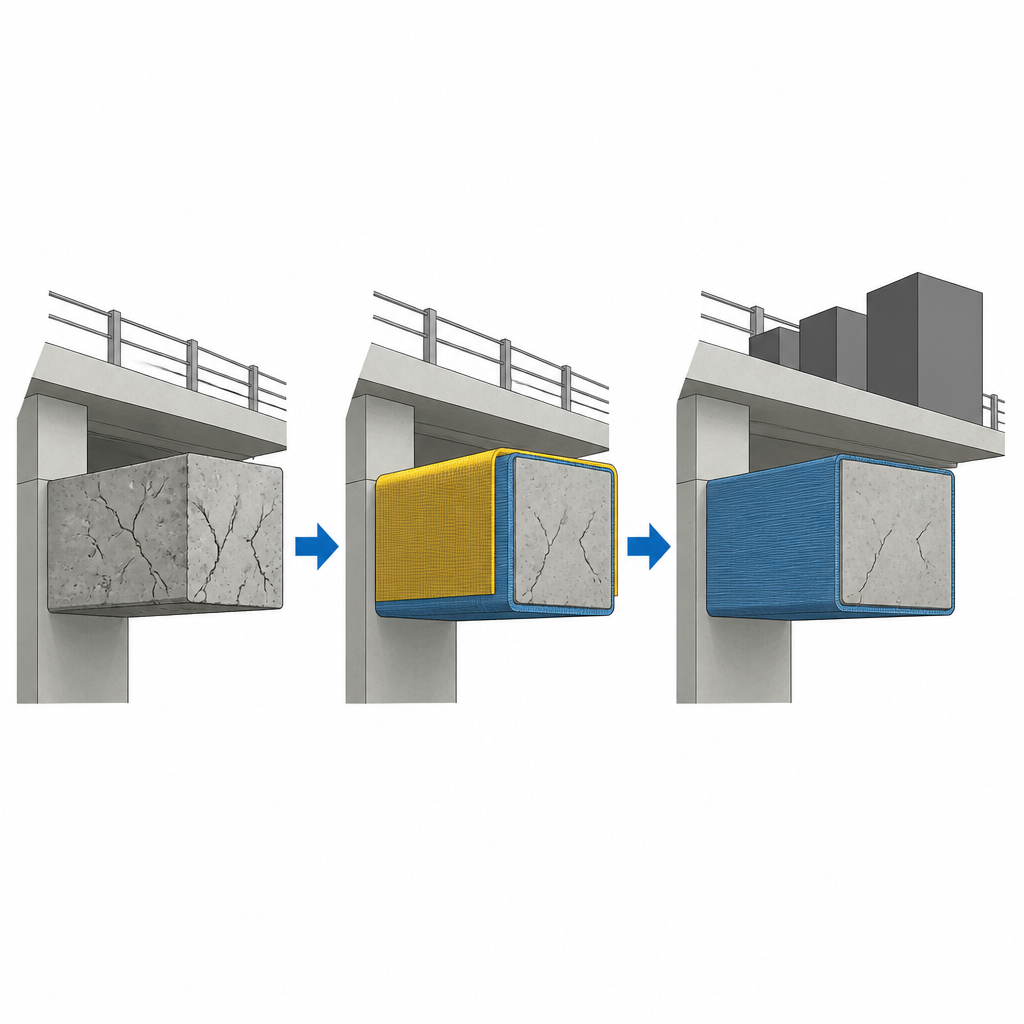
How concrete beams usually fail
Concrete is very good at carrying squeezing forces but poor at handling stretching forces, which show up as bending and sliding in a beam. Over time, beams develop visible cracks that can grow suddenly, leading to brittle breakage with little warning. The researchers focused on two key ways beams can fail: bending in the middle, which makes them sag, and shear near the supports, which causes sharp diagonal cracks and abrupt collapse. Understanding and improving these two weak spots is critical for the safety of everyday structures like floors, bridges, and parking decks.
Wrapping beams with glass fiber skins
Instead of replacing weak beams, the team tested thin glass fiber mats that could be glued to the outside of a beam like a bandage. They used two types of mats: a fuzzy, randomly oriented layer called chopped strand mat and a neater woven layer called woven roving mat. Both were bonded with an epoxy glue and applied in a U shape around the sides and bottom of each concrete beam, leaving the top face free so the beam could still sit on supports. Eight full-size beams were built and divided into groups to study bending and shear separately, each group including one unwrapped control and beams wrapped with one layer of each mat alone or both together. 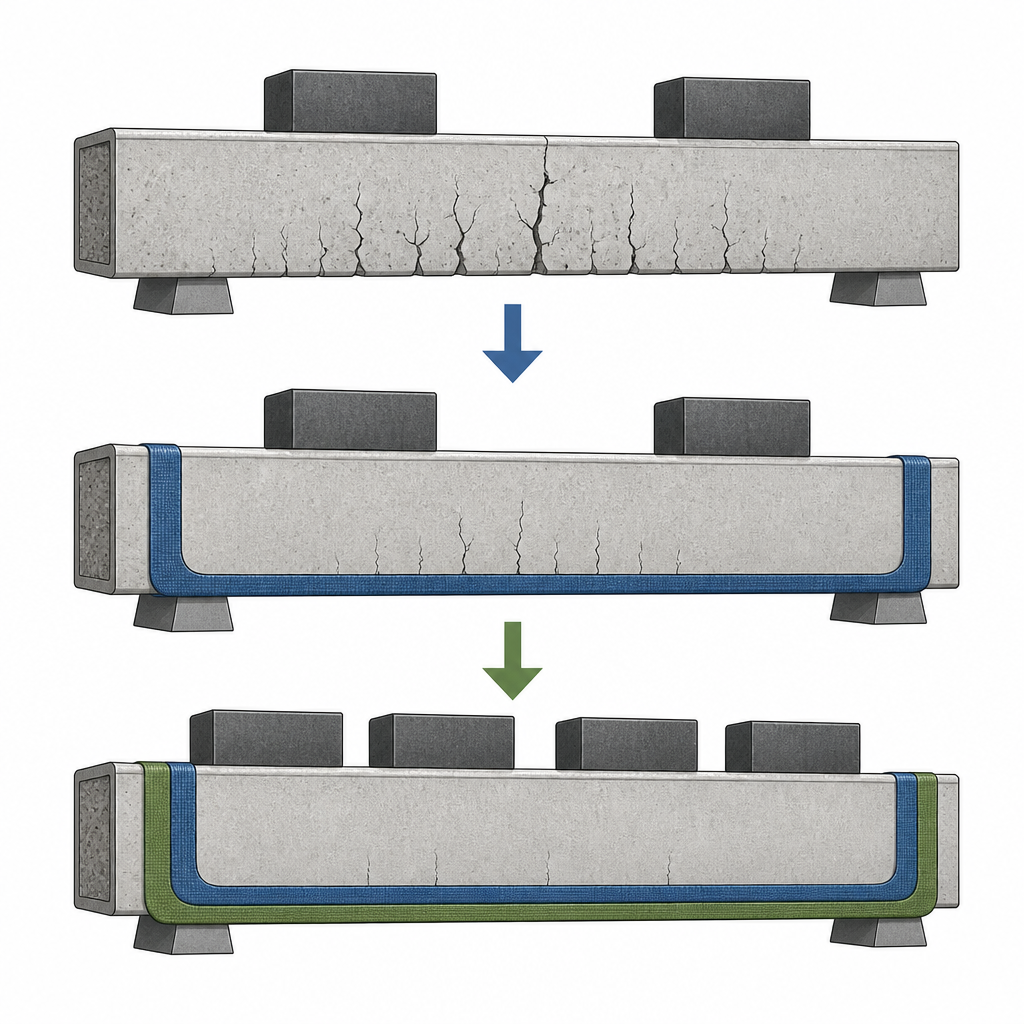
What the experiments revealed
The beams were placed in a testing frame and loaded with hydraulic jacks until they failed, while the team tracked how much they bent, how their internal stiffness changed, and how cracks formed and spread. Wrapping delayed the first appearance of cracks and allowed the beams to bend more and absorb more energy before breaking. In bending tests, the unwrapped beam carried 18.6 kilonewtons, while beams wrapped with the chopped mat, the woven mat, and the hybrid of both reached 23.6, 27.2, and 31.84 kilonewtons, respectively, up to about 42 percent more than the control. In shear tests, the same sequence raised the capacity from 18.6 to 24.0, 25.2, and 28.32 kilonewtons, increases of roughly 22 to 34 percent.
Why the hybrid wrap worked best
Careful readings of beam curvature, stiffness loss, and shear strain showed that the two glass mats contributed in different ways. The chopped mat offered widespread crack control and ductility, while the woven mat added stronger, better aligned fibers that carried more load across critical zones. When combined in a hybrid wrap, they worked together: cracks formed later, stayed narrower, and the beams carried higher loads in both bending and shear before failure. The tradeoff was that the weakest point shifted from the concrete itself to the glued interface, where some beams failed by the fiber layer peeling away, underscoring the importance of surface preparation and adhesive performance.
What this means for real structures
For non-specialists, the message is that thin, lightweight glass fiber jackets can significantly boost the strength and toughness of existing concrete beams without adding much weight or size. The study indicates that a U-shaped hybrid wrap using both chopped and woven glass mats is especially effective, improving how beams carry everyday bending and shear forces and how they behave when pushed close to failure. While the authors note that more tests are needed on larger sets of beams and long-term durability, their results suggest a practical path to extend the service life of aging concrete bridges and buildings using relatively simple external reinforcement.
Citation: Govindarajan, S., Devi, V., Yong, X. et al. Performance evaluation of strengthened concrete beams: flexural and shear enhancement using chopped strand and woven roving mats. Sci Rep 16, 15415 (2026). https://doi.org/10.1038/s41598-026-43304-2
Keywords: concrete beams, glass fiber wrapping, structural strengthening, flexural and shear capacity, retrofitting