Clear Sky Science · en
Smart decision framework for financial planning and investment optimization
Why Smarter Investing Matters Now
For anyone trying to grow savings, fund a pension, or invest responsibly, today’s financial world can feel overwhelming. Markets swing sharply, new digital assets appear overnight, and social and environmental concerns now sit alongside profits in many investors’ priorities. This paper explores a “smart” decision framework designed to help investors and policymakers navigate this complexity, blending hard numbers, expert judgment, and uncertainty into one coherent way to choose better portfolios.
From Chaotic Markets to Structured Choices
The authors start by describing how inflation, market volatility, geopolitics, and rapid technological change have made traditional investment tools look dated. Older models lean heavily on historical data and simple optimization formulas. They struggle to include investor sentiment, risk tolerance, and values such as environmental and social responsibility. They also tend to treat data as if it were perfectly reliable, even when markets are noisy and experts disagree. The result is a gap between how real investors think and how portfolios are actually built.
Blending Data and Human Judgment
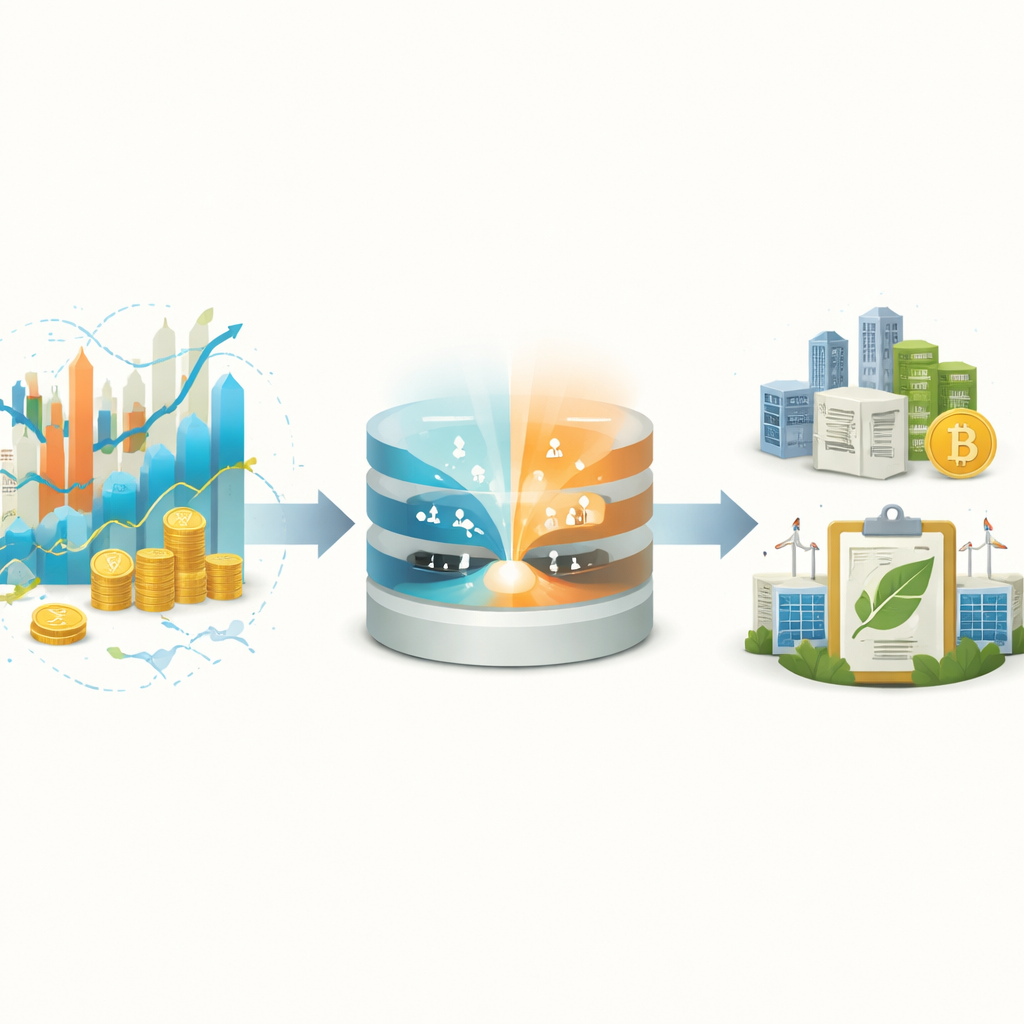
To close this gap, the paper proposes a hybrid decision system that deliberately combines two kinds of information: objective data and subjective expert views. On the data side, a technique called LOPCOW looks across many financial criteria—such as expected return, risk, diversification, liquidity, costs, and inflation protection—and assigns weights based on how informative and discriminating each measure is. On the judgment side, a method named RANCOM takes rankings from specialists such as institutional investors, analysts, ESG officers, and AI strategists, and turns their comparative preferences into another set of weights. These two sets are then merged, so no single viewpoint dominates: numbers keep experts honest, and experts ensure the numbers reflect real-world priorities.
Capturing Uncertainty Instead of Ignoring It
Real decisions rarely rest on crisp, certain inputs, so the framework is built to handle fuzziness directly. The authors use a mathematical device called intuitionistic fuzzy Z-numbers to represent not only how strongly an expert supports an assessment (for example, that a portfolio has “high liquidity”), but also how confident they are in that judgment. This allows the system to record hesitation and partial belief instead of forcing yes-or-no answers. On top of that, the ranking engine—an enhanced version of a method called PROMETHEE-II—relies on nonlinear distance and similarity measures. In plain terms, it can detect subtle differences between portfolios that look similar, and it is less easily thrown off by noisy or conflicting inputs.
Putting the Framework to Work
To test their approach, the authors evaluate eight modern investment strategies, ranging from a cryptocurrency fund and a real-estate tokenization model to sustainable infrastructure bonds, an AI-driven robo-advisory system, and an ESG-focused portfolio. Ten criteria reflect both financial performance and broader concerns: expected returns, risk and downside loss, liquidity, protection against inflation, diversification, transaction costs, an AI confidence index, and a combined environmental, social, and governance (ESG) score. Multiple experts assess each option using linguistic terms like “strong” or “weak,” which are converted into the fuzzy numbers the model can process. The system then aggregates these inputs, computes blended weights, and ranks the portfolios through its refined preference engine.

What Rises to the Top—and Why It Stays There
The resulting rankings consistently place the ESG-focused portfolio in first place. It offers solid expected returns, good diversification, and strong ESG performance, which together improve resilience under volatile conditions and reduce regulatory and reputational risks. The AI-driven robo-advisory system and a quantitative hedge strategy follow, reflecting the growing power of advanced analytics for managing risk and adapting to change. A cryptocurrency fund comes last: while it offers high potential upside, its extreme volatility and regulatory uncertainty make it the least attractive overall once risk, stability, and sustainability are all considered. Importantly, sensitivity checks—changing how much weight is given to data versus experts, and tweaking technical parameters—barely affect the ordering, showing the rankings are robust rather than fragile.
What This Means for Everyday Investors
In simple terms, the article concludes that smarter financial planning does not require choosing between formulas and human insight—it works best when the two are carefully combined and uncertainty is made explicit instead of hidden. By integrating objective metrics, expert experience, and measures of confidence into a single transparent process, the proposed framework offers investors and policymakers a clearer, more reliable way to compare complex portfolio choices. It also shows that when sustainability is evaluated alongside profit and risk in a disciplined way, ESG-focused strategies can emerge not as feel-good add-ons, but as top-performing, future-ready investments.
Citation: Chen, X., Shen, A. Smart decision framework for financial planning and investment optimization. Sci Rep 16, 13089 (2026). https://doi.org/10.1038/s41598-026-43270-9
Keywords: sustainable investing, portfolio optimization, decision support systems, financial risk management, expert judgment