Clear Sky Science · en
Route evaluation strategy of the Beijing-Tianjin multi-airport system based on the two-dimensional evaluation framework
Why Flight Routes Matter to Everyday Travelers
When you book a flight from Beijing or Tianjin, you probably care about price, punctuality, and convenience—not how airports juggle dozens of overlapping routes. Yet behind the scenes, China’s fast-growing civil aviation system struggles with crowded skies, duplicated routes, and underused resources. This study looks under the hood of the Beijing–Tianjin multi-airport system to ask a deceptively simple question: are all these routes actually pulling their weight, and are they assigned to the right airports? The answers help explain why some flights feel effortless while others seem perpetually marginal, and they point to smarter ways to organize air travel in major city regions.

Three Neighboring Airports, One Shared Problem
The Beijing–Tianjin region is served by three major airports: Beijing Capital, Beijing Daxing, and Tianjin Binhai. Together they form a dense web of routes to dozens of shared destinations. Instead of working like a coordinated team, however, these airports often chase the same markets with similar routes. This “route homogenization” creates wasteful competition, duplicate flights and less-than-full planes, while some communities remain underserved. Unlike older multi-airport regions in Europe or North America, where each airport has a clearer role—such as international hub, low-cost base, or regional gateway—China’s airports are still refining who should specialize in what.
Measuring Route Quality, Not Just Airport Size
Most earlier research judged performance at the level of entire airports or airlines, averaging together thousands of flights. This paper zooms in instead on individual routes shared across the three airports, asking two separate questions. First, what is the operational level of a route—does it match the airport’s official role, offer convenient schedules, and carry enough passengers to matter? Second, what is the route’s operational efficiency—how well does it turn inputs like flights, seats, aircraft types and operating airlines into actual passenger journeys? By separating “how important and well-positioned a route is” from “how efficiently it uses resources,” the authors can spot hidden strengths and weaknesses that a single score would miss.
From Raw Data to a Two-Dimensional Map
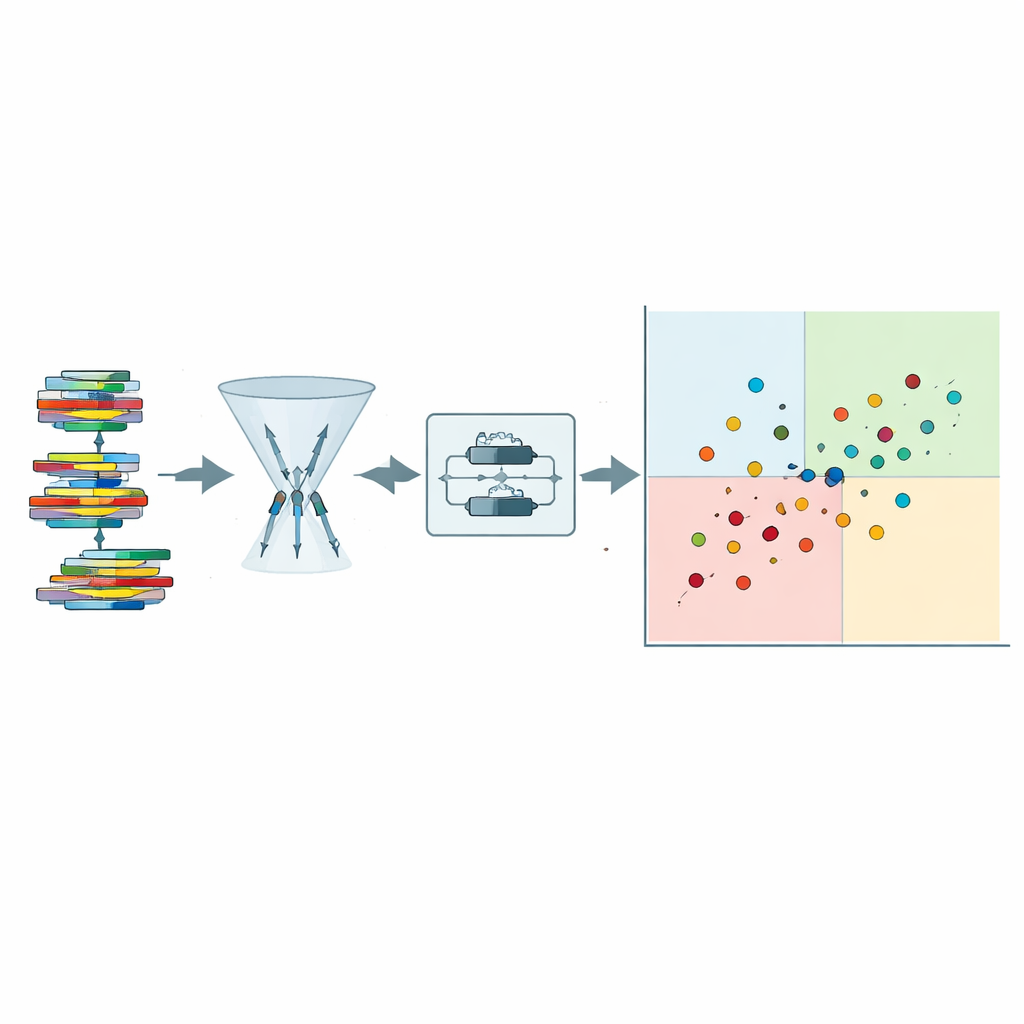
To rate operational level, the study combines several indicators: how closely a destination’s airport fits Beijing Capital or Daxing’s role as international hubs, or Tianjin’s role as a regional hub; how often flights operate each week; on-time performance; how well the destination connects onward to other cities; how many passengers the route carries; and how full the planes typically are. A refined "entropy–TOPSIS" method assigns objective weights to these indicators, favoring those that genuinely distinguish strong routes from weak ones. To assess efficiency, the authors use a three-stage DEA model, which first estimates how effectively each route converts inputs into passenger output, then strips out the effects of local factors like regional income and population, and finally recalculates efficiency as if all routes operated under the same economic conditions. This allows a fair comparison between, say, a busy coastal city and a smaller inland town.
Four Types of Routes, Four Management Strategies
With both scores in hand, each route is placed on a simple two-axis chart: operational level on one side and efficiency on the other. This creates four categories. “Double-excellent” routes, such as flights from Beijing to Shanghai, Guangzhou, Shenzhen and key tourist hotspots, both fit the airport’s role and use resources very efficiently; these should be protected and nurtured. A second group has high operational level but low efficiency—big, in-demand routes whose planes and schedules are not used optimally; here, managers might tweak aircraft size, flight frequency or how routes are split between Capital and Daxing. A third group has low operational level but high efficiency: smaller, niche routes that don’t perfectly match a hub’s mission but run lean and well; the authors suggest keeping them, possibly as connecting or transfer-focused services. Finally, “double-low” routes perform poorly on both dimensions; for these, reducing frequency, shifting them to Tianjin, or even canceling them can free up valuable slots.
What This Means for Travelers and Cities
For non-specialists, the core message is straightforward: not every flight is equally valuable to a city’s air network. By judging each route on both its strategic role and its actual efficiency, the Beijing–Tianjin airports can cut wasteful duplication, strengthen key corridors, and better serve both business centers and tourist regions. The proposed two-dimensional framework is simple enough to be applied to other airport clusters worldwide, from Los Angeles to London. If adopted widely, this kind of route-level “health check” could make air travel networks more reliable and sustainable—delivering fuller planes, smarter schedules, and better use of limited runways and airspace.
Citation: Li, Y., Liu, Y. Route evaluation strategy of the Beijing-Tianjin multi-airport system based on the two-dimensional evaluation framework. Sci Rep 16, 14463 (2026). https://doi.org/10.1038/s41598-026-43096-5
Keywords: multi-airport systems, air route efficiency, Beijing Tianjin airports, air network planning, data envelopment analysis