Clear Sky Science · en
Water hazard prevention technology for confined mining beneath dual extremely thin aquicludes in roof and floor
Why water matters in deep coal mines
Deep underground, coal miners face an invisible enemy: pressurized groundwater trapped in rock layers above and below the coal. If those natural rock "plugs" that keep the water in place are very thin, mining can suddenly open hidden pathways and unleash violent floods. This paper explores how to mine such dangerous coal seams safely by reshaping the rock and water system around them.
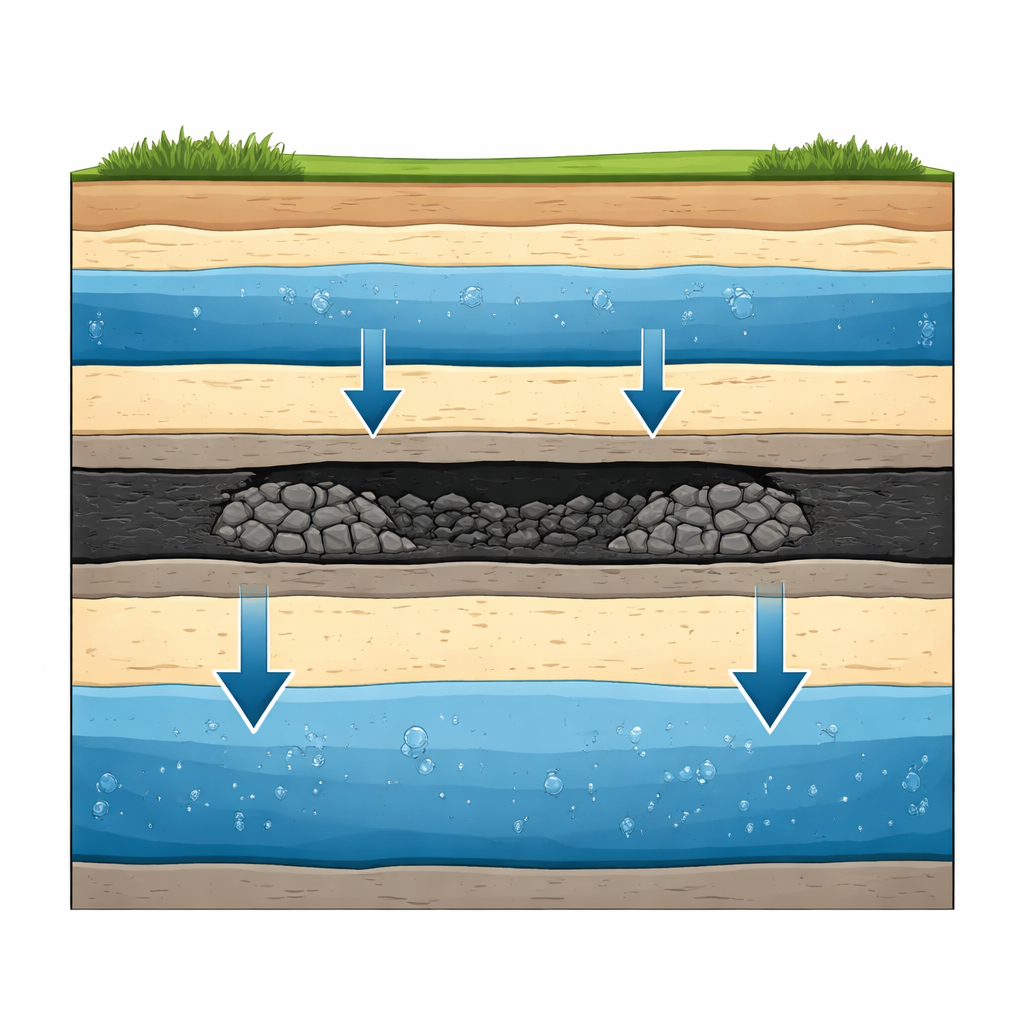
A fragile sandwich of rock and water
The authors focus on a mine in northern China where a coal seam lies like the filling in a sandwich between water-bearing rock layers above and below. Only very thin layers of relatively tight rock separate the coal from these aquifers, which hold water under high pressure. Conventional approaches can usually deal with water coming from either the roof or the floor alone, but here both directions are risky at the same time. Earlier research mostly treated single aquifers or thicker protective layers, leaving this “dual thin barrier” situation largely unstudied and many such seams effectively off-limits.
Testing safe and unsafe ways to mine
To understand what happens when the coal is removed, the team built a detailed three-dimensional computer model of the mine’s geology and simulated four different approaches: ordinary mechanized mining, strengthening the floor with injected grout, filling the mined-out void with solid material, and a combination of floor grouting plus backfill. The model tracks how stresses shift in the surrounding rock and where it cracks or fails. If fractures extend through the thin protective layers into the aquifers, water can connect directly with the mining void, posing a serious inrush hazard.
What goes wrong when only one side is protected
The simulations show that mining without any special measures produces tall fracture zones in the roof and deep damage zones in the floor, both easily reaching nearby aquifers. Reinforcing only the floor with grout does help: it creates an artificial, stronger barrier that greatly cuts the depth of damage below the seam. Yet the roof still develops a tall cracked zone that can link to the overlying water. Filling the mined-out cavity, on the other hand, is very effective for the roof. The backfill supports the overlying rock, smooths out stress peaks, and keeps roof fractures much shorter than the thin protective layer above. However, the floor remains close to its breaking limit, and in weak spots the cracked zone can still touch a water-bearing layer.
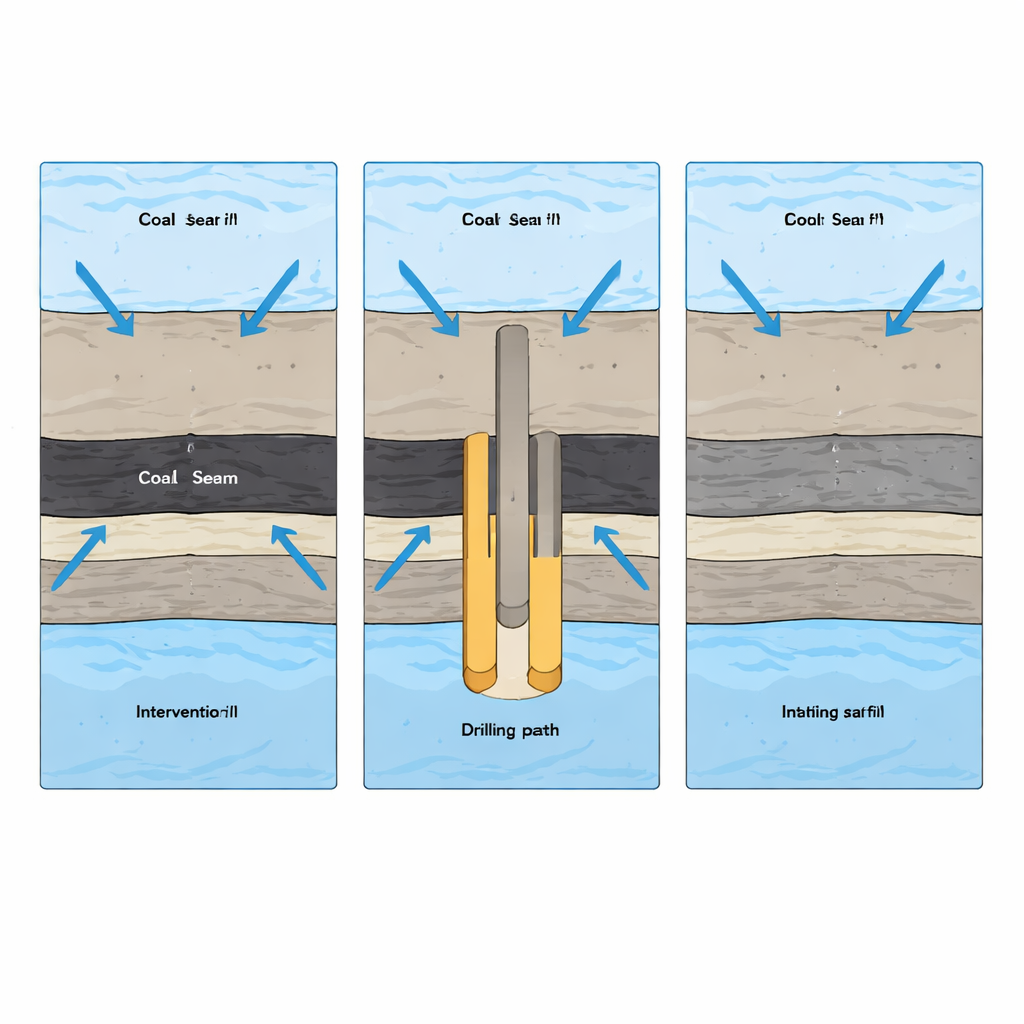
How combining two methods changes the rock system
The key insight of the study is that floor grouting and backfill mining work best together. Grout pumped into the rock above the deep aquifer thickens and strengthens the floor barrier, while backfill supports the roof and reduces bending and breakage. In the coupled scheme, stresses around the mined area are no longer concentrated in sharp peaks but spread out in a smooth arch-like pattern. As a result, the simulation predicts that roof fractures stop well below the roof aquifer, and floor damage remains comfortably above the deeper aquifer. The authors then applied this combined method in the real mine, monitored tiny fracture-related tremors, and performed water-pressure tests in boreholes to map where water could still move. The measured fracture heights and depths matched the simulations within about half a meter, confirming that the protective layers stayed intact.
What this means for future coal extraction
In plain terms, the study shows that neither floor reinforcement nor backfilling alone is enough when coal is trapped between very thin, water-sensitive layers. But when these two techniques are carefully designed and used together, they can turn an unmineable and highly hazardous coal seam into one that can be worked safely. The combined approach keeps cracks short, thickens the barriers that hold back pressurized water, and prevents the formation of direct water pathways into the mine. For other coalfields around the world with similar risky geology, this work provides a practical, tested recipe for balancing resource extraction with protection against catastrophic flooding.
Citation: Wang, G., Yin, S., Cao, M. et al. Water hazard prevention technology for confined mining beneath dual extremely thin aquicludes in roof and floor. Sci Rep 16, 13426 (2026). https://doi.org/10.1038/s41598-026-43043-4
Keywords: coal mine water hazards, aquifer protection, backfill mining, grouting reinforcement, confined seam extraction