Clear Sky Science · en
Release dynamics and plant availability of POLY4 fertilizer nutrients in tropical acidic soils
Feeding Crops While Protecting Fragile Soils
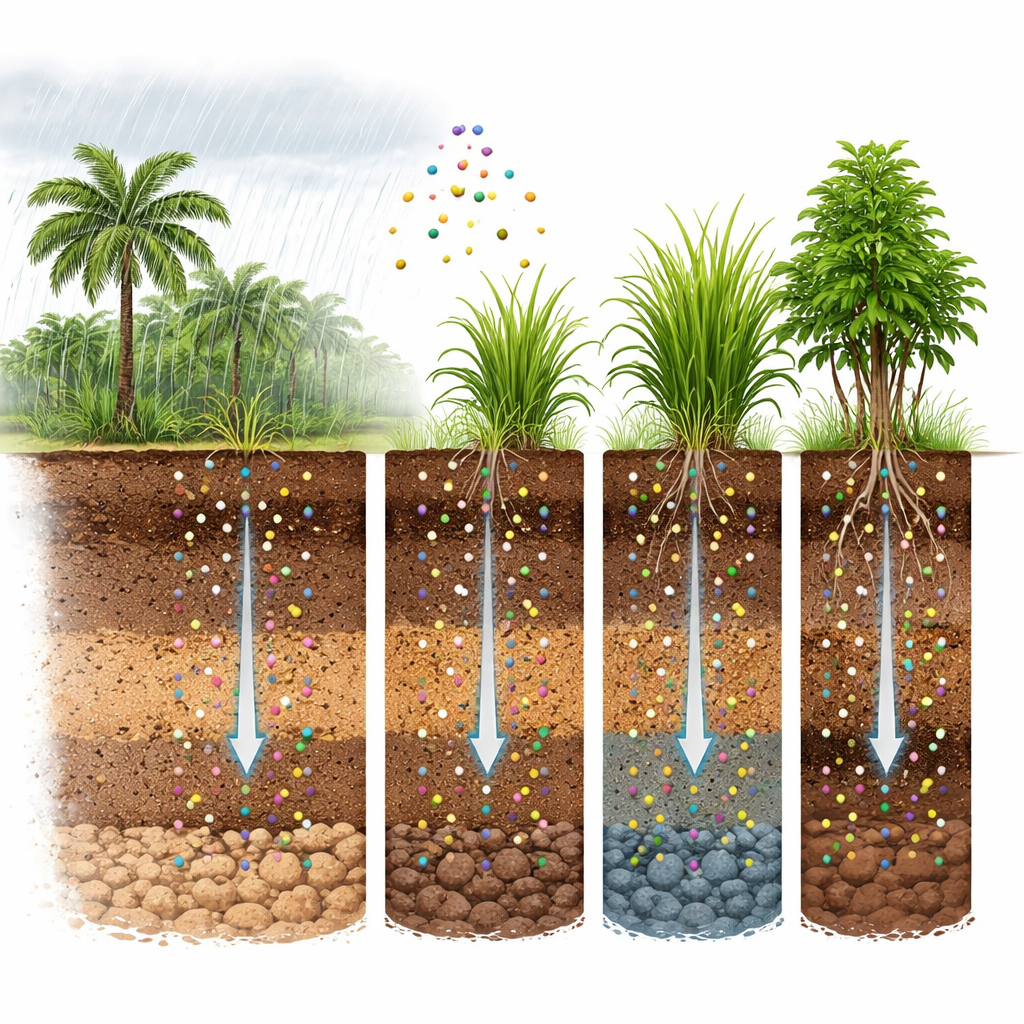
Farmers in the humid tropics face a tricky balancing act: their crops need large doses of nutrients, yet heavy rains quickly wash those nutrients out of the soil. This study examines a new multi-nutrient fertilizer, called POLY4, to see whether it can feed crops efficiently in acidic tropical soils while wasting less and potentially improving long‑term soil health.
A New Kind of Plant Food
POLY4 is made from a natural mineral called polyhalite. Unlike most common potassium fertilizers, which supply mainly one nutrient, POLY4 delivers four at once: potassium, magnesium, calcium, and sulfur. These elements help plants form fruits and seeds, fuel photosynthesis, and strengthen cell walls. In regions such as Southeast Asia, oil palm and forage grasses like Napier grass demand large amounts of potassium and magnesium, but their acidic, rain‑soaked soils tend to lose nutrients quickly. Farmers there often rely on highly soluble potassium chloride (muriate of potash, or MOP), which dissolves fast but can leach away just as quickly and also adds chloride, an ion that is not always desirable in high amounts.
Testing How Nutrients Move Through Soil
The researchers set up column experiments in the lab using three real farm soils from Malaysia: an organic‑rich peat soil, a clay‑rich soil influenced by the sea, and a sandy soil with low nutrient‑holding capacity. They mixed each soil with either POLY4 (in chipped “standard” form or as compact granules) or conventional fertilizers at the same potassium rate, then slowly leached the columns with water for about a month to mimic a year of tropical rainfall. By collecting and analyzing the drainage water, they tracked how quickly potassium, magnesium, calcium, sodium, sulfate, and chloride were released and how deep they moved through the soil.
Putting the Fertilizer to Work on Living Plants
To see what these patterns meant for crops, the team grew Napier grass in bags of the same three soils in a shaded greenhouse. Some plants received no potassium, some received MOP, and others received either granular or standard POLY4, again at equal potassium levels. Over many months and several harvests, the scientists measured the grass dry weight and the amounts of each nutrient taken up. This allowed them to compare not just how much of each element left the fertilizer, but how much actually ended up in plant tissue.
What Happened to the Nutrients
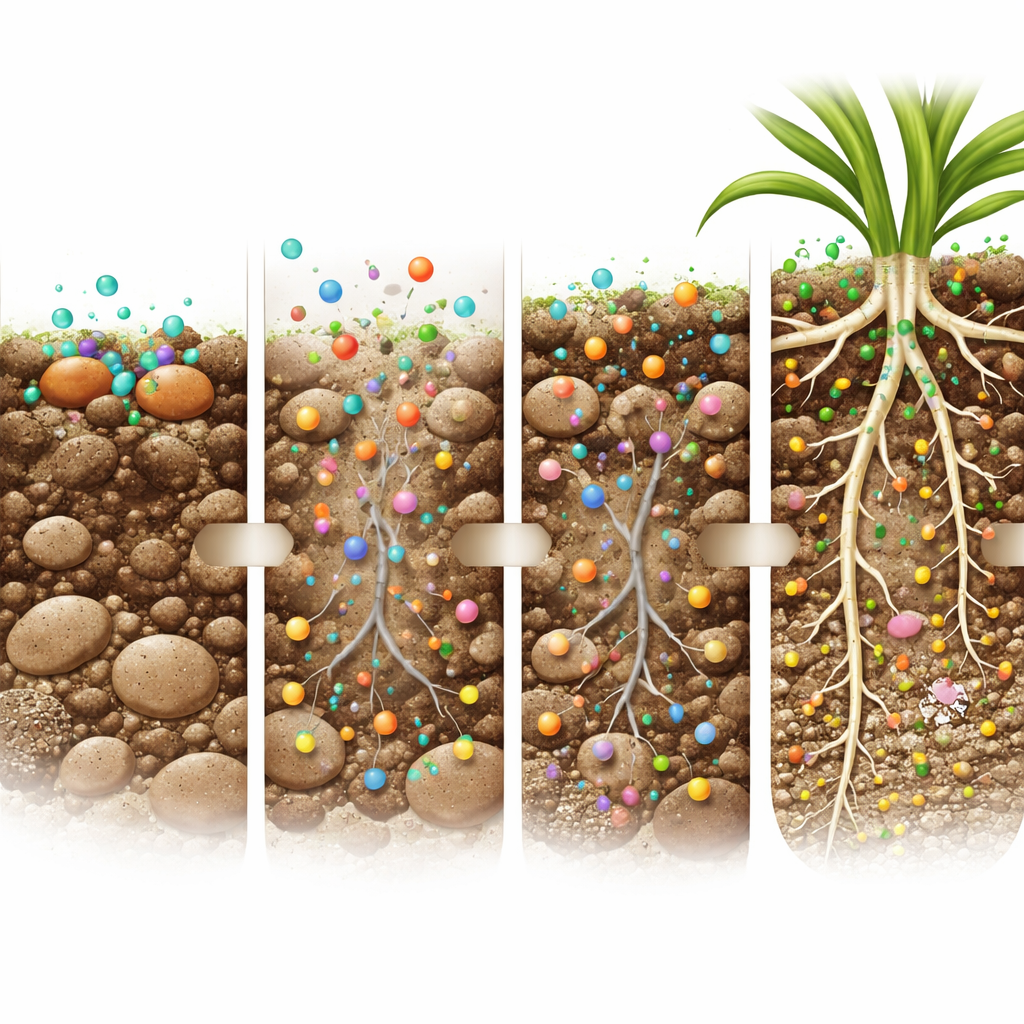
In water, both forms of POLY4 dissolved completely, releasing all four nutrients. In soil columns, potassium from POLY4 emerged steadily and in substantial amounts, especially in the sandy soil, confirming that the fertilizer can act as a strong source of potassium in acidic conditions. Magnesium from POLY4 standard dissolved particularly well, often more completely than calcium, which tended to linger in deeper layers or form less soluble compounds. When Napier grass was grown, total yields with POLY4 were similar to or better than yields with MOP, and in the clay‑rich soil POLY4 standard produced much higher biomass over time. For every unit of potassium released, plants recovered a large share of the accompanying magnesium—about four‑fifths on average—but less than one‑third of the calcium.
Why These Findings Matter for Farmers
The study shows that POLY4 can supply potassium effectively in tropical acidic soils while also delivering valuable magnesium and sulfur, with only small amounts of unwanted chloride. However, not all nutrients from POLY4 behave the same way once they enter the soil: magnesium tends to move into the plant readily, whereas much of the calcium becomes tied up in forms that roots cannot easily use. For practical fertilizer planning, this means POLY4 can help meet a crop’s magnesium needs but may not fully cover its calcium requirements. Overall, POLY4 appears to be a promising, multi‑nutrient alternative to standard potassium chloride in humid tropical agriculture, especially where managing nutrient losses and improving soil conditions are high priorities.
Citation: Hanafi, M.M., Gusyana, D., Shcherbakov, A. et al. Release dynamics and plant availability of POLY4 fertilizer nutrients in tropical acidic soils. Sci Rep 16, 12823 (2026). https://doi.org/10.1038/s41598-026-42984-0
Keywords: polyhalite fertilizer, tropical acidic soils, potassium nutrition, magnesium uptake, Napier grass