Clear Sky Science · en
Effects of immersive training on motor competence: a systematic review and meta-analysis
Why screens and movement now go hand in hand
From video games that make you jump to headsets that transport you onto a virtual court, immersive technology is rapidly moving from the living room into gyms and clinics. This study asks a simple question that matters to athletes, older adults, coaches, and therapists alike: can training in virtual and augmented worlds genuinely help people move better in real life, or is it just a high-tech distraction?
How virtual worlds meet real muscles
The researchers looked at immersive training that uses virtual reality, which places users inside a fully digital scene through headsets, and augmented reality, which layers digital images onto the real world. Unlike purely mental or seated games, the focus here was on programs that made people actually move: walking on treadmills enhanced with virtual scenes, balancing on boards guided by on-screen feedback, playing virtual sports, or reacting to moving targets in a headset. These sessions try to make practice more engaging and more flexible, especially where space, safety, or equipment limit traditional training.
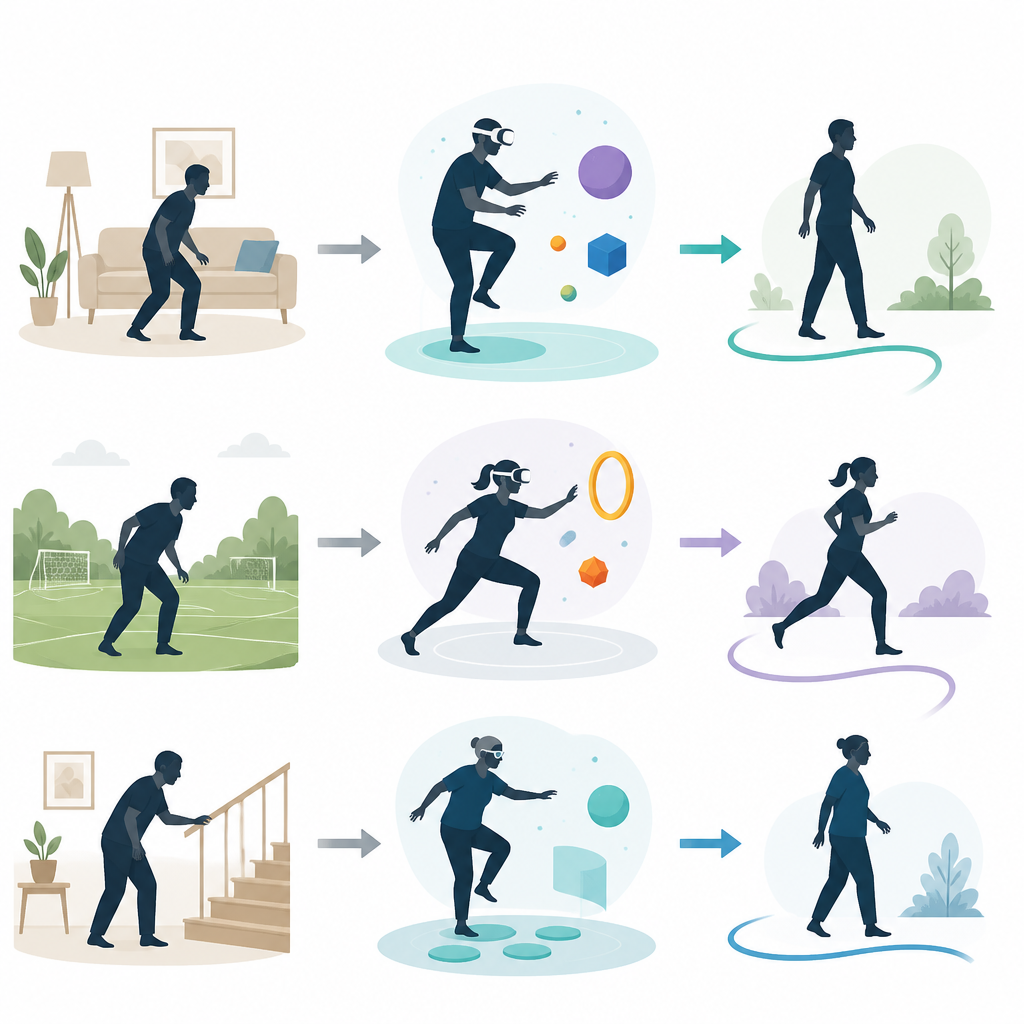
What “moving better” really means
To keep things clear, the team broke movement into two broad families. The first covers stability and functional mobility: everyday abilities like standing steady, walking safely, getting up from a chair, or climbing stairs. The second family covers object control and visuomotor skills: tracking balls, changing direction quickly, or reacting to fast-moving visual cues. Within these, they also separated quieter, predictable tasks such as standing balance from fast, unpredictable ones such as catching or dodging, mirroring how real-world sports and daily life combine steady control with split-second reactions.
What the numbers say about immersive training
Across 18 controlled studies with 678 participants, immersive training produced moderate gains overall compared with either usual exercise or no extra training. For stability and functional mobility, people generally walked a bit farther, rose from chairs more quickly, and stood more steadily after programs that blended physical movement with virtual or augmented scenes. The improvements were similar in size across different balance and walking tests, although results varied from study to study depending on how training was delivered and measured. For object control and visuomotor skills, gains were also moderate on average, but here task type mattered: complex sport-style skills such as ball control, agility drills, or table tennis play improved more than simple reaction-time tasks.
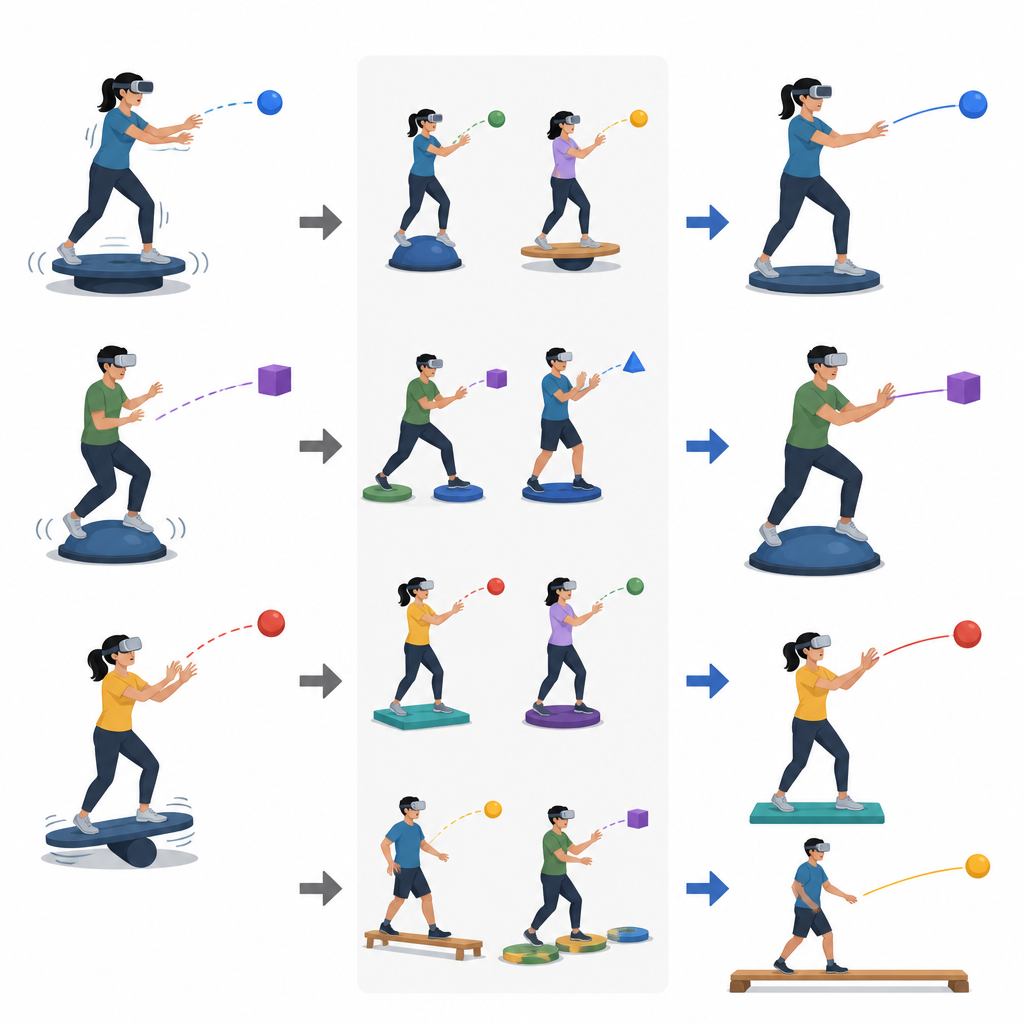
Why complex skills gain more than simple ones
Immersive systems seem especially helpful when they closely resemble the real situations people care about. In virtual table tennis, karate, or basketball, players practiced in lively, changing scenes that demanded full-body movement, quick decisions, and tight coordination between eyes and limbs. Because the virtual tasks looked and felt much like the real sport, the practice appeared to carry over more strongly. By contrast, sessions that only trained basic reactions, such as hitting a single target as fast as possible, offered less realistic challenges and led to smaller gains. In both cases, repeated practice with rich visual and sometimes sound or touch feedback likely helped the brain fine-tune control over the body.
How solid is the evidence so far
The review found that results were generally stable when individual studies were removed one by one, and there were no strong signs that only positive studies had been published. Still, many trials were small, and some groups of studies differed widely in methods, making it hard to apply the findings to every setting. Importantly, immersive training usually matched, rather than clearly beat, well-designed traditional programs when both were available. That suggests headsets and augmented displays are best viewed as another tool in the toolbox rather than a magic replacement for careful coaching or therapy.
What this means for everyday training
For a layperson, the takeaway is straightforward: training in virtual or augmented environments can genuinely help people walk more confidently, balance better, and handle complex movement tasks, especially when the digital scenes closely mirror real-world challenges. These tools seem particularly useful where safety, space, or motivation are concerns, such as fall prevention in older adults or skill practice in demanding sports. At the same time, their benefits depend on thoughtful program design and do not remove the need for good instruction and real-world practice.
Citation: Ji, Y., Wang, B. & Yang, Q. Effects of immersive training on motor competence: a systematic review and meta-analysis. Sci Rep 16, 15004 (2026). https://doi.org/10.1038/s41598-026-42962-6
Keywords: virtual reality training, augmented reality, motor skills, balance and mobility, sports performance