Clear Sky Science · en
The role of preparatory muscle activity in a one-step approach to vertical jumping
Why the way we prepare to jump matters
Anyone who has tried to jump higher knows that taking a quick step before leaping can make a big difference. But what happens inside the body during that brief instant of preparation is less obvious. This study looks under the skin at the split‑second muscle activity that happens just before a one‑step vertical jump. By tracking how these "preparatory" muscle signals relate to jump height and body motion, the researchers show that smarter, not harder, muscle use in the run‑up can help turn forward speed into upward lift.
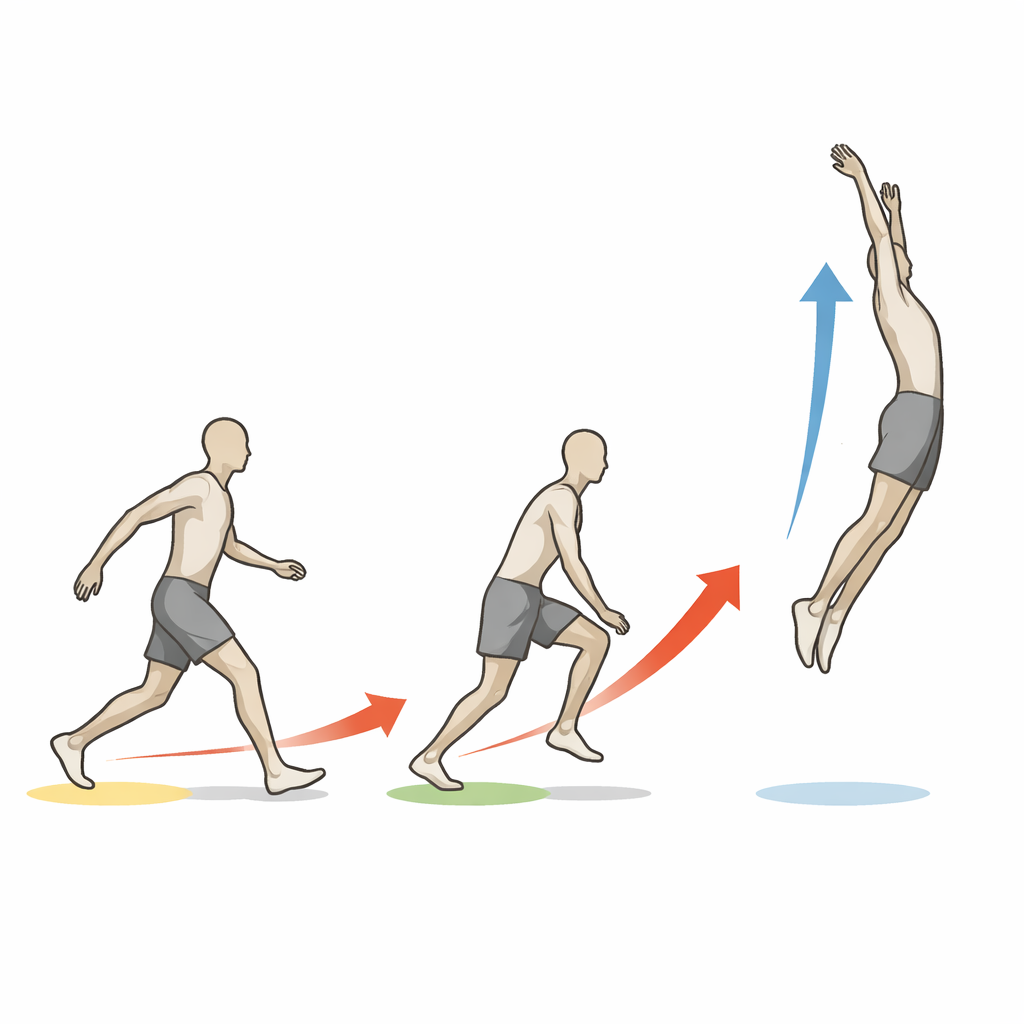
From a running step to straight up in the air
The researchers focused on a common sports move: taking one step forward and then jumping straight up. Fourteen healthy young men performed repeated one‑step vertical jumps in a laboratory. While they moved, a 3D motion capture system tracked the motion of reflective markers placed across the body, allowing the scientists to calculate the path and speed of the body’s center of mass. At the same time, electrodes on key leg and trunk muscles recorded electrical activity, providing a detailed picture of when each muscle switched on or off and how strongly it was working in the half‑second before the main push‑off.
Key body motions that go with higher jumps
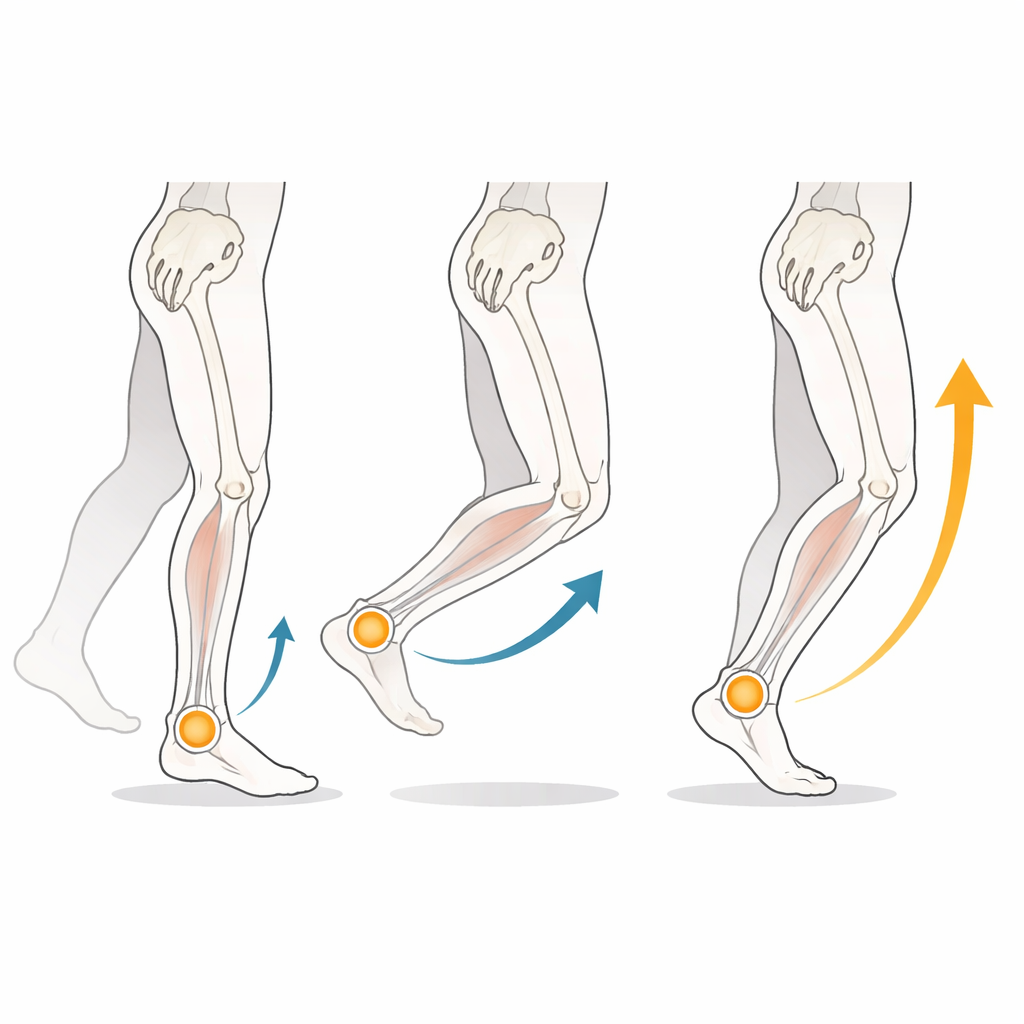
First, the team identified the movement features most closely tied to better jumps in this one‑step task. They found that higher jumps went hand‑in‑hand with a faster upward speed of the center of mass at take‑off and with a larger forward‑backward sway of the body just before leaving the ground. Another important factor was how quickly the ankle changed from a flexed position (bent forward) to a pointed position during the short time between heel contact and take‑off. This "ankle plantar flexion rate" was strongly linked both to how fast the body moved upward and to how far it shifted forward and back, confirming that it is a central piece of how forward motion is redirected into vertical lift.
Timing the muscles for an efficient push
The heart of the study was how the nervous system times muscle activity before the jump. The shin muscle that lifts the toes (tibialis anterior) tended to switch on earlier in the best jumps. Earlier activity in this muscle was associated with a greater change in ankle angle before take‑off, helping the ankle bend and then spring back more effectively. In contrast, two muscles that help extend the hip and ankle (the biceps femoris at the back of the thigh and the medial gastrocnemius in the calf) were more helpful when they turned on later, closer to the actual thrust. Delaying their activation appears to give the ankle more time to flex, setting up better conditions for redirecting the forward step into upward motion.
Less muscle effort can sometimes mean more height
Surprisingly, stronger muscle firing during the preparatory phase was not always better. For several of the main muscles used in the final push‑off—the back extensor, front thigh, outer thigh, inner calf, and deep calf—the study found that smaller preparatory amplitudes were linked to higher upward speeds of the body. In other words, when these prime movers were relatively quiet during the half‑second before the thrust, the eventual take‑off tended to be more powerful. The authors suggest that excess early activity in these muscles may act like a brake, wasting energy or stiffening the body in a way that reduces the effective spring‑like recoil of tendons during the actual jump.
What this means for athletes and coaches
Together, the findings paint a picture of jumping where the crucial work begins before the obvious push off the ground. The nervous system appears to fine‑tune posture and joint angles during the final step, using early activity in some muscles and delayed activity in others to shape how the ankle moves and how the body’s center of mass is positioned. At the same time, keeping the main pushing muscles relatively relaxed during this preparatory window may help avoid braking and allow stored elastic energy to be used more effectively. For athletes and coaches, this suggests that technique and timing in the approach step—and not just raw strength—are key to turning horizontal approach speed into vertical height in a one‑step jump.
Citation: Konno, K., Noshiro, T., Itaya, A. et al. The role of preparatory muscle activity in a one-step approach to vertical jumping. Sci Rep 16, 12764 (2026). https://doi.org/10.1038/s41598-026-42943-9
Keywords: vertical jump, muscle timing, sports performance, movement control, biomechanics