Clear Sky Science · en
LSD1 promotes prostate cancer cell proliferation by upregulating PRAC1 expression
Why this research matters for men's health
Prostate cancer is one of the most common cancers in men, yet the inner switches that tell prostate cells to grow or slow down are still being uncovered. This study zooms in on two such switches—molecules called PRAC1 and LSD1—to ask a simple but crucial question: what is driving prostate cancer cells to multiply, and can we turn that drive off? By answering this, the work points toward new ways to treat prostate cancer beyond conventional surgery, radiation, and hormone therapy.
A little-known gene in a familiar disease
PRAC1 is a small gene mostly active in the prostate, rectum, and lower colon. Earlier work showed that it helps maintain normal prostate stem cells and even serves as a forensic marker for semen. But its role in prostate cancer itself was murky. Using large public gene-expression databases, the authors compared tumor samples with non-cancerous prostate tissue. They found that PRAC1 levels are actually higher in prostate cancer than in healthy prostate, hinting that cancer cells may be hijacking this normally helpful gene to fuel their own growth.
Turning down PRAC1 slows cancer cells
To test whether PRAC1 is more than just a bystander, the researchers used genetic tools to "knock down" PRAC1 in two common prostate cancer cell lines grown in the lab. When PRAC1 was reduced, the cells divided more slowly and formed fewer colonies—clusters that signal strong growth potential. The cells were also less able to migrate and invade through artificial barriers, behaviors linked to the spread of cancer. In mice implanted with human prostate cancer cells, tumors with lowered PRAC1 grew more slowly and stayed smaller than tumors with normal PRAC1, tying this gene directly to tumor growth in a living system.
The growth switch that flips PRAC1 on
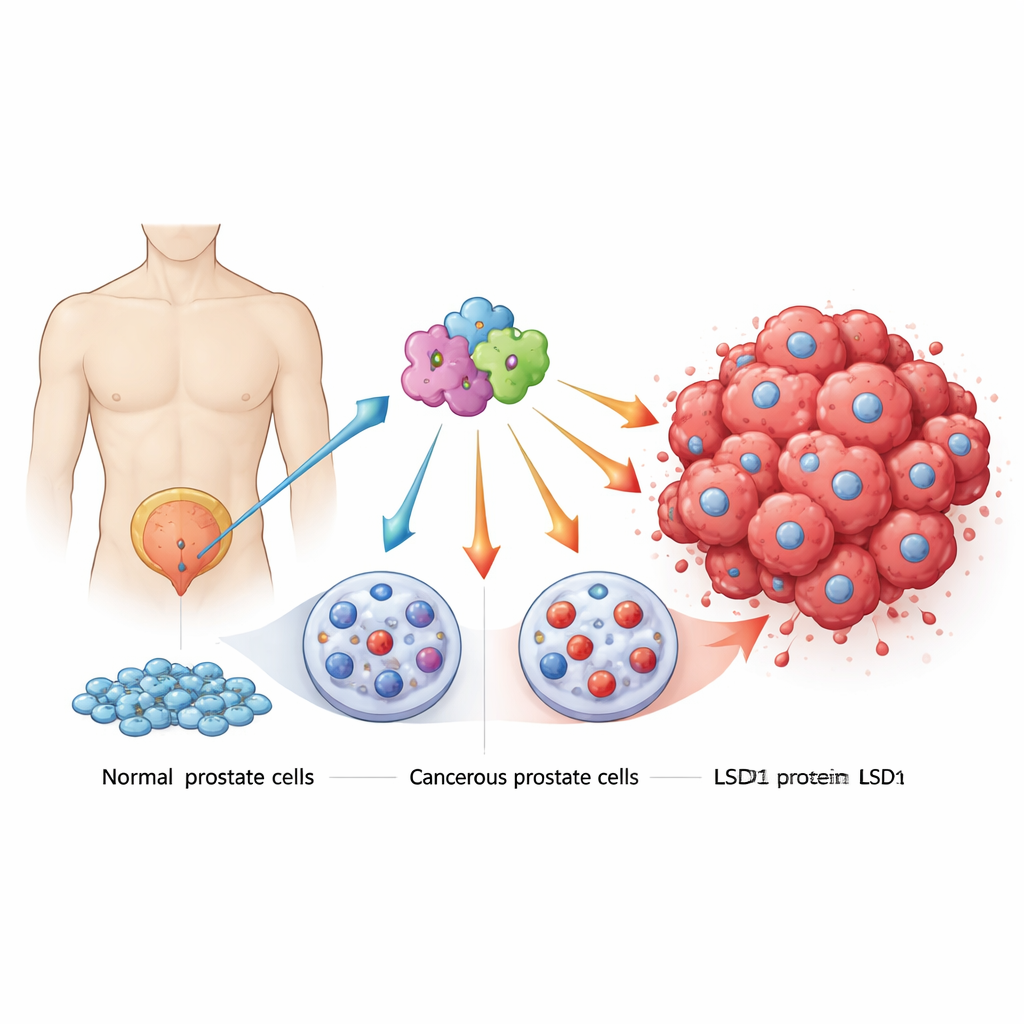
The next question was: what turns PRAC1 up in prostate cancer? By mining a large database that catalogs how thousands of genes respond when others are experimentally altered, the team identified several candidates, with one standing out—LSD1. LSD1 is an enzyme that edits chemical marks on DNA-packaging proteins, thereby changing how tightly genes are wound and whether they are switched on or off. In prostate tissues, the levels of LSD1 and PRAC1 rose and fell together, and LSD1 itself was higher in tumors than in normal tissue. When the researchers reduced LSD1 in prostate cancer cells, PRAC1 levels dropped at both the RNA and protein level. Boosting LSD1 had the opposite effect, increasing PRAC1’s activity. These experiments place LSD1 upstream of PRAC1, acting like a master dimmer switch for this growth-related gene.
A drug candidate that puts on the brakes
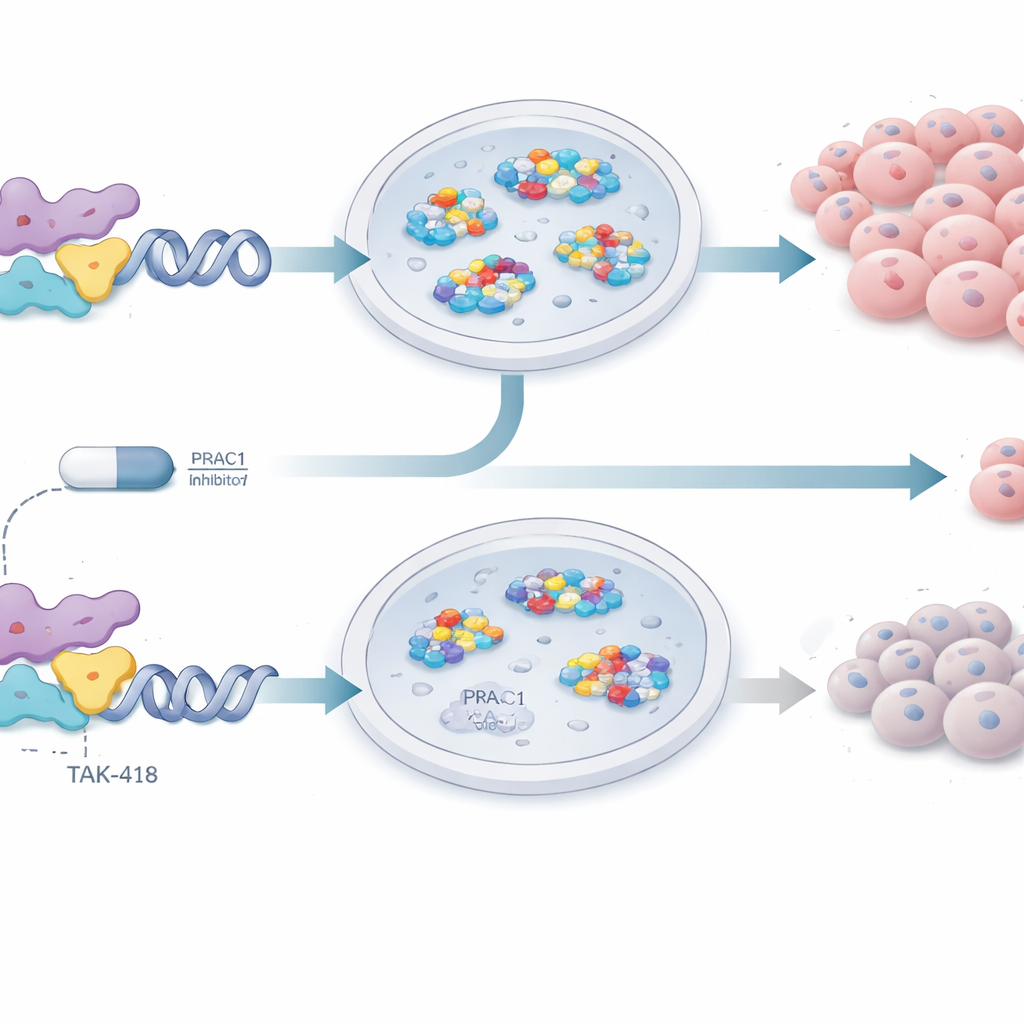
Because LSD1 is an enzyme, it can be targeted by small-molecule drugs. The authors focused on TAK-418, a newer LSD1-blocking compound originally developed for brain disorders. In prostate cancer cells, increasing doses of TAK-418 led to a steady decline in PRAC1 levels and a marked slowdown in cell growth. Importantly, when the researchers forced cells to overproduce PRAC1 while also exposing them to TAK-418 or to LSD1 knockdown, some of the growth inhibition was reversed. This "rescue" experiment strongly suggests that much of TAK-418’s anti-cancer effect works through the LSD1–PRAC1 pathway rather than unrelated side effects.
New targets in the fight against prostate cancer
Taken together, the study outlines a clear chain of events: LSD1 activity rises in prostate cancer, this boost switches on PRAC1, and high PRAC1 helps tumor cells multiply, spread, and grow in animals. Blocking LSD1 with TAK-418 lowers PRAC1 and slows cancer cell growth, an effect that can be partially undone by restoring PRAC1. For non-specialist readers, the takeaway is that researchers have identified a new wiring diagram inside prostate cancer cells—with LSD1 as the control knob and PRAC1 as the output line that drives growth. That diagram now offers two promising places to intervene: drugs that inhibit LSD1, like TAK-418, and future strategies that directly dampen PRAC1. While more work is needed before any such treatment reaches the clinic, this study moves the field closer to more precise, biology-based therapies for prostate cancer.
Citation: Liao, Y., Liu, C. LSD1 promotes prostate cancer cell proliferation by upregulating PRAC1 expression. Sci Rep 16, 12974 (2026). https://doi.org/10.1038/s41598-026-42928-8
Keywords: prostate cancer, epigenetic therapy, LSD1 inhibitor, PRAC1, TAK-418