Clear Sky Science · en
Optimising the caffeine nap for counteracting driver sleepiness in CPAP treated obstructive sleep apnoea patients
Why staying awake at the wheel matters
Many of us have fought sleepiness on a long drive, but for people with obstructive sleep apnoea (OSA) the stakes are even higher. OSA disrupts sleep at night and can leave drivers less alert during the day, even when they use standard treatment with a CPAP machine. Road-safety campaigns often recommend a “caffeine nap” – drinking coffee and then taking a brief nap – as a way to combat drowsy driving. This study asked whether that advice actually works for drivers with treated OSA, and which quick remedy gives them the safest boost behind the wheel.
Who the study looked at
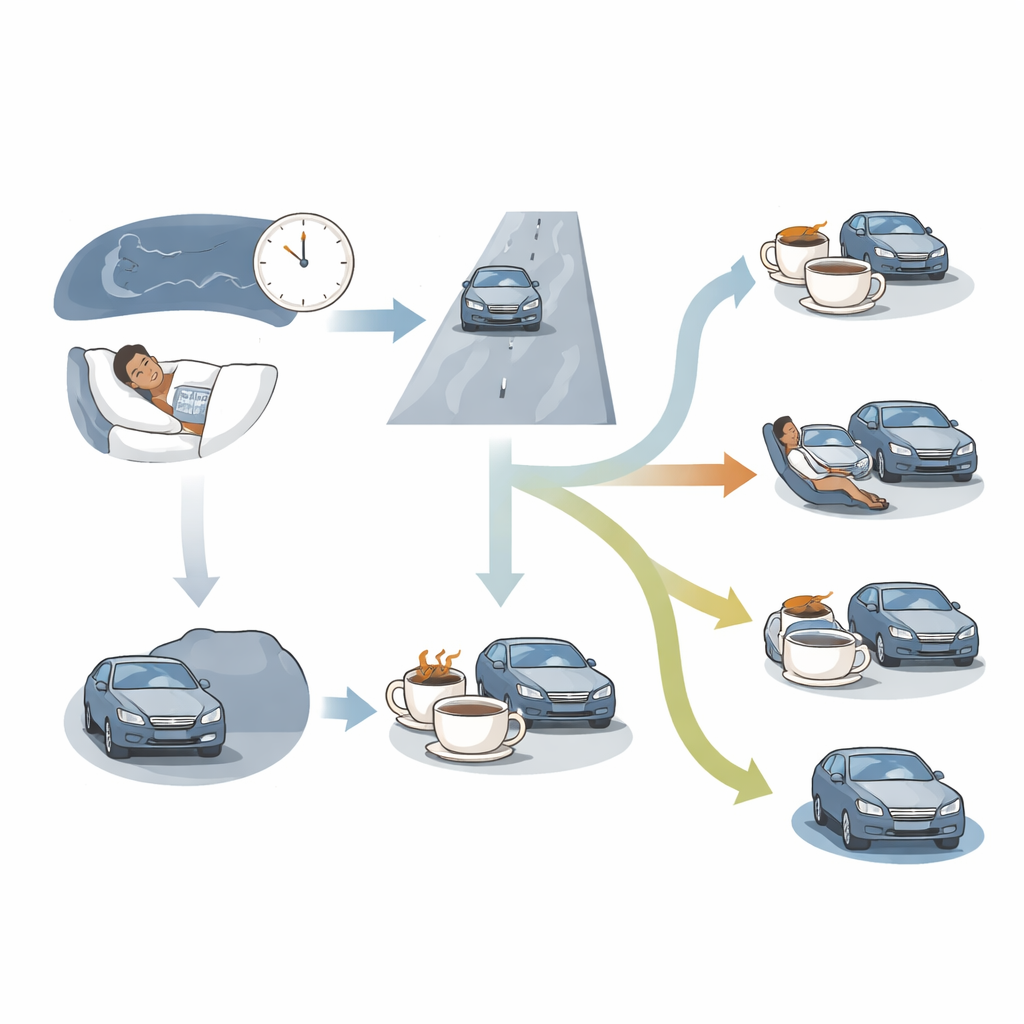
The researchers invited 21 regular drivers with long-standing, CPAP-treated OSA, mostly in their 50s and 60s, to a driving simulator lab for six separate visits. On one visit they came in after a normal night’s sleep and drove while fully rested. On the other five visits, their sleep was deliberately cut to about four hours by asking them to go to bed late, though they still used their CPAP machines at home. Each visit involved a long, monotonous motorway-style drive designed to bring on drowsiness, so the team could see how well different countermeasures helped people stay in their lane and stay awake.
Testing coffee strength and nap length
The first part of the project compared two doses of caffeine, delivered as canned iced coffee that drivers might buy at a service station. On separate days, participants drank either one can (about 128 mg caffeine) or two cans (about 255 mg), after 30 minutes of sleepy driving, and then resumed driving for another 45 minutes. The stronger dose clearly made people feel less sleepy and led to fewer minor drifts over lane markings than the weaker drink. One can helped only modestly, while two cans gave a noticeable, though still short-lived, improvement in both self-rated alertness and driving control.
Next, the team tested nap opportunities without caffeine. After the same sleep restriction and pre-drive, participants stopped and tried to nap in the driver’s seat for either 15 or 30 minutes before driving again. Many did doze off, but extending the nap to 30 minutes did not meaningfully improve lane keeping or reduce sleepiness compared with the 15-minute nap. In some measures, the shorter nap performed just as well, suggesting that longer naps may add little benefit and might even risk grogginess on waking.
Putting coffee and nap together
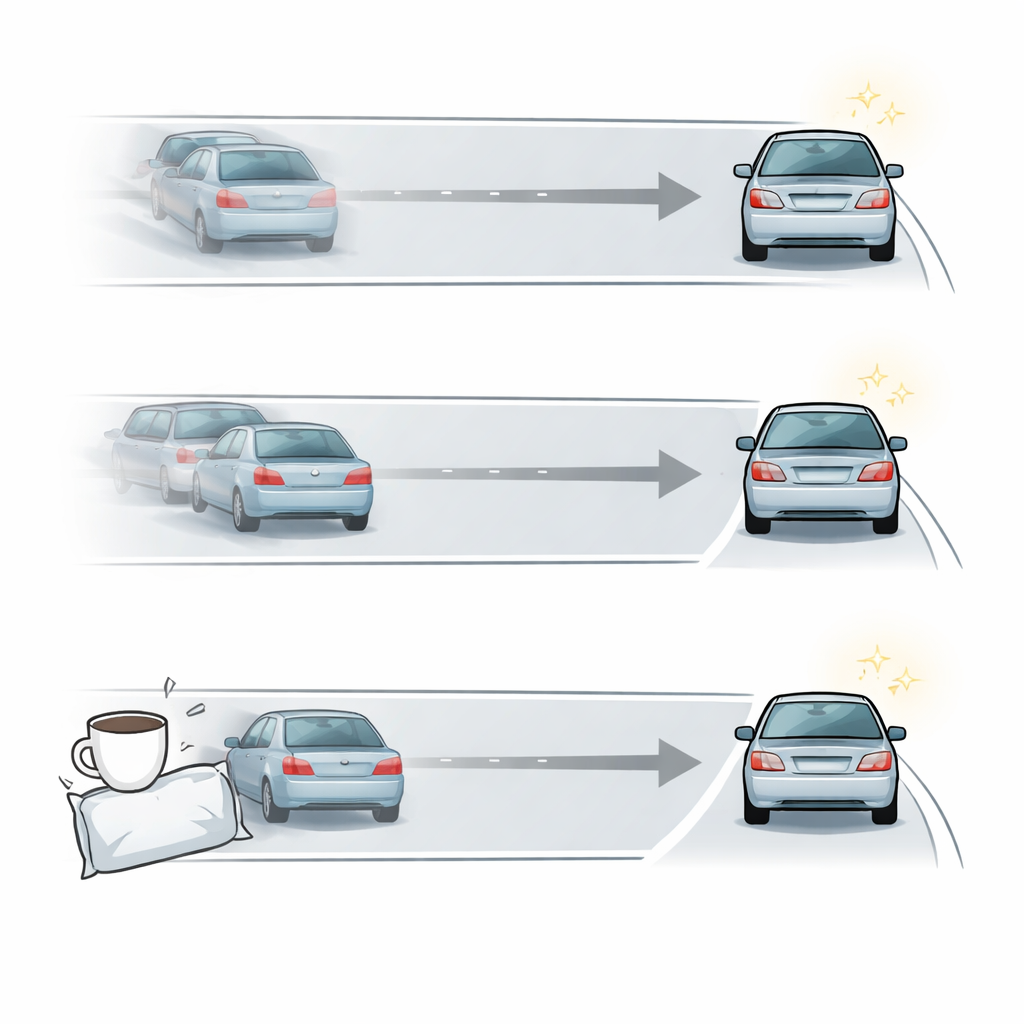
Finally, the researchers combined the “best” elements: two cans of coffee followed by a 15-minute nap, mirroring the caffeine-nap advice often given to the general public. Drivers completed one simulator session when they were fully rested, and two more after sleep restriction – one before and one after this combined countermeasure. The coffee-plus-nap routine offered some temporary gains in alertness and driving steadiness compared with driving while sleepy. However, when directly compared with two cans of coffee alone, the combined approach did not provide a clear practical advantage in how well drivers held their lane or how sleepy they felt over the following 45 minutes.
What this means for real-world driving
Taken together, the findings suggest that for drivers with treated OSA who find themselves becoming sleepy at the wheel after a short night, the most effective quick fix tested was simply to pull over and drink the equivalent of two strong coffees. Napping in the car, with or without caffeine, was less reliably helpful, and a longer nap did not outperform a brief one. Importantly, all of these measures were only stopgaps: their benefits began to fade within an hour, and none restored performance to the level seen after a full night’s sleep. For people with OSA, as for all drivers, the safest strategy is still to avoid driving when sleep-deprived, using caffeine only as a short-term aid rather than a substitute for proper rest.
Citation: Filtness, A.J., Miller, K.A., Maynard, S. et al. Optimising the caffeine nap for counteracting driver sleepiness in CPAP treated obstructive sleep apnoea patients. Sci Rep 16, 14380 (2026). https://doi.org/10.1038/s41598-026-42894-1
Keywords: drowsy driving, obstructive sleep apnoea, caffeine nap, CPAP treatment, road safety