Clear Sky Science · en
Enhancing credit card fraud detection with a hybrid approach using machine and deep learning
Why this matters to your wallet
Every time you tap your card or shop online, a silent race begins: can your bank’s computers spot a thief before your money disappears? As digital payments explode worldwide, criminals constantly invent new tricks, and simple rule-based security (like “block all transactions over $5,000 at night”) is no longer enough. This study shows how combining several kinds of artificial intelligence into a single “team of experts” can catch nearly every fake credit card transaction in a widely used real dataset, while explaining why the system made each decision.

The rising tide of digital trickery
Credit card fraud is big business. Global losses already reach tens of billions of dollars each year and are expected to keep climbing as e‑commerce, online banking, and cashless payments grow. Most transactions are perfectly legitimate, but a tiny fraction are fraudulent—sometimes less than two in a thousand. That imbalance makes the problem hard: a system can look very accurate simply by calling almost everything “normal,” yet still miss most fraud. The authors focus on this imbalance and on the fact that fraud tactics keep changing, which together demand flexible, data‑driven tools rather than rigid hand‑written rules.
Turning rare fraud into a learnable signal
The researchers start with a real set of European credit card transactions collected over two days: about 285,000 payments, of which only 492 are fraudulent. To make sure the model does not drown in normal cases, they use a technique that fabricates realistic extra examples of the rare class so that the data becomes more balanced. The main method, called SMOTE, creates synthetic fraud‑like points in between real fraud cases. They also test a more complex hybrid method that both adds minority examples and removes noisy majority ones. By carefully scaling transaction amounts and times and keeping sensitive details hidden behind mathematical transformations, they prepare a clean, privacy‑preserving dataset that a computer can learn from.
Building a team of digital fraud hunters
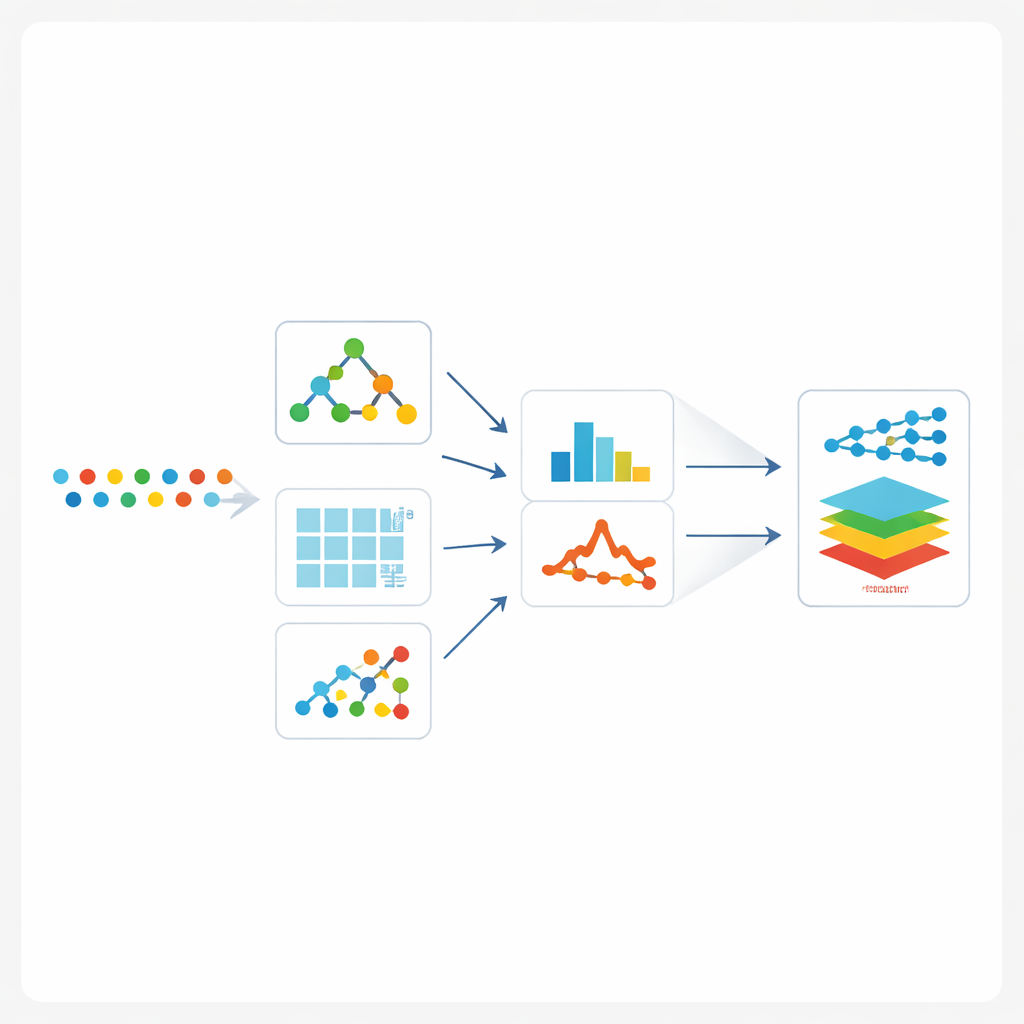
Instead of betting on a single algorithm, the authors train 37 different models drawn from classic machine learning, modern boosted decision trees, and deep neural networks. Then they design two special “stacking ensembles,” which act like a panel of specialists whose opinions are combined by a final referee. In the first ensemble, a fast tree‑based model, a pattern‑spotting image‑style network, and a sequence‑aware network each study the same transactions. Their outputs are then fed into a powerful booster model that learns how much to trust each specialist. The second ensemble combines several kinds of tree‑based boosters and forests in a similar layered setup. Both ensembles are trained first on the original skewed data and then again on the balanced version produced by SMOTE and the hybrid method.
Near‑perfect detection and what it costs
On the balanced data created with SMOTE, both proposed ensembles reach strikingly high scores on every standard measure of success: they almost never miss a fraudulent transaction and almost never raise a false alarm on a genuine one in this dataset. When the authors compare against many individual models and against earlier published methods that used the same data, their stacked systems consistently come out on top. They also measure the practical side: how long training takes and how much memory is needed. The ensemble that leans heavily on deep neural networks is more computationally expensive, while the tree‑focused ensemble delivers similar accuracy with substantially lower time and memory demands, making it more attractive for real‑time bank systems.
Seeing inside the black box
A common worry with advanced AI is that it acts like a black box: even its designers may not know why it flagged your purchase as suspicious. To address this, the study uses two explanation tools that show which hidden features of a transaction matter most for a given decision and across the system as a whole. Visual analyses reveal a small set of transformed variables that repeatedly drive fraud predictions, while many others play only a supporting role. The authors also inspect where the models still make mistakes, how confident they are when they err, and how well results hold up as more data is used. These checks suggest the models are genuinely learning stable patterns rather than simply memorizing the training data.
What this means for everyday card users
For non‑experts, the headline is reassuring: by balancing the data smartly and letting several AI approaches work together, banks can build fraud detectors that are both extremely accurate on benchmark data and reasonably efficient to run. Just as important, the system can explain its calls, which helps institutions trust and refine it and helps regulators understand its behavior. While real‑world deployment still faces challenges—such as ever‑evolving criminal tactics and the need for fast, continuous updates—this hybrid approach offers a strong blueprint for keeping your card safe without drowning you in false alarms.
Citation: Gamal, N., Younis, E.M.G. & Makram, W.M. Enhancing credit card fraud detection with a hybrid approach using machine and deep learning. Sci Rep 16, 10944 (2026). https://doi.org/10.1038/s41598-026-42891-4
Keywords: credit card fraud detection, machine learning, deep learning, ensemble models, imbalanced data