Clear Sky Science · en
Trapezius fascia reveals mechanosensory capacity and predominance of nociceptive axons in occipital neuralgia
A Hidden Source of Headache Pain
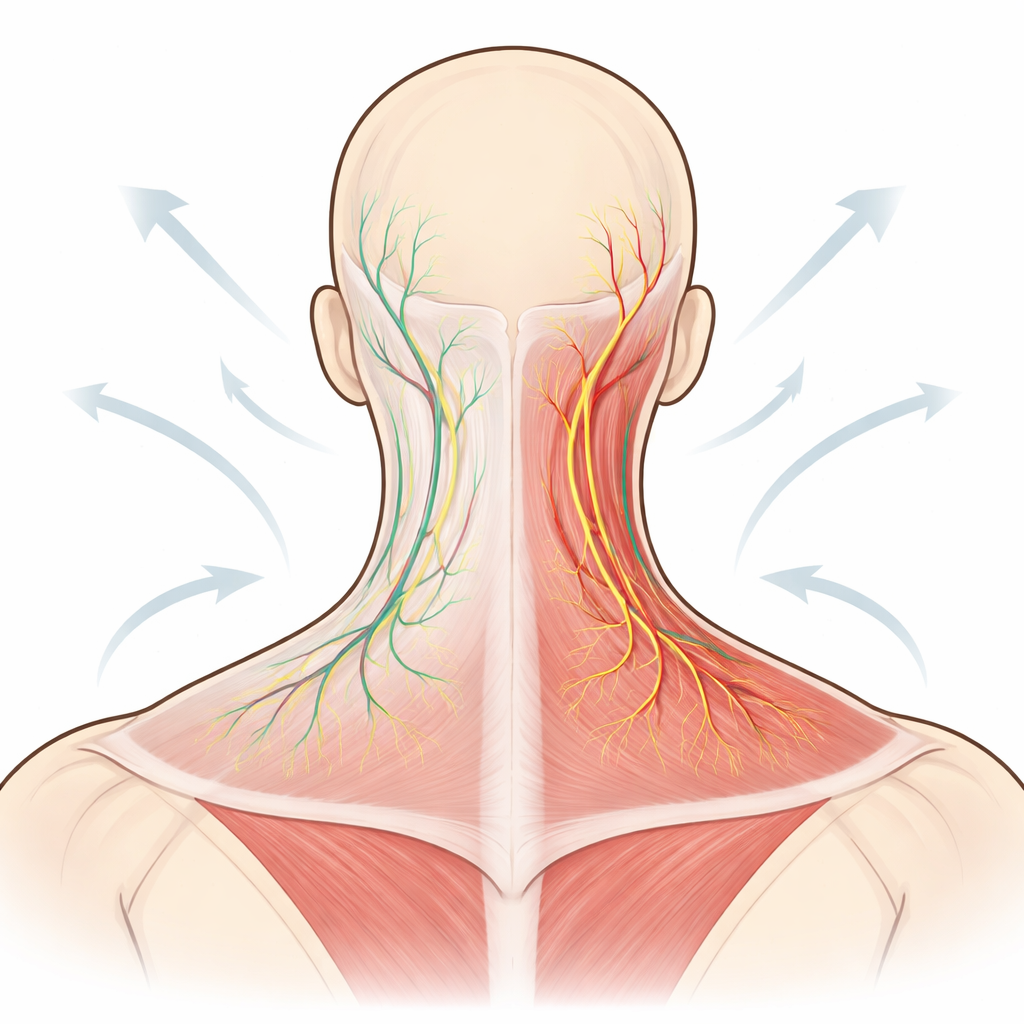
Many people live with piercing, electric shock–like headaches that shoot from the neck up over the back of the head. This condition, called occipital neuralgia, can be so disabling that everyday tasks become a struggle. Surgeons can sometimes ease the pain by freeing irritated nerves in the neck, but doctors have not fully understood why those nerves become so sensitive in the first place. This study looks closely at an overlooked tissue—the thin sheet of connective tissue over the upper back and neck, known as the trapezius fascia—to reveal how it may sense movement and amplify pain signals in people with occipital neuralgia.
The Painful Puzzle at the Back of the Head
Occipital neuralgia arises when nerves running from the upper spine to the back of the scalp become irritated or compressed. Patients often describe stabbing pain, tenderness where the nerves exit the neck, and headaches that resist standard treatments. Surgeons have noticed that, in many of these patients, the fascia covering the trapezius muscle appears unusually thick around the greater and lesser occipital nerves. This observation raised an important question: is this fascia simply squeezing the nerves from the outside, or is it itself an active player in sensing and producing pain?
Peering Inside a Thin Layer of Tissue
To explore this, the researchers collected small samples of trapezius fascia from 18 patients undergoing surgery for occipital neuralgia and from 10 comparison patients having spine surgery who did not have chronic headaches. They preserved and sliced the tissue, then used fluorescent tags to highlight different kinds of nerve fibers and pressure-sensing structures. By examining the samples with high‑resolution confocal microscopes and using computer‑based image analysis, the team could measure how many nerve fibers were present, what types they were, and where specific pain‑related molecules were concentrated.
Nerves and Pressure Sensors Where We Least Expected Them
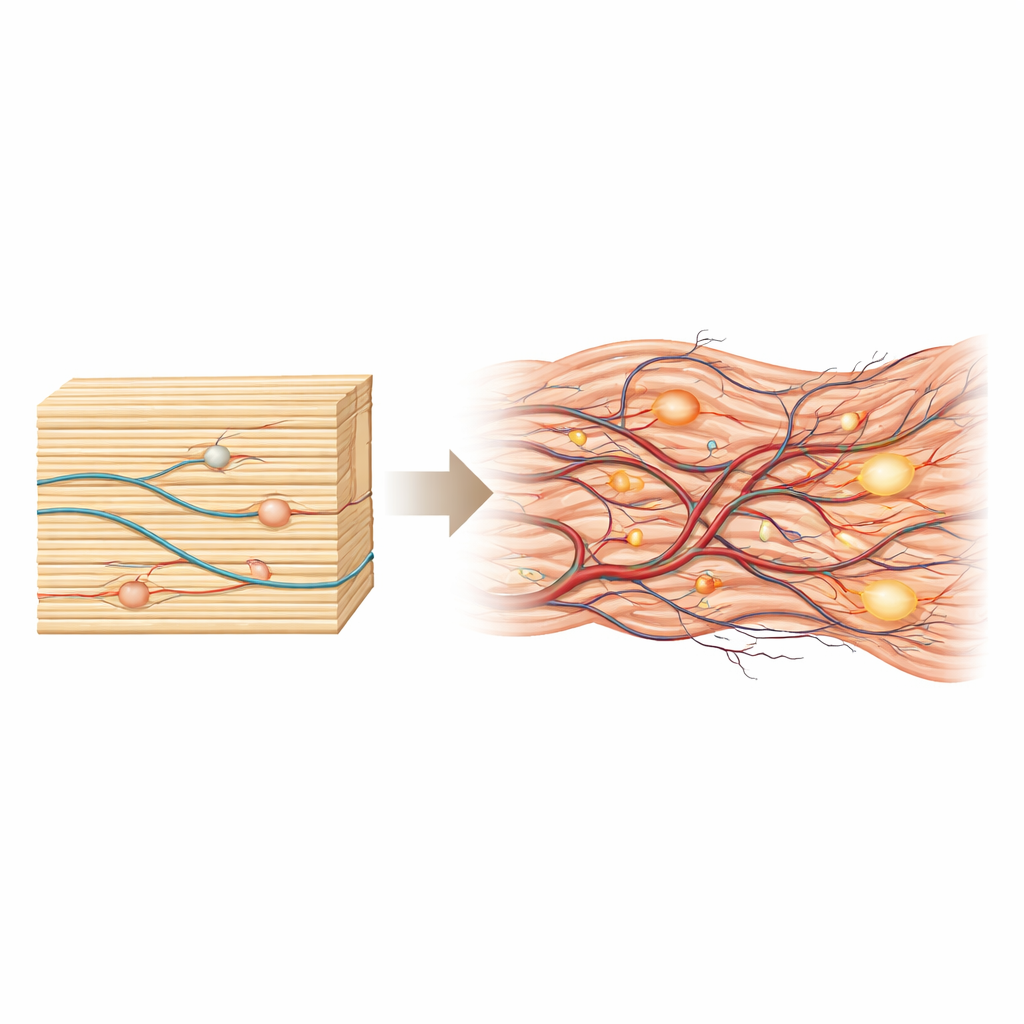
The fascia, once thought to be just a passive wrapping around muscle, turned out to be richly wired in both groups. In almost all samples, the team found a network of nerve fibers running within the fascia, some with insulating sheaths and some without, along with blood vessels and collagen fibers. They also discovered specialized structures that look like classic touch and stretch receptors (similar to Pacinian and Ruffini endings found in the skin), showing that the fascia can likely sense mechanical forces—such as stretch, pressure, and movement. This suggests that the trapezius fascia is not simply a structural sheet but an active sensory organ feeding information to the nervous system.
When Sensing Turns Into Suffering
The biggest differences emerged when the team compared the fine details of nerve chemistry between patients and controls. In people with occipital neuralgia, the fascia contained many more nerve fibers linked to pain signaling. There was a marked increase in axons carrying a molecule called CGRP, which is strongly associated with pain pathways and is already a treatment target in migraine. The proportion of pain‑related axons within the fascia was roughly 70 percent higher in patients than in controls. The intensity of CGRP within these nerves was also greater, indicating that the neural wiring in the fascia had shifted toward a pain‑amplifying state. In addition, only the patient group showed abundant sympathetic nerve fibers—nerves that help regulate blood flow and tissue tone—hinting that stress or temperature changes might further disturb this sensitized tissue.
What This Means for People With Chronic Headache
These findings recast the trapezius fascia as a sensitive communication hub between muscles, nerves, and the brain rather than a simple wrapper. In occipital neuralgia, this hub appears to be rewired: pain‑carrying nerve fibers and stress‑linked sympathetic fibers are more prominent, and the tissue’s built‑in pressure sensors may help convert normal movement into painful signals. Because these changes were seen even in patients without clear neck injuries, the problem likely goes beyond simple trauma. Understanding the fascia’s active role could explain why some patients relapse after nerve surgery and points toward new treatments that target the fascia’s nerve supply and pain‑related chemistry—potentially offering more lasting relief for those living with severe, persistent headaches.
Citation: Tereshenko, V., Hazewinkel, M.J., Hussey, M. et al. Trapezius fascia reveals mechanosensory capacity and predominance of nociceptive axons in occipital neuralgia. Sci Rep 16, 13202 (2026). https://doi.org/10.1038/s41598-026-42746-y
Keywords: occipital neuralgia, trapezius fascia, chronic headache, nociceptive nerves, mechanosensation