Clear Sky Science · en
Spatial modeling of Borrelia genospecies in human-biting ticks from the French citizen science programme CiTIQUE
Why this matters for people who enjoy the outdoors
Across Europe, Lyme disease has become the most common illness spread by ticks, yet the risk of being bitten by an infected tick can change dramatically from one landscape to another. This study uses an unusual source of information—ticks sent in by everyday citizens in France—to build detailed maps of where Lyme-causing bacteria are most common and what kinds of environments, wildlife, and human activities are linked to higher or lower risk. The results help explain why some regions and habitats are more dangerous than others and point toward smarter ways to target prevention.
Getting help from the public to track risky ticks
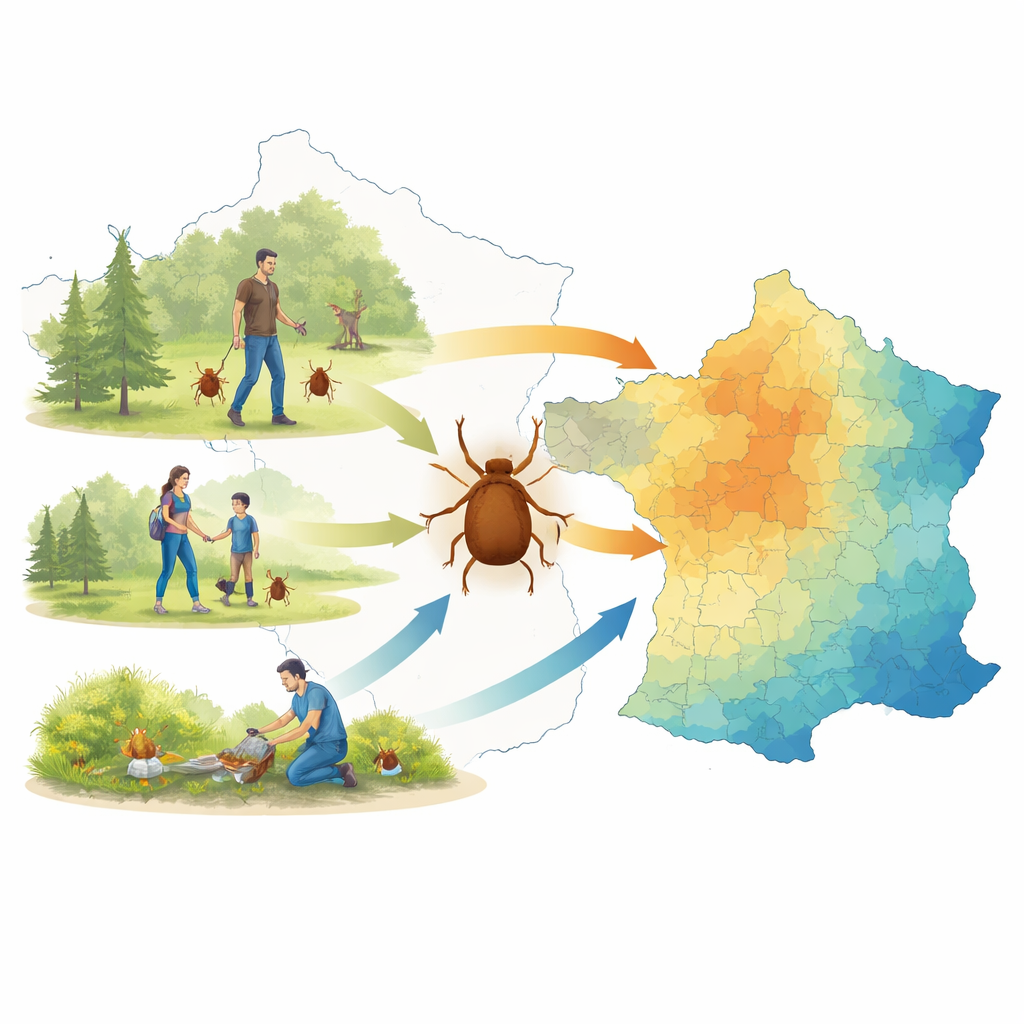
The researchers turned to CiTIQUE, a French citizen science program that asks people to report tick bites and mail in the attached ticks. Between 2017 and 2019, nearly 1,900 human-biting ticks of the species Ixodes ricinus were tested for bacteria from the Borrelia burgdorferi sensu lato group, which cause Lyme disease. About 15 percent carried at least one Lyme-related bacterium. Two species dominated: Borrelia afzelii, often linked to small mammals like mice and voles, and Borrelia garinii, more closely tied to birds. Because every tick had GPS coordinates, the team could link each infection to the surrounding landscape and climate at a national scale, something traditional small, local field studies rarely achieve.
Uneven risks across French regions
The team built computer models to relate infection in ticks to broad patterns in the environment, wildlife communities, and human presence. They found that the single most consistent factor was how suitable an area is for the tick itself: places that provide good habitat for Ixodes ricinus, such as humid, mixed woodlands and edges, tended to have a higher share of infected ticks. Maps of France revealed large high-risk zones in the eastern and central regions—Grand Est, Bourgogne–Franche-Comté, Centre–Val de Loire, and parts of Auvergne–Rhône-Alpes and Nouvelle–Aquitaine—while northwestern regions like Bretagne and Normandie generally showed lower risk. The models also captured uncertainty, which was greatest in mountainous and less-sampled areas where fewer ticks had been submitted.
Different bacteria follow different animals
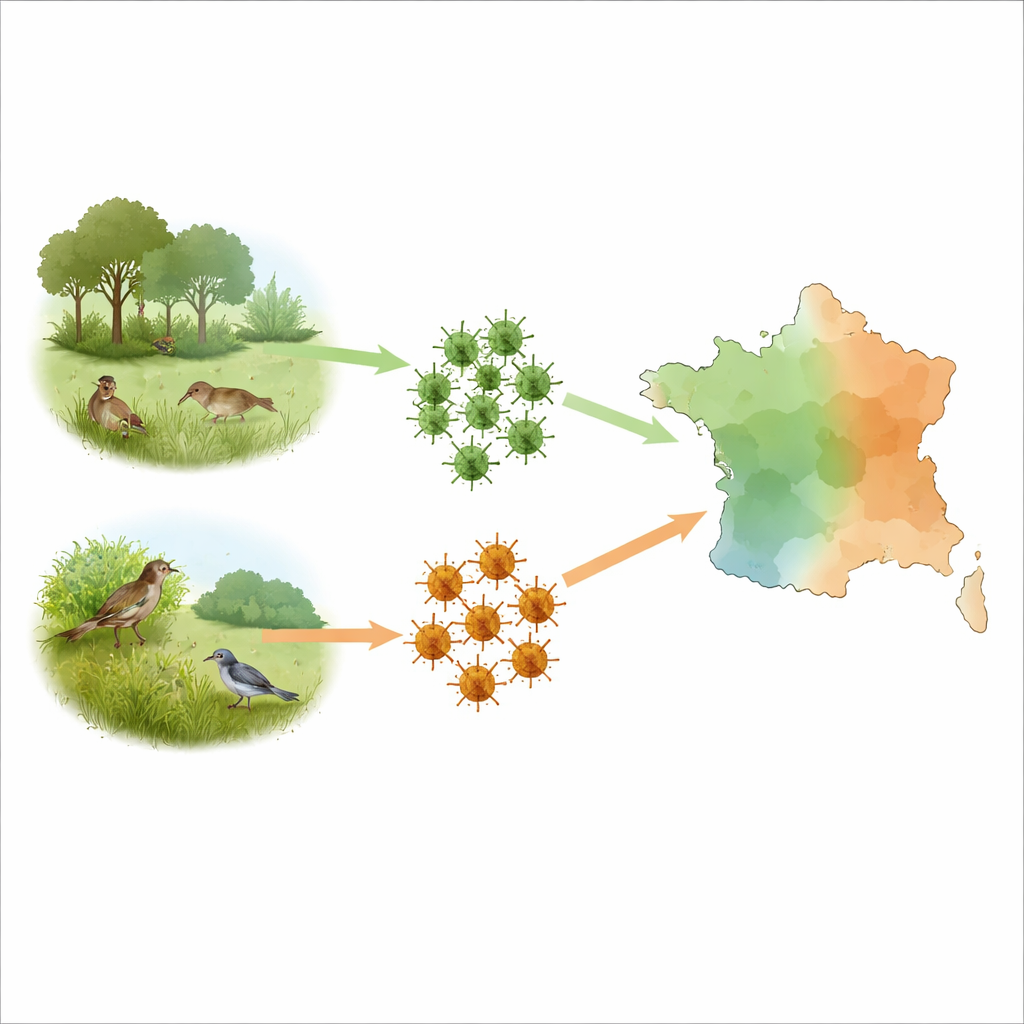
Looking more closely at the two main Lyme bacteria showed how strongly wildlife communities shape human risk. Borrelia afzelii was more common in places with richer rodent communities, supporting the idea that small mammals form its core reservoir. Its presence peaked in landscapes with intermediate grass cover, typical of forest edges, gardens near woods, and patchy woodland rather than open pastures. Areas with high cattle density tended to have fewer B. afzelii–infected ticks, suggesting that livestock grazing can reduce small-mammal habitat or alter tick survival. In contrast, Borrelia garinii was more likely where thrush-like birds from the Turdidae family were abundant and less likely where many rodent species coexisted, hinting at a "dilution" effect in which non-bird hosts draw ticks away from the key bird carriers.
Strengths and limits of citizen-powered surveillance
Using human-biting ticks offers a direct view of what people actually encounter outdoors, but it also comes with trade-offs. Most submitted ticks came from places where many people live or visit, leaving remote areas underrepresented. The laboratory method could only see the dominant Borrelia species in a tick, so mixed infections were likely undercounted. And while the models identified meaningful patterns—such as the importance of tick-friendly habitats and specific host animals—their overall predictive power remained modest, reflecting the complexity of Lyme ecology and remaining data gaps. Still, the CiTIQUE database already contains tens of thousands more ticks, offering a growing resource to refine and update these risk maps over time.
What this means for staying safe outdoors
For non-specialists, the key message is that Lyme risk is not evenly spread across France: it is highest where the environment favors both ticks and their preferred wild hosts, especially rodents and certain birds, and where people frequently use those landscapes. Citizen science proved to be a powerful way to capture this fine-scale variation by turning thousands of everyday tick bites into a national early-warning system. As contributions continue and models improve, health agencies can better target public warnings, guide park management, and adapt prevention campaigns to local conditions—helping people enjoy forests, fields, and gardens while reducing the odds that a tiny tick bite leads to serious disease.
Citation: Bah, T.M., Durand, J., Cougoul, A. et al. Spatial modeling of Borrelia genospecies in human-biting ticks from the French citizen science programme CiTIQUE. Sci Rep 16, 12919 (2026). https://doi.org/10.1038/s41598-026-42619-4
Keywords: Lyme disease, ticks, citizen science, Borrelia, France