Clear Sky Science · en
Isotropic components of microseismic moment tensors at Utah FORGE reveal a diversity of fluid pathway creation processes in EGS development
Why tiny quakes matter for clean energy
To turn deep underground heat into usable clean energy, engineers must gently crack hot, dry rock so water can move through it and return to the surface as steam. But forcing fluid into the Earth can trigger tiny earthquakes, and understanding exactly how and where the rock breaks is crucial for making geothermal projects both efficient and safe. This study at the Utah FORGE underground laboratory uses hundreds of very small earthquakes to reveal how fluid creates and reuses cracks, offering a window into the invisible plumbing that could power future low‑carbon energy systems.
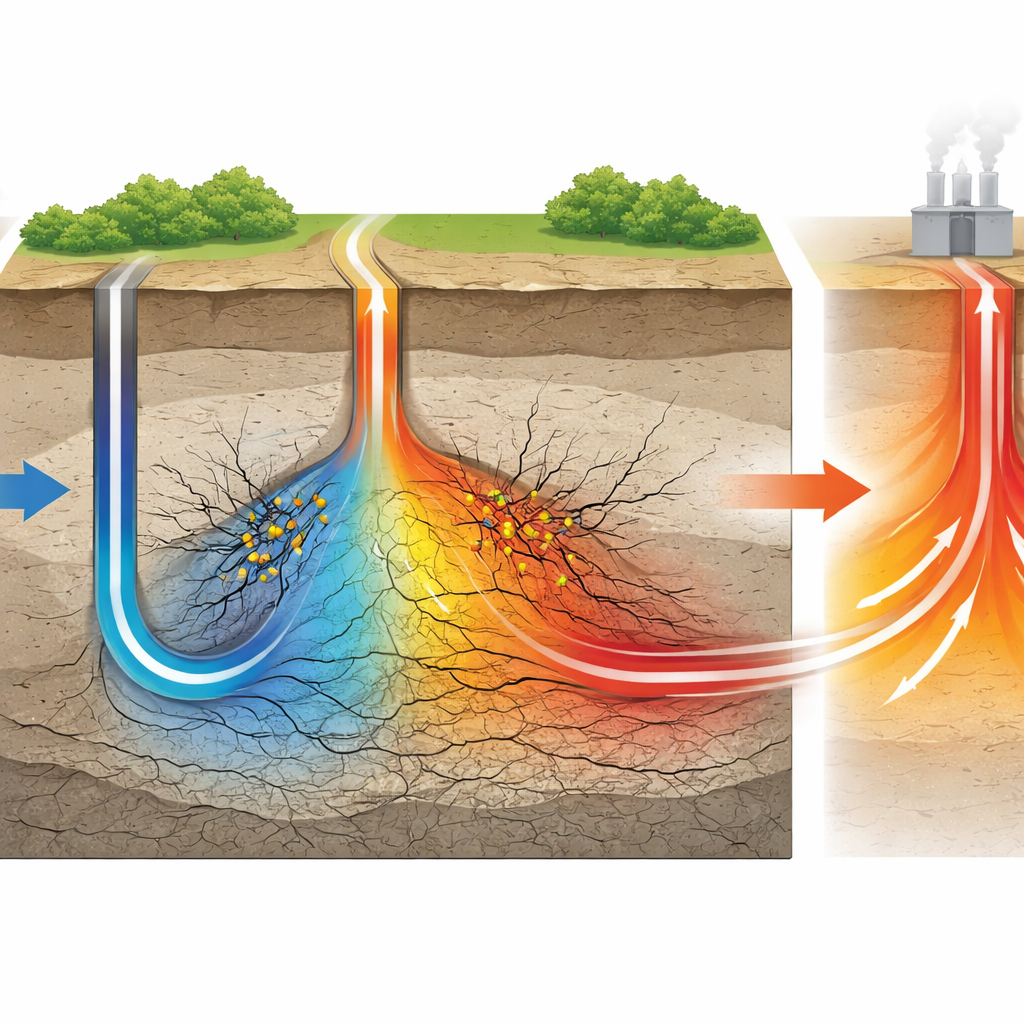
A test bed for engineered geothermal heat
Utah FORGE is a field laboratory in central Utah designed specifically to figure out how to build enhanced geothermal systems in hard, crystalline basement rock. Instead of relying on naturally porous layers, engineers drill two long wells into hot but largely impermeable rock and then inject water under high pressure to create pathways between them. In April 2024, a series of stimulation stages pumped thousands of cubic meters of water into one well. A dense network of permanent and temporary seismic sensors recorded hundreds of tiny earthquakes, most too small to feel, that occurred as the rock responded to this fluid injection.
Reading the fingerprints of tiny earthquakes
Each earthquake carries a subtle “fingerprint” of how the rock moved, encoded in a mathematical object called a moment tensor. By inverting the recorded seismic waves for more than 180 events, the researchers separated two main ingredients: shear slip, where two sides of a fracture slide past each other, and opening or closing, where the rock volume changes slightly. Most events showed classic strike‑slip motion, broadly consistent with the regional stress field. However, many also contained a positive volumetric, or isotropic, component that signals local opening as the fracture slipped, hinting that some of these tiny quakes were also prying fractures wider for fluid to pass through.
Two fracture zones, three ways to make pathways
The microearthquakes clustered into two main fracture zones activated at different times. In the first zone, which had been stimulated in earlier campaigns, the events mostly showed strong shearing with only modest opening, and the pattern of seismicity lined up with a narrow, pressurized region interpreted as a large hydraulic fracture or tightly packed fracture bundle. Here, most of the volume increase from injected fluid seems to be taken up by this larger structure, while the small earthquakes simply mark where stress transfers to nearby cracks. The second zone behaved differently: its fractures were ideally oriented to slip under the regional stresses, and the events there showed much larger opening components that grew as more fluid was injected. This pattern points to preexisting fault zones being reactivated and dilated, turning them into important fluid highways rather than just passive bystanders.
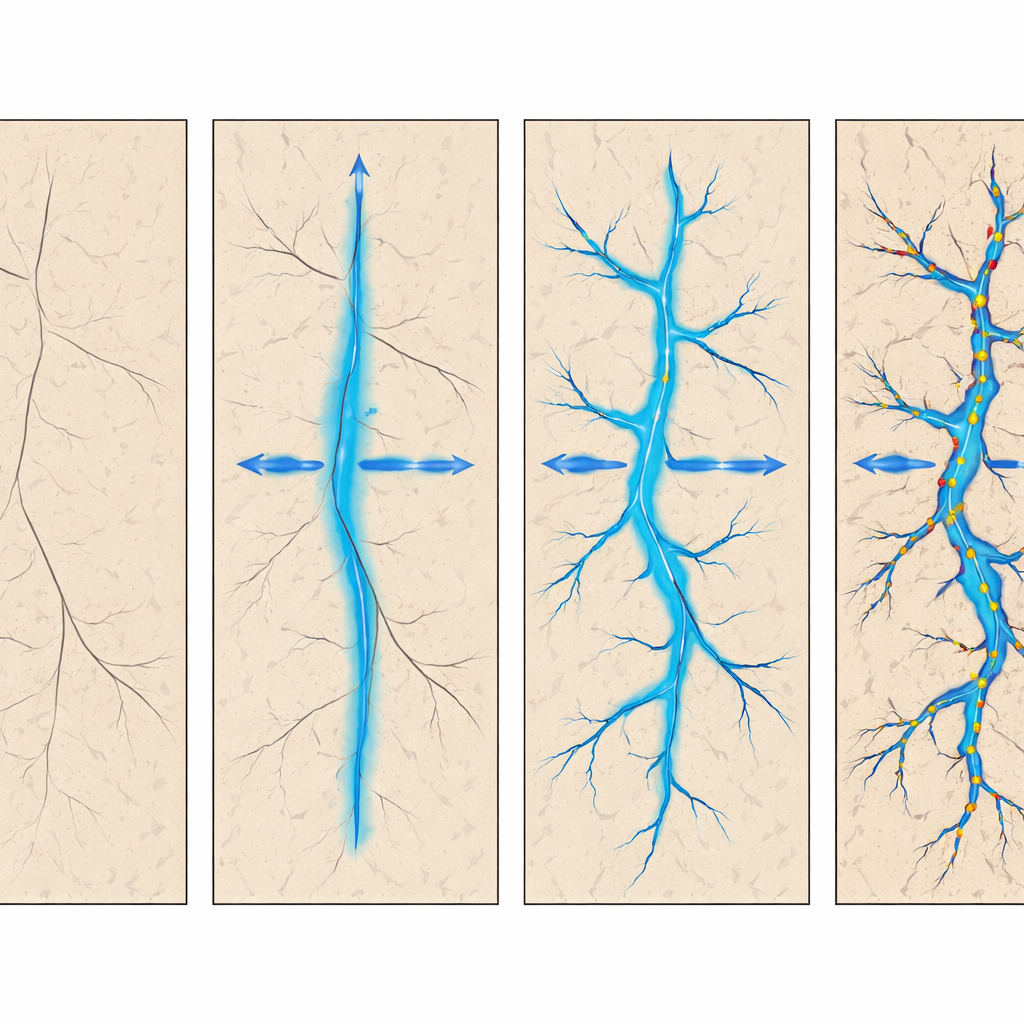
A mixed network of cracks and faults
Not all parts of the reservoir fit neatly into “big hydraulic fracture” or “reactivated fault” categories. In some areas, the microearthquakes outline dense clusters of small fractures that are well oriented for slip but only weakly connected to one another. The authors interpret these regions as mixed‑mode fracture networks: a mesh in which new hydraulic fractures and old cracks interact. In this setting, some events slip mostly in shear, while others show strong opening, depending on how much pressurized fluid reaches each fracture and how local stresses are perturbed. Together, these patterns reveal a surprisingly diverse set of fluid‑driven behaviors occurring only a few hundred meters apart within the same engineered reservoir.
What this means for safer geothermal projects
By carefully isolating the opening components of tiny earthquakes, the study shows that microseismic signals can distinguish between a simple, narrow hydraulic fracture and a more complex, connected fault network. Where opening components grow with injected volume on well‑oriented faults, it likely marks places where fluid is actively flowing and widening existing weaknesses—features that can boost energy production but might also transmit pressure farther than intended. In contrast, areas where quakes show little opening may indicate that most volume change is confined to a main hydraulic fracture. Used in real time, this type of analysis could help operators steer stimulations toward productive, well‑contained fracture systems and away from pathways that might reach larger, potentially hazardous faults, improving both the performance and safety of enhanced geothermal energy.
Citation: Niemz, P., Petersen, G., Rutledge, J. et al. Isotropic components of microseismic moment tensors at Utah FORGE reveal a diversity of fluid pathway creation processes in EGS development. Sci Rep 16, 12916 (2026). https://doi.org/10.1038/s41598-026-42493-0
Keywords: enhanced geothermal systems, induced microseismicity, fracture networks, fault reactivation, Utah FORGE