Clear Sky Science · en
First molecular confirmations of Anopheles dirus and Anopheles scanloni in Indonesia, with DNA of zoonotic, enzootic and human malarias detected in An. dirus
Why monkey malaria matters for people
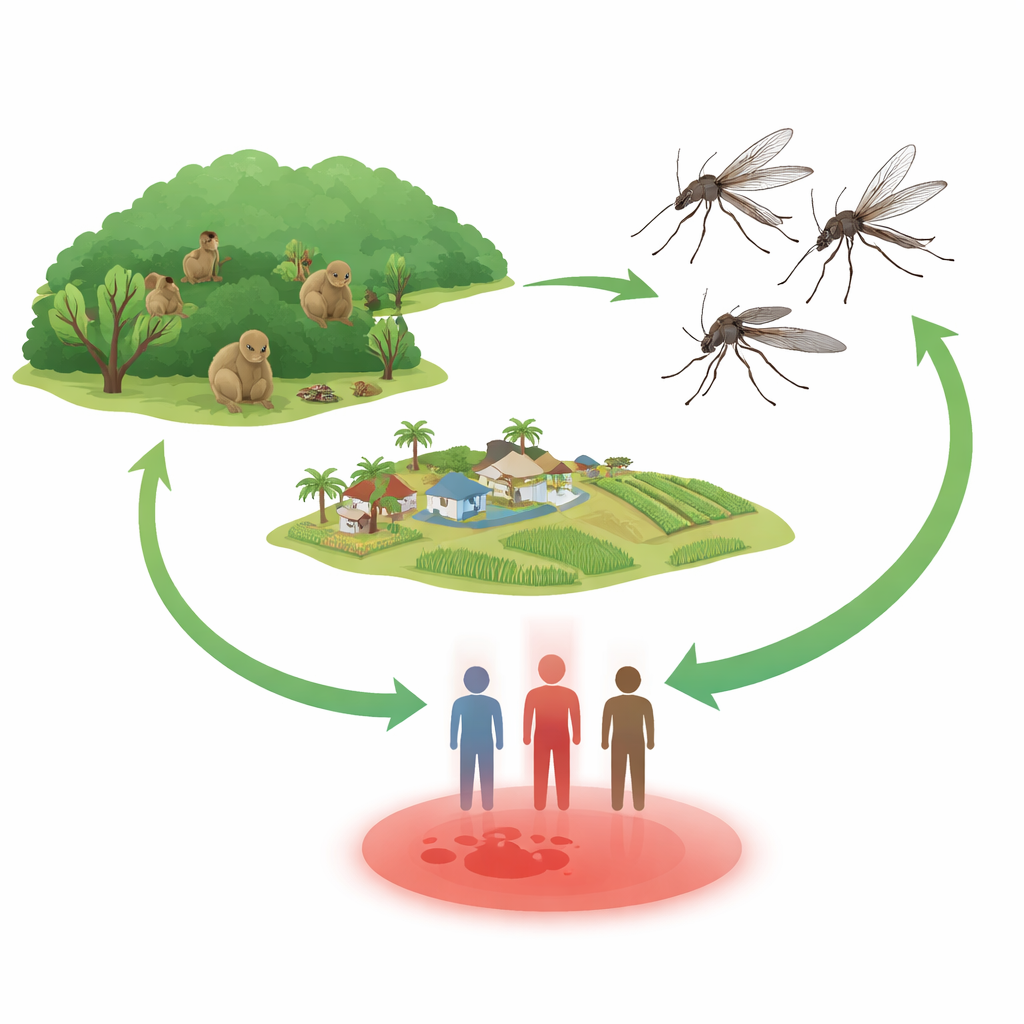
Malaria is usually thought of as a human disease carried by mosquitoes from person to person. But in parts of Southeast Asia, some malaria parasites live naturally in wild monkeys and only sometimes spill over into humans. This study focuses on North Sumatra, Indonesia, where an emerging “monkey malaria” species, Plasmodium knowlesi, has infected hundreds of people. Until now, no one knew which local mosquito species were actually picking up these parasites from monkeys and potentially passing them on to humans. Identifying those mosquitoes is crucial for predicting where risk is highest and for designing effective control measures.
Following mosquitoes at the forest edge
The researchers worked in a rural, hilly part of Langkat Regency in North Sumatra, where farms, oil palm plantations, and fragments of forest sit side by side. This is the kind of landscape where people, mosquitoes, and macaque monkeys frequently overlap. Over a year, teams of trained adult volunteers collected night‑biting mosquitoes that landed on their exposed legs, the standard way to sample mosquitoes that seek human blood. In the field, the insects were sorted using microscopes and identification keys to pick out members of a group known to contain important malaria vectors in Southeast Asia, the Leucosphyrus Group.
Putting names to look‑alike mosquitoes
Many mosquito species in this group look extremely similar, making them hard to tell apart by eye alone. The team therefore turned to DNA analysis of a genetic region called ITS2, along with newly developed species‑specific tests. Out of 597 mosquitoes that had been labeled as Leucosphyrus Group in the field, laboratory work showed that almost all — about 98% — were Anopheles dirus, and a small fraction — about 2% — were Anopheles scanloni. This is the first time that An. dirus has been molecularly confirmed in Indonesia and the first record of An. scanloni on the island of Sumatra, extending the known range of both species.
Checking for hidden malaria infections
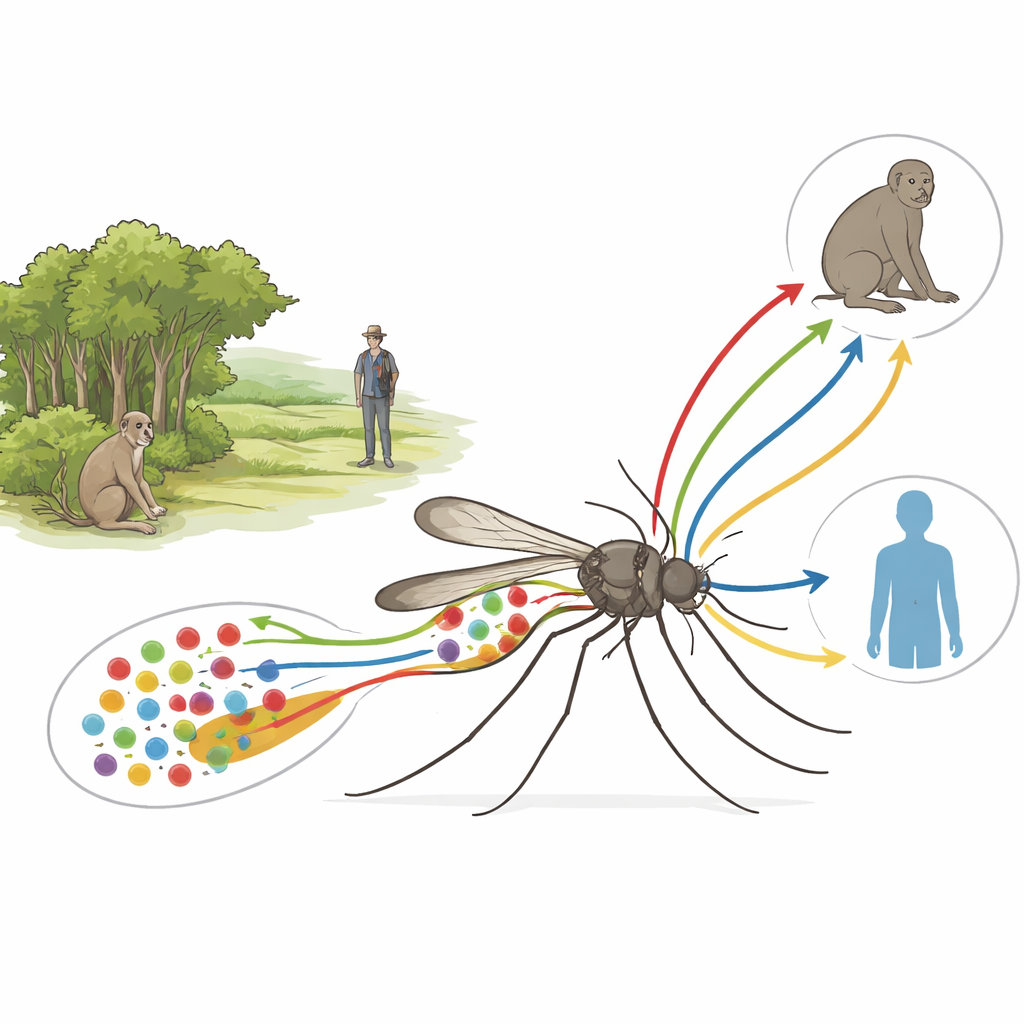
Finding the mosquitoes was only half the story; the crucial question was whether they carried malaria parasites. The scientists carefully separated each mosquito’s head and upper body, where infectious stages would be found, and used highly sensitive molecular tests to detect malaria DNA. Thirteen An. dirus mosquitoes tested positive for malaria at the genus level, and six of these had clear evidence of specific parasite species. All six carried multiple kinds of malaria at once. These included the monkey parasites P. knowlesi, P. inui, and P. coatneyi, as well as the common human parasite P. vivax. In contrast, none of the An. scanloni mosquitoes showed malaria DNA, although the sample size for this species was small.
Monkey and human parasites sharing one mosquito
The mixed infections inside An. dirus underline how closely human and monkey malaria cycles are intertwined in this setting. The presence of monkey‑only parasites, such as P. inui and P. coatneyi, alongside human parasites in the same mosquitoes suggests that these insects are feeding on both hosts. It also highlights how difficult it can be to distinguish very similar parasite species using genetic tests, since some primers can accidentally pick up the wrong target. Even so, the consistent detection of P. knowlesi DNA in a subset of mosquitoes establishes that this species is genuinely present in the local mosquito population, not just in people and monkeys.
What this means for malaria control
The study shows that in North Sumatra, Anopheles dirus is both widespread and infected with a combination of human and monkey malaria parasites, including P. knowlesi. This strongly suggests that An. dirus may be an important bridge vector that can move parasites from forest‑dwelling macaques into nearby villagers, sustaining zoonotic and human malaria transmission. While An. scanloni was found, its role remains unclear due to low numbers and lack of detected infections. Together, these findings argue for intensified surveillance of An. dirus — tracking where it occurs, when and whom it bites, and how it responds to control tools — so that Indonesia’s malaria programs can better protect communities living at the forest–farm frontier.
Citation: Sebayang, B.F., van de Straat, B., Kurniawan, A. et al. First molecular confirmations of Anopheles dirus and Anopheles scanloni in Indonesia, with DNA of zoonotic, enzootic and human malarias detected in An. dirus. Sci Rep 16, 11572 (2026). https://doi.org/10.1038/s41598-026-42478-z
Keywords: zoonotic malaria, Anopheles dirus, Plasmodium knowlesi, North Sumatra, macaque reservoirs