Clear Sky Science · en
Three-dimensional reconstruction of ediacaran ceramiales (Rhodophyta) from the phosphorite doushantuo formation, South China
Ancient Seaweeds and the Story of Early Complex Life
Long before animals with shells and skeletons crowded the oceans, Earth’s seas were already home to surprisingly complex seaweeds. This study uncovers a new fossil red alga, Vetusceramium sinense, preserved in remarkable three-dimensional detail in South China. By peering inside these tiny, stone-embedded plants with powerful X‑ray imaging, scientists show that advanced seaweed architecture—and thus sophisticated multicellular life—had evolved more than half a billion years ago, long before the famous Cambrian explosion of animals.
A Special Window into Deep Time
The fossils come from the Doushantuo Formation, rocks laid down in shallow seas between about 635 and 551 million years ago. In this region, seafloor sediments were unusually rich in phosphate, a mineral that can quickly coat and fill soft tissues. That rapid mineralization locked in delicate cells before they decayed, turning the Weng’an area of Guizhou Province into one of the world’s best archives of early complex life. The new alga was found in the darker, organic-rich layers of this formation, where gentle burial and chemical conditions favored the preservation of entire tiny organisms, not just their tough outer parts. 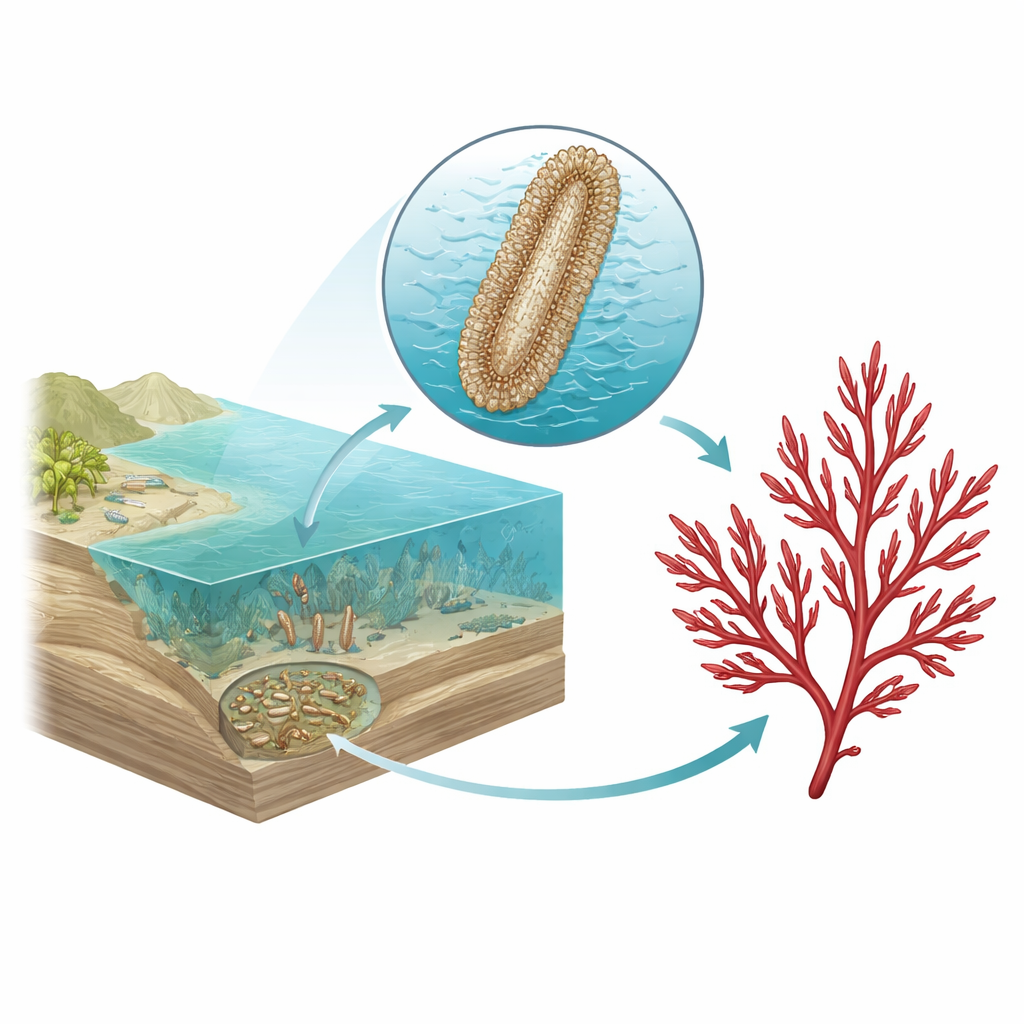
Revealing a Tiny Seaweed in 3D
The team used synchrotron X‑ray tomography, a form of ultra‑high‑resolution 3D scanning, to look inside small chunks of phosphorite rock without breaking them apart. The scans revealed a minuscule but elegantly built seaweed body about a quarter of a millimeter long. It appears as an elongated cylinder, with a narrow tip and a broader base, much like the growing end of some modern red seaweeds. By reconstructing the fossil slice by slice, the researchers could distinguish several nested layers of tissue and even walls between individual cells.
Architecture of a Surprisingly Sophisticated Alga
Inside each tiny cylinder, the scientists found a large central tube made of stacked cells, surrounded by a sheath of slimmer filaments and an outer skin‑like layer. The central cells are separated by thick cross walls that flare into trumpet‑shaped openings. In several places, the images show small passages crossing these walls—structures that closely resemble the “pit connections” that link neighboring cells in living red algae. Around this central axis, finer filaments branch and weave into a supporting network, with their arrangement changing from the base to the tip in ways that suggest both mechanical support and efficient light capture for photosynthesis.
Linking Ediacaran Fossils to Modern Red Seaweeds
The combination of a single main axis, a surrounding crown of filaments, and probable pit connections strongly echoes the structure of living seaweeds in the order Ceramiales, one of the most diverse and intricate groups of red algae today. However, the fossil lacks preserved reproductive organs, which are crucial for placing it firmly inside the modern family tree. Because of this, the authors interpret Vetusceramium as a “stem” form—an early relative that sits just outside the modern Ceramiales group but already displays many of its hallmark features. This pushes Ceramiales‑like body plans back into the late Ediacaran, hundreds of millions of years earlier than suggested by the sparse fossil record alone. 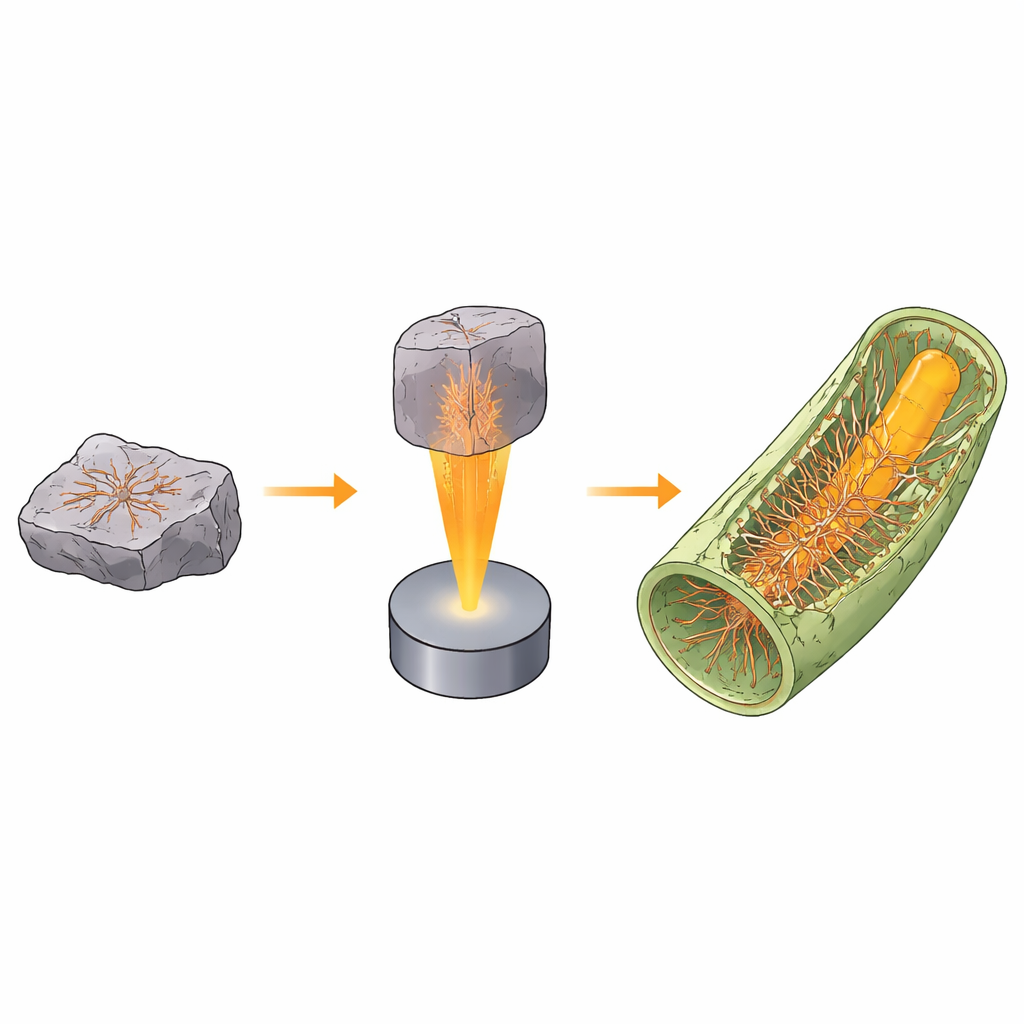
Ruling Out Other Life Forms
Could these tubes belong to some other kind of organism, such as sponges, worms, or green and brown seaweeds? The authors carefully compared Vetusceramium to a range of candidates. Unlike sponges, the fossils show no pores for filter feeding. They also lack the calcified skeletons of some early seaweeds and do not match the internal tissue patterns of green or brown algae. Instead, the consistent presence of thick cell walls, central axial cells, and possible pit connections—a feature unique to red algae—points strongly toward a red seaweed identity.
Why This Ancient Seaweed Matters
This fossil seaweed shows that elaborate multicellular designs were already in place long before animals rose to prominence. The discovery confirms that red algae with complex internal plumbing and specialized tissues were thriving in Ediacaran seas more than 580 million years ago. Such organisms would have contributed to oxygen production, built habitats on the seafloor, and helped shape the chemistry of the oceans. By preserving these algae in three dimensions down to individual cell walls, the Doushantuo rocks give scientists an unprecedented look at how early seaweeds were built, bridging the gap between simple microbial mats and the rich, macroscopic life that would soon follow.
Citation: Du, W., Wang, X., Wang, Y. et al. Three-dimensional reconstruction of ediacaran ceramiales (Rhodophyta) from the phosphorite doushantuo formation, South China. Sci Rep 16, 9935 (2026). https://doi.org/10.1038/s41598-026-42410-5
Keywords: Ediacaran red algae, Doushantuo fossils, multicellularity, synchrotron tomography, early marine ecosystems