Clear Sky Science · en
A machine learning-based classification method for SynRM faults
Why smarter motor health matters
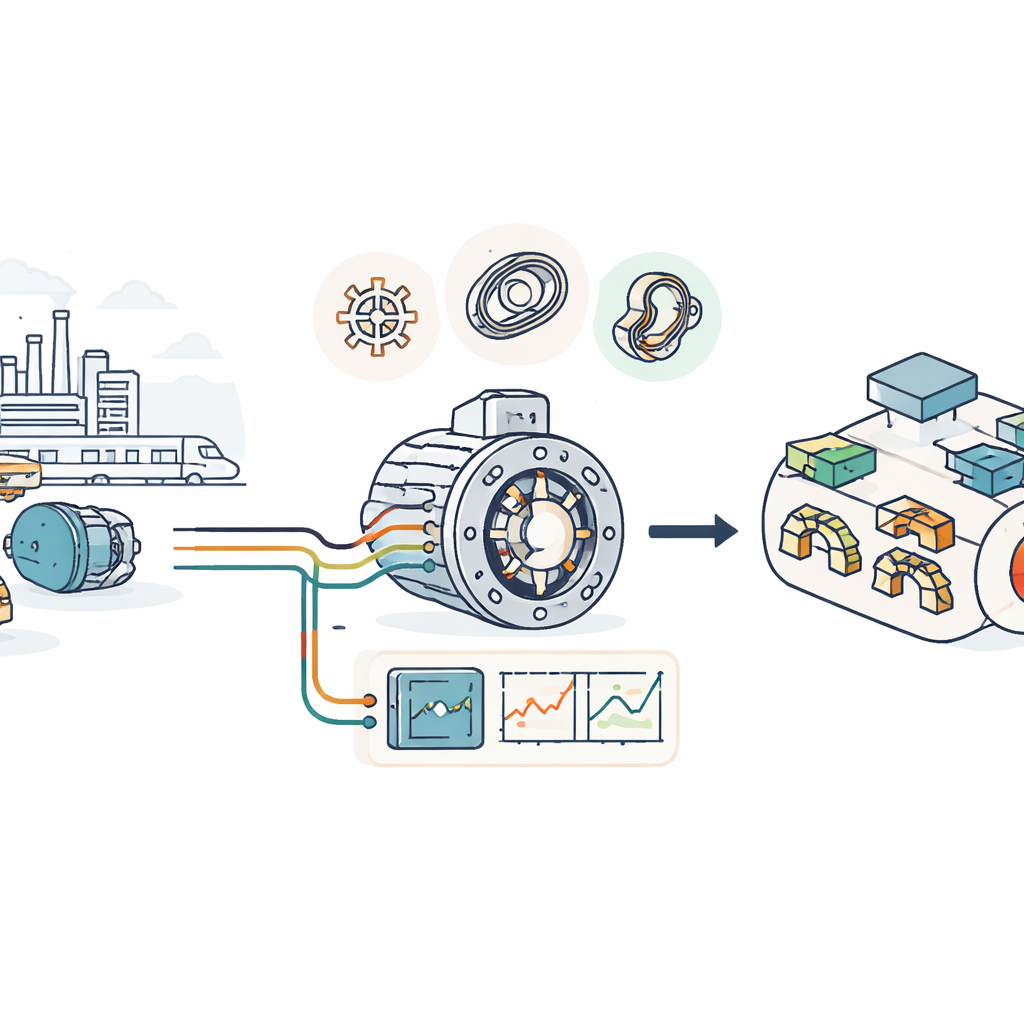
Electric motors quietly run factories, trains, and countless machines, and when they fail without warning the result can be costly downtime or even dangerous accidents. A newer type of motor, the synchronous reluctance motor, promises high efficiency without relying on rare-earth magnets, making it attractive for a low‑carbon future. But the very features that make these motors appealing also make their early-warning signs of trouble harder to read. This study shows how carefully designed machine learning can watch the motor’s electrical heartbeat and spot several different kinds of damage quickly and reliably, opening the door to safer, greener, and more dependable drives.
A new kind of motor, a new kind of problem
Synchronous reluctance motors differ inside from traditional induction or magnet-based motors: they have no rotor windings or permanent magnets, and their magnetic pathways are strongly directional. That internal structure changes how electrical faults show up in the motor’s current. Methods that work well for other motors often stumble here, especially in real factories where loads vary and noise creeps into measurements. Until now, most research either simulated single faults, tested just one algorithm, or ignored how a solution would run in real time on practical hardware. The authors set out to build a complete, fair, and repeatable testbed focused specifically on this motor type and on combinations of faults, not just one fault at a time.
Making real and virtual faults to learn from
To teach computers what trouble looks like, the team created both physical and simulated damage. In the lab they used a 2.2 kilowatt motor and deliberately introduced two common and dangerous problems: shorted turns in the stator windings and defects in the inner race of the bearings. They ran the motor at no load, half load, and full load, recording three-phase current signals for each condition many times to ensure repeatability. A third fault type—an uneven air gap between rotor and stator, called eccentricity—was modeled using detailed electromagnetic simulations, then carefully “noised up” and scaled so its current patterns resembled those measured in the lab. All signals, whether from experiments or simulations, were processed in the same way so that the learning algorithms would focus on physical fault patterns rather than artifacts of how the data were generated.
Listening to the current in time and frequency
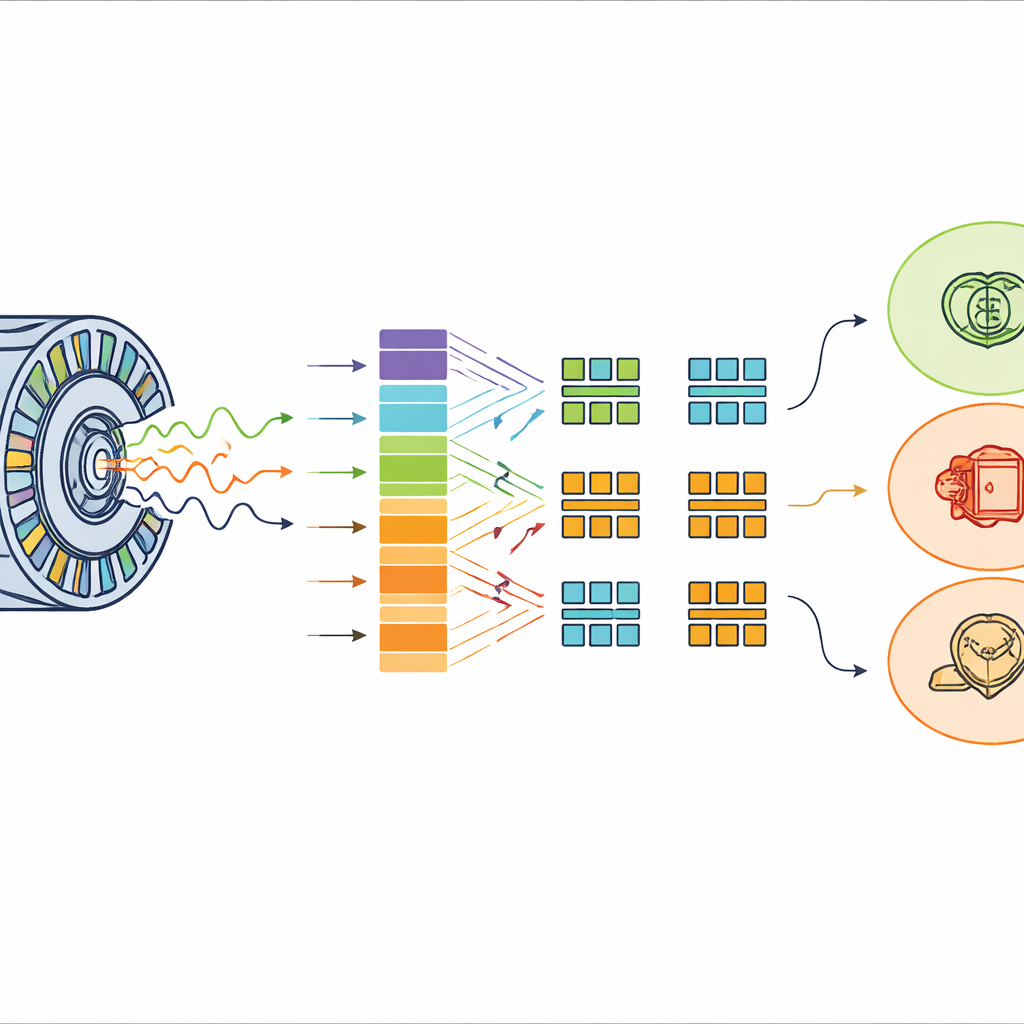
Because a faulty motor’s current changes over time and across a wide range of frequencies, the authors used a tool called the discrete wavelet transform. Rather than producing just a simple spectrum, this method breaks the current into several bands that capture both slow, low‑frequency ripples and sharp, high‑frequency spikes. From each short slice of current—about a tenth of a second long—they distilled a compact set of 12 numbers describing how energy and randomness were distributed across these bands. These numbers form a fingerprint for the motor’s condition. By sliding the analysis window across long recordings and balancing the samples, they built large, well-controlled datasets with 10,000 “fingerprints” per class, covering healthy operation and each fault scenario alone and in combination.
Putting machine learning models to a fair test
Armed with this dataset, the researchers compared eight popular machine learning methods, from simple linear schemes to sophisticated ensembles of decision trees. They followed strict rules to avoid common pitfalls: all windows from a given run were kept entirely in training or testing sets to prevent leakage, parameters were tuned through systematic grid searches with cross‑validation, and performance was judged using accuracy, precision, and—most importantly—recall, which measures how often real faults are correctly caught. For single faults in windings and bearings, random forests—an ensemble of many shallow trees—stood out, reaching about 99.98% accuracy with no missed faults. For eccentricity, boosting methods such as AdaBoost and XGBoost reached perfect accuracy with far less training time than support vector machines that performed similarly but scaled poorly with data size.
From lab accuracy to real‑time protection
The most demanding test was a 16‑class task reflecting many possible combinations of faults. Here, a newer ensemble method called CatBoost provided the best balance, correctly identifying more than 99.9% of cases and keeping missed faults exceptionally rare. Although this model is heavier in memory use than others, its response time remained in the tens of microseconds—fast enough for industrial protection standards that require motors to be disconnected within milliseconds when something goes wrong. Across all tests, the study shows that tree‑based ensembles, chosen and tuned with care, can turn noisy current measurements into a highly reliable early warning system. In plain terms, the work demonstrates that with the right kind of data and models, manufacturers can watch over these efficient motors in real time, catching small problems before they grow into costly or dangerous failures.
Citation: Rajini, V., Nagarajan, V.S., Gulbarga, M.I. et al. A machine learning-based classification method for SynRM faults. Sci Rep 16, 13790 (2026). https://doi.org/10.1038/s41598-026-42396-0
Keywords: synchronous reluctance motor, fault diagnosis, motor current analysis, machine learning, condition monitoring